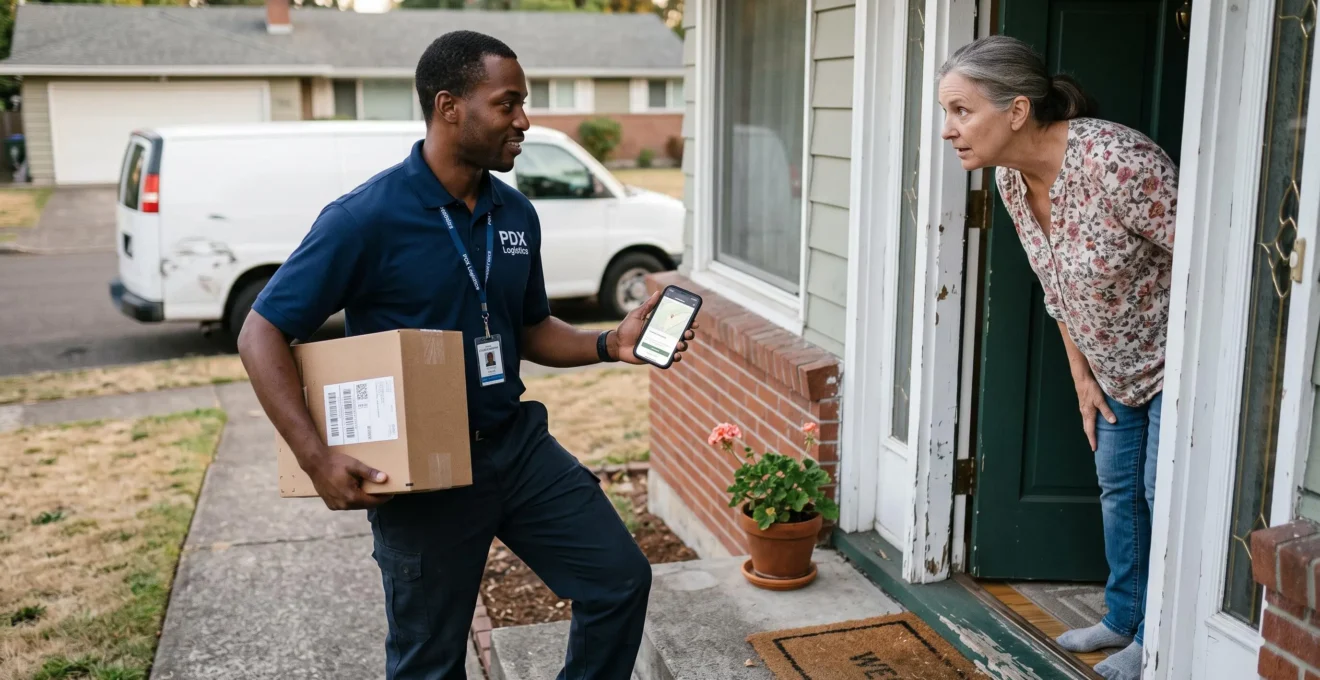
« You’re late. Where have you been? » A customer asks the question before the parcel has even changed hands. The driver has another stop waiting, limited information about the delay, and perhaps only seconds to prevent a tense conversation from becoming a formal complaint.
The safest response is short, factual, and helpful: « I understand this arrived later than expected. I’m sorry for the inconvenience. I have your parcel here, and I can help you check the next step if there’s still an issue. »
That response acknowledges the customer’s experience without inventing an explanation or promising compensation. It also keeps the conversation focused on what can happen next.
Effective doorstep communication extends beyond apologies. Drivers need reliable rules for unsuccessful contact attempts, customer notifications, proof of delivery, and recordkeeping. These practices help establish what happened when a customer challenges the handover immediately or raises a dispute days later.
Late delivery: three rules for calmer handovers
- Acknowledge before explaining: recognise the inconvenience, confirm the delivery status, and offer an authorised next step.
- Contact with purpose: use calls for immediate coordination and written messages for clear, traceable updates.
- Document the outcome: record accurate delivery details in approved systems without exposing customer information unnecessarily.
- Why Do Customers Leave 1-Star Ratings After “Normal” Deliveries?
- How to Handle No-Answer Customers Without Wasting 10 Minutes per Stop?
- Call or Message: Which Reduces “I Never Got It” Claims After a Missed Drop?
- The One Sentence That Turns a Minor Delay Into a Formal Complaint
- When Should You Message Customers to Cut Failed Deliveries Without Annoying Them?
- Why Do Businesses Refuse Payment Without a “Perfect” Proof of Delivery?
- The Verbal Approval Mistake That Leads to Disputed Repair Bills
- The Delivery Paperwork That Saves You When a Claim Appears 14 Days Later
Why Do Customers Leave 1-Star Ratings After “Normal” Deliveries?
Customers may leave one-star ratings after an otherwise successful delivery because receiving the parcel and having a satisfactory delivery experience are different outcomes. A late arrival, unexpected handover, dismissive explanation, or unnecessary inconvenience can influence their assessment. Drivers cannot control every disruption, but they can acknowledge problems, communicate clearly, and avoid making the interaction worse.
Consider a hypothetical delivery that arrives 20 minutes beyond the customer’s expected window. The parcel is undamaged, the address is correct, and the handover takes seconds. Operationally, the delivery is complete. Yet the customer may have rearranged their afternoon to receive it.
The customer’s complaint may therefore concern the disruption rather than the physical delivery.
71%
Of UK parcel recipients surveyed by Ofcom in 2026 reported experiencing at least one delivery issue during the preceding six months. The figure measures reported experiences, not the percentage of individual parcels delivered incorrectly.
Ofcom also reported delivery delays among delivery delays among 32% of surveyed recipients and insufficient time to answer the door among 20%. These findings demonstrate the range of issues customers notice, although they do not establish what causes individual one-star ratings.
For practical training, three useful categories help drivers recognise potentially damaging interactions:
- Surprise: the customer expected an earlier delivery and received no useful warning. Acknowledge the unexpected arrival rather than pretending nothing happened.
- Blame: the customer suspects someone is withholding information or avoiding responsibility. State only what the delivery system confirms.
- Effort: the customer had to wait, repeatedly check tracking, or contact support. Recognise the inconvenience and identify a practical next action.
These are communication categories, not a scientifically validated rating model. Their purpose is to help a driver choose a useful response.
A simple arrival script combines three elements: acknowledgement, status, and next step.
Suggested script: « I understand you’ve been waiting. Your parcel is here now. If the delivery timing caused a problem, you can report it through the tracking support option. »
Silence is rarely a helpful substitute when a customer has already raised a concern. However, an apology does not require a lengthy discussion or an admission that the driver personally caused the delay.
Watch for repeated questions, a customer showing tracking information, or references to contacting « the company. » These indicate that the person wants an explanation or formal resolution. Slow down, confirm the facts, and make an accurate note if policy permits.
A calm exchange cannot guarantee a positive rating. It can, however, avoid adding a communication failure to an existing delivery problem. The same principle becomes important when nobody answers the door.
How to Handle No-Answer Customers Without Wasting 10 Minutes per Stop?
Handle an unanswered door with a repeatable contact sequence rather than waiting indefinitely. Follow the required knock or bell procedure, make an authorised call, send a concise written update if permitted, and apply the carrier’s waiting-time and failed-delivery rules. The appropriate outcome depends on safe-place instructions, signature requirements, local procedures, and whether unattended delivery is authorised.
The main problem is uncertainty. Without an established sequence, one driver may leave almost immediately while another spends several minutes repeatedly calling the same unanswered number.
A practical workflow should remove that guesswork without overriding mandatory delivery procedures.
- Verify the stop. Check the delivery address, apartment number, access instructions, and any special handover requirements.
- Attempt the required contact. Ring or knock as instructed. If permitted, place one call using a short identification script.
- Send a written update. Record the attempt and explain the next step through an approved communication channel.
- Apply the dwell-time rule. Wait for the period specified by the delivery service or route procedure.
- Record the outcome. Complete an authorised safe-place delivery, schedule another attempt, or return the parcel as instructed.
A suitable phone script is: « Hello, this is your delivery driver. I’m at the entrance for your parcel delivery. If you’re available, please come to the door. Otherwise, I’ll follow the delivery instructions for an unsuccessful attempt. »
This establishes the reason for the call without disclosing unnecessary information.
A written update can establish that contact was attempted, but it should never imply that the customer received or read it.
Suggested no-answer message: « Delivery attempted at [confirmed address] at [time]. No response at the door. Your parcel will be [next authorised action]. Please check your official tracking information for updates. »
If a photograph is required, capture it in the approved delivery application. Photographing the closed entrance can help establish location where permitted, but a photograph of an unanswered door is not proof that the recipient was absent.
Before leaving a parcel unattended, consider four practical risk factors: visibility from the street, exposure to rain or other weather, the item’s value or special handling requirements, and the customer’s approved instructions.
If any condition conflicts with carrier policy or the specified delivery method, do not leave the parcel. A failed attempt may be preferable to an insecure handover.
Some customers screen unknown numbers or mute application notifications. Repeated unsuccessful contact is not proof that they are away, and drivers cannot reliably distinguish an absent customer from a contact-averse one through unanswered calls alone.
Once the approved contact sequence has been completed, further calls are rarely useful unless new information justifies them. The next decision is which communication channel best serves the situation.
Call or Message: Which Reduces “I Never Got It” Claims After a Missed Drop?
A written message generally provides a clearer record of what a driver communicated, while a phone call may resolve an immediate handover problem more quickly. Neither independently proves that a parcel reached its recipient. To handle contested deliveries, use the communication method permitted by the carrier, document the outcome, and rely on compliant proof-of-delivery records rather than contact attempts alone.
The important distinction is between reassurance and evidence. A call can confirm whether someone is available. A message can preserve the information sent and its time, subject to the platform’s logging and retention features.
Both channels have limitations.
| Decision factor | Phone call | Written message |
|---|---|---|
| Immediate coordination | Useful if answered | Depends on when the customer reads it |
| Record of information shared | Call logs generally show contact attempts, not the conversation | Approved systems may preserve the message content and timestamp |
| Customer availability | May be screened or missed | Can be read later |
| Delivery dispute | Supports a contact timeline | Supports a communication timeline, not proof of receipt |
| Common failure | Unanswered call or disputed conversation | Unread notification or outdated contact details |
Choose the channel according to the task. When someone needs to open a gate or meet the driver at an entrance, a call may be appropriate. When an attempt has failed, a written explanation provides a clearer account of what happened.
A three-stage communication pattern can be useful when each stage is necessary and permitted:
- Before arrival: send one actionable notification when the estimated arrival is sufficiently reliable.
- At the door: attempt an approved call if there is no response.
- After the attempt: send a factual message stating the actual delivery status and authorised next step.
This is a conditional workflow, not a requirement to contact every customer three times. Existing automatic notifications may already complete the first or final stage.
For a hypothetical missed apartment delivery, an appropriate follow-up might read: « Attempted delivery at 14:35. Unable to complete the required handover. Parcel marked for the next authorised delivery step. Please see your tracking page. »
Do not write « delivered » when the parcel was returned to the vehicle. Similarly, do not claim that a customer declined the delivery unless that actually occurred.
Delivery notes may specify a preferred contact method, a building access procedure, or a prohibition on calling. Review these before contacting the customer, and use only company-authorised channels.
A reliable contact record explains what the driver attempted. It does not replace proof of handover, and it cannot correct a poorly worded explanation once a frustrated customer begins complaining.
The One Sentence That Turns a Minor Delay Into a Formal Complaint
« That’s not my problem » is a particularly risky response when a customer challenges a late delivery. Even when the underlying delay is outside the driver’s control, the statement communicates indifference and can make the interaction itself the focus of a complaint.
Other potentially escalatory phrases include « You weren’t home, » « The company always gets this wrong, » and « There’s nothing I can do. » Each statement may introduce blame, dismissal, or unnecessary conflict.
The safer alternative is not to accept responsibility for events the driver cannot verify. It is to acknowledge the situation while accurately explaining what can happen next.
Compare these responses:
| Avoid saying | Say instead | Why it works |
|---|---|---|
| « You weren’t home. » | « I couldn’t complete the handover during the earlier attempt. » | Describes the outcome without assuming why nobody answered |
| « It’s the company’s fault. » | « I don’t have a confirmed explanation for the delay. » | Avoids unsupported blame |
| « Not my problem. » | « I understand the inconvenience. Here’s the next step available. » | Recognises the concern without promising an unauthorised fix |
| « You’ll definitely get a refund. » | « The support team can review any available remedy. » | Does not guarantee a result outside the driver’s authority |
A customer may remember and repeat a particularly dismissive sentence when explaining their complaint. Drivers should therefore treat doorstep communication as professionally accountable, even when no formal transcript exists.
When a customer becomes upset, avoid matching their volume or rushing to defend the route schedule. Use a calm voice, keep an appropriate distance, and focus on the immediate delivery issue. If the situation becomes threatening, follow company safety procedures and disengage when necessary.
Repair script: « I didn’t explain that well. I meant that I can’t confirm the cause of the delay from the information available to me. I understand it was inconvenient. Here’s how you can have the issue reviewed. »
This correction does three useful things: it acknowledges unclear wording, restores factual accuracy, and provides a path forward.
Avoid making the correction sound like a new excuse. The purpose is not to win an argument or persuade the customer to withdraw a complaint. It is to prevent an avoidable misunderstanding from growing.
The customer’s preferred resolution may require a refund, investigation, or delivery adjustment. Drivers should direct those requests to the appropriate team instead of making promises about outcomes they do not control.
Correcting an unhelpful sentence early may keep the conversation productive, but it does not erase a legitimate service problem. Better communication begins before the driver reaches the door.
When Should You Message Customers to Cut Failed Deliveries Without Annoying Them?
Message customers when the estimated arrival time is reliable enough for them to take useful action, rather than following a rigid clock schedule. A notification should clarify when the driver expects to arrive and whether the customer needs to prepare for the handover. Avoid duplicating automatic tracking alerts or sending repeated updates without a meaningful change.
A message sent too early may provide information that becomes inaccurate as traffic, access delays, and earlier stops change the route. A message sent too late may leave the customer insufficient time to reach the entrance.
The useful moment depends on route predictability and the customer’s actual task.
For example, when a driver has a sufficiently reliable estimate of approximately 10 minutes, a message might say: « Your delivery is expected in about 10 minutes. Please have someone available if a signature is required. I’ll update you if the estimate changes significantly. »
Only mention a signature when the shipment actually requires one. Similarly, do not describe an estimated arrival as a guarantee.
There are three common notification situations:
- Predictable residential stop: send a short arrival window when the driver is close enough for the estimate to be actionable.
- Restricted-access building: contact the customer with sufficient time to organise an authorised entrance or handover.
- Uncertain route: wait until the estimate stabilises instead of sending a precise time that may repeatedly change.
Message content matters as much as timing. « Your parcel is on the way » offers little additional value when the tracking application already reports that status. « Your driver expects to arrive shortly; please keep the intercom available » provides an actionable instruction when appropriate.
As a practical communication preference, one useful proactive message plus a response when needed is often more considerate than a stream of routine updates. This is a suggested operating principle, not an evidence-based universal messaging limit.
Customers who request continuous progress updates need clear expectations. A suitable answer is: « I’ll send an update when I have a reliable arrival estimate. I may not be able to respond while driving or completing other deliveries. »
Drivers must not text while operating a vehicle. Messages should be sent only when safely stopped and through approved tools, respecting local road rules and company procedures.
There is no basis for claiming that a specific number of notifications universally reduces failed deliveries. Outcomes depend on delivery type, customer availability, the accuracy of estimates, and whether messages reach the intended recipient.
Clear, restrained messaging can improve coordination without burdening the recipient. After the handover, however, communication records alone are insufficient when a business needs evidence that the delivery was completed correctly.
Why Do Businesses Refuse Payment Without a “Perfect” Proof of Delivery?
Businesses may withhold or delay payment when proof of delivery does not meet the requirements of a contract, carrier process, or dispute review. The concern is evidential: an unclear photograph, missing signature, or inconsistent delivery record may prevent verification of the completed service. However, no universal rule allows businesses to deny driver payment whenever evidence is imperfect.
Proof of delivery, or POD, connects an operational event to a verifiable shipment record. It helps carriers, merchants, customers, and authorised reviewers assess where, when, and how a delivery was recorded.
According to FedEx‘s proof-of-delivery documentation, available records may include shipping information, recipient signatures, or photographs for eligible safe-place deliveries. The available evidence depends on the shipment and service.
A useful POD record should be consistent across three dimensions:
- Location: the recorded delivery point matches the authorised address or handover location.
- Shipment: the record identifies the correct parcel or shipment without exposing more personal information than necessary.
- Time and outcome: the timestamp and delivery status accurately describe what happened.
A photograph is not automatically reliable simply because it exists. An image taken at the wrong entrance, a parcel partly outside the frame, or a delivery status inconsistent with the photograph can create uncertainty.
Consider a hypothetical multi-unit building. A photograph shows a parcel beside a brown door, but no identifying location context appears in the authorised delivery record. The customer reports that the parcel never reached their unit.
The photograph confirms that a parcel was photographed at a door. It does not necessarily establish which unit received it.
The response is to improve accuracy, not to capture unlimited personal information. Follow the carrier’s approved photo requirements, avoid including bystanders or unrelated parcels, and do not expose full shipping labels when unnecessary.
Dispute reviewers may give greater weight to evidence that is consistent and verifiable, but their decisions depend on the platform, contract, applicable rules, and available information. An ambiguous photograph does not automatically mean the driver loses a claim or payment.
Cash-on-delivery shipments introduce an additional question: whether the correct amount was collected from an authorised recipient and properly recorded.
Where cash collection is permitted, follow the established procedure for recording the amount, shipment, payment status, and any required acknowledgement or receipt. Do not replace mandatory payment documentation with an informal photograph or verbal statement.
Five checks before closing a completed delivery
- Confirm the destination: match the authorised handover location to the shipment record; deliverable: the correct stop recorded in the app.
- Verify the required handover: complete the signature, recipient confirmation, or safe-place procedure when applicable; deliverable: the required acknowledgement or status.
- Capture authorised evidence: take the required photograph or complete the relevant POD field; deliverable: an accepted record attached to the correct shipment.
- Check data consistency: confirm the recorded time, location, and delivery outcome are accurate; deliverable: a coherent completed-stop entry.
- Record exceptions immediately: note access problems, deviations, or unsuccessful handovers through the permitted workflow; deliverable: a factual exception record.
These checks are practical training guidance, not a universal carrier standard. Actual evidence requirements must come from the relevant delivery service and agreement.
Strong documentation reduces uncertainty but cannot guarantee payment or resolve every claim. The same difficulty arises when additional work is approved verbally without a clear record of the agreed terms.
The Verbal Approval Mistake That Leads to Disputed Repair Bills
A verbal « go ahead » can create a billing dispute when the parties have not clearly agreed on the work, price, or authority to approve it. The problem is not that every verbal approval is invalid. It is that the scope and terms may be difficult to prove afterward, particularly when someone other than the account holder gave permission.
This problem is especially relevant to delivery drivers who also perform installations, equipment servicing, appliance setup, or other chargeable work at a customer’s property.
A customer might say, « While you’re here, can you replace that part too? » The technician responds, « Sure, » and completes the extra task. The final invoice later includes a charge the customer claims was never explained.
The disagreement may concern three separate facts: which task was requested, what it would cost, and whether the person who requested it had authority to approve the expense.
US FTC guidance on automotive repair estimates and authorisation recommends written estimates covering the condition requiring repair, relevant parts, and anticipated labour charges. It also recommends arranging approval before work exceeds specified time or cost thresholds.
The FTC guidance concerns vehicle repairs in the United States. Specific authorisation requirements can vary by state and should not be treated as universal rules for parcel delivery or other service industries.
A practical spoken confirmation is:
Suggested script: « To confirm, you’re requesting [additional work] for [stated price], and you’re authorised to approve this charge. I’ll need the required confirmation recorded before I begin. »
Follow that with a written record through the authorised workflow:
« As discussed, the proposed additional work is [description] at [price and applicable charges]. Please confirm through the approved authorisation process before work begins. »
Some businesses may accept an electronic reply, signature, or documented service-order approval. Others require a specific form or direct account-holder authorisation. A customer’s text reply saying « YES » is not necessarily sufficient in every contract or jurisdiction.
The authority question deserves particular attention. Someone present at an address may be able to receive a parcel but not approve additional chargeable work.
Before starting extras, verify the authorised decision-maker according to the service agreement. If authority cannot be established, pause the additional work and escalate it through the proper channel.
Verbal conversations can form part of the evidence, especially when promptly corroborated by an accurate job note, message, recording lawfully obtained, or approved signature. Yet corroboration is not automatically a substitute for legally or contractually required authorisation.
For ordinary parcel drivers, the transferable lesson is straightforward: do not turn an unclear doorstep request into an undocumented commitment. When a dispute appears later, the quality and availability of the original record matter.
Key takeaways before a delivery claim arrives
- Preserve consistency: a delivery timeline is easier to review when status changes, contact attempts, and handover details agree.
- Respect data boundaries: customer records belong in authorised systems with defined access and retention rules.
- Prepare for delayed questions: document unusual events when they happen rather than reconstructing them from memory after a complaint.
The Delivery Paperwork That Saves You When a Claim Appears 14 Days Later
A delivery complaint received 14 days after a handover can be difficult to investigate because the driver’s recollection may be incomplete and relevant records may be spread across several systems. A reliable defence depends on contemporaneous, authorised evidence: accurate delivery status, timestamps, proof of handover, contact history, and factual notes about exceptions.
The specific 14-day interval is an illustrative dispute scenario, not a universal claim deadline. Some complaints arrive sooner or later, and retention periods depend on the carrier, record type, contract, and applicable law.
For a hypothetical delivery, a customer contacts support two weeks after the parcel was marked complete. The customer reports that it was left at the wrong entrance.
Without records, the driver may remember the neighbourhood but not the particular door. A vague recollection provides limited evidence when compared with a detailed complaint.
The most useful record set typically contains:
- Delivery event: accurate time, recorded location, shipment reference, and completion status.
- Proof of handover: a signature, eligible delivery photograph, or other documentation required for that service.
- Contact history: authorised call attempts, delivery messages, and relevant customer instructions.
- Exception note: a concise factual description of access problems, unusual instructions, or an unsuccessful attempt.
These records should remain linked to the shipment in the organisation’s approved delivery or records-management system. Drivers should not automatically export photographs, addresses, signatures, or customer messages to personal cloud accounts or private devices.
A photograph can be helpful, but it is not the only form of evidence and does not necessarily prove that the intended recipient personally received the parcel. Its value depends on the circumstances, authorised delivery method, and consistency with other records.
UK ICO guidance on collecting and retaining employment records explains data minimisation and storage-limitation principles. Personal information should be retained only where justified and for an appropriate period.
Although that guidance addresses employment records rather than courier documentation specifically, it reinforces an important principle: retaining customer information requires a legitimate purpose, appropriate safeguards, and compliance with relevant policies and laws.
For delivery teams operating in different English-speaking countries, local privacy obligations and contractual retention requirements may differ. Drivers should ask their supervisors how long evidence remains available, which records can be accessed for disputes, and whether any approved export or preservation process exists.
If an original delivery photograph or message is no longer available, reconstruct the event using authorised sources rather than speculation.
- Retrieve the shipment’s original tracking events and recorded status transitions.
- Check available delivery-system timestamps and location information.
- Review authorised customer messages, contact attempts, and delivery instructions.
- Compare the available records with the disputed address and reported circumstances.
- Identify missing evidence explicitly and submit the factual reconstruction through the claims procedure.
A location event may show where a device registered a delivery action, but it does not independently prove physical receipt. Similarly, a recorded call attempt does not establish that a conversation occurred.
When a record is incomplete, avoid filling the gap with a confident assumption.
Better delivery note: « Delivery attempt recorded at 16:42. Entrance intercom unanswered. One call attempted through delivery app. Parcel retained for return according to route instructions. »
Weaker delivery note: « Customer was probably ignoring calls and always causes problems. »
The first version describes observable events. The second speculates about motives and adds information that cannot be verified.
Do not backdate notes, alter historical records, or present a reconstruction as though it were written at the time of delivery. Any later addition should be clearly identified as such, with its actual creation time.
When a complaint emerges, preserve the relevant records through the authorised process and cooperate with the designated reviewer. The objective is to establish a fair, accurate account, not to manufacture a defence.
At the next delivery, apply one repeatable habit: acknowledge the concern, explain only what is verified, complete the authorised handover procedure, and record any exception immediately. Those steps create a clearer experience for the customer and a more reliable account for anyone reviewing the delivery afterward.
Should a delivery driver apologise when the delay was not their fault?
Yes. A driver can acknowledge the inconvenience without accepting personal responsibility for the cause. For example: « I’m sorry this arrived later than expected. I understand the inconvenience. » Avoid guessing why the delay happened or promising compensation that has not been authorised.
What should a driver do if a customer becomes aggressive at the door?
Remain calm, avoid arguing, maintain a safe distance, and explain the available next step only if it is safe to continue. If the customer threatens violence or the situation becomes unsafe, disengage and follow employer safety and incident-reporting procedures. Do not prioritise completing the handover over personal safety.
Can a delivery photograph prove that a customer received a parcel?
Not necessarily. A photograph may support evidence of a parcel being placed at a particular location, but it does not always establish personal receipt. Its significance depends on the authorised delivery method, the quality of the record, and other available evidence. Signature-required shipments must follow their applicable handover requirements.
Can drivers keep delivery photos on their personal phones in case of disputes?
Only where company policy and applicable privacy requirements expressly permit it. Delivery photographs may contain personal information, including addresses, names, and other identifying details. The safer default is to use approved systems with controlled access and appropriate retention periods rather than creating an independent personal archive.
What should a driver say when a customer demands a refund at the door?
Use a neutral response such as: « I understand why you’d like that reviewed. I can’t confirm a refund from here, but the customer support team can assess your request through the official process. » If the driver has an authorised refund or escalation procedure, follow it. Never guarantee reimbursement without the required authority.