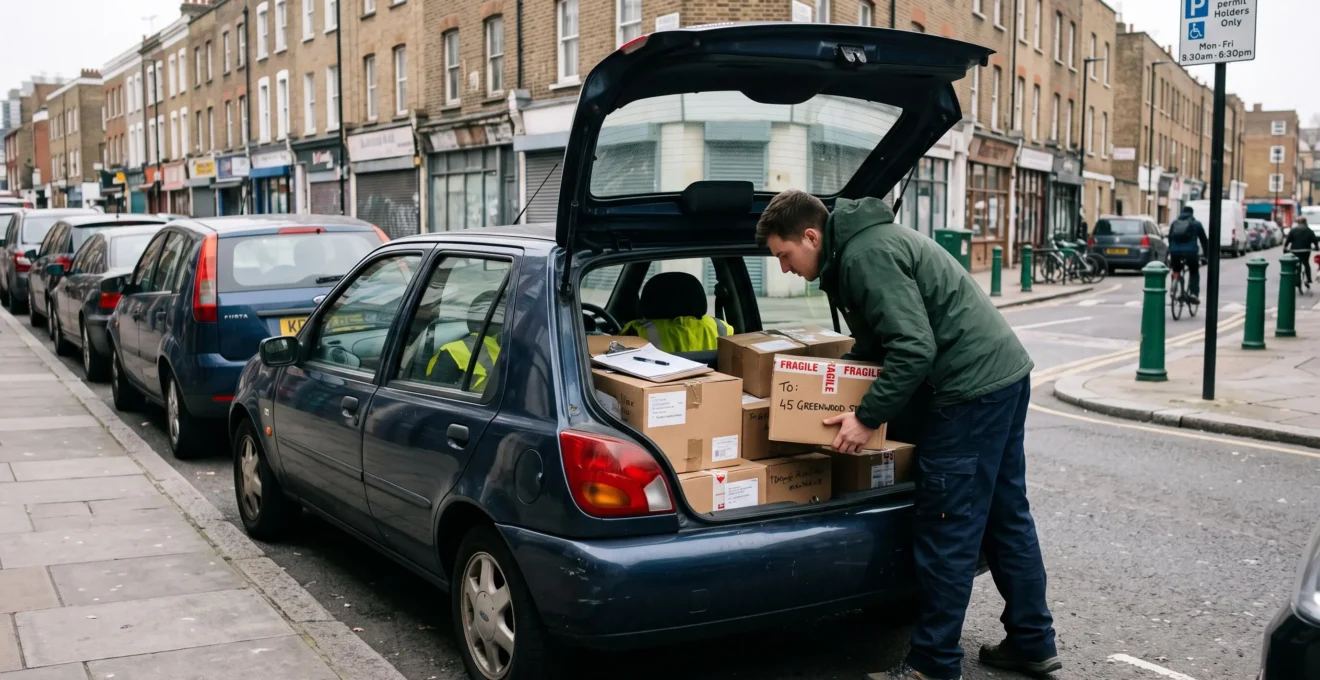
A small car can handle a busy urban delivery round without needing a van, provided the route fits its usable cargo space, legal weight limits and practical loading arrangement. The advantage comes from combining easier parking with faster parcel access, rather than simply squeezing more boxes into the boot.
For city couriers driving hatchbacks, running out of space by midday often starts with a poor loading sequence. Parcels become buried behind later deliveries, oversized boxes disrupt the arrangement, and repeated searches consume time that should be spent completing stops.
The solution is to measure the vehicle, organise parcels around the delivery order and understand when a small car stops being economical. A compact vehicle works particularly well when drops are concentrated in neighbourhoods where parking and manoeuvring are difficult. However, extra cargo must never compromise braking, visibility or vehicle stability.
With a repeatable loading system and a realistic capacity limit, a hatchback can become an efficient delivery vehicle rather than a daily packing puzzle.
Small-Car Delivery: The Essentials
- Small cars can gain time on dense urban routes through easier parking and shorter access walks, provided local restrictions allow the intended stops.
- Measure actual parcel capacity and load in reverse delivery order to reduce searching and unnecessary handling.
- Respect weight limits and monitor operating costs. Better packing can postpone a van upgrade, but cannot eliminate the car’s physical limits.
- Why Can a Small Car Complete More Drops in City Centres Than a Van?
- How to Build a Small-Car Loading System That Saves 20 Minutes per Shift
- Hatchback or Small Estate: Which Fits 15 Parcels and Still Parks Easily?
- The Overload Habit That Wears Small-Car Brakes Out in 3 Months
- When Should You Stop Using a Small Car for Deliveries Before Costs Spike?
- Why Do 5-Minute Stops Turn Into 15 Minutes on Urban Delivery Routes?
- How to Measure Real Usable Cargo Space in 10 Minutes Without Special Tools?
- How to Add 25% More Cargo Space Without Upgrading to a Van
Why Can a Small Car Complete More Drops in City Centres Than a Van?
A small car can complete more city-centre deliveries than a van when parking availability, manoeuvring and walking distances matter more than cargo volume. Compact vehicles may fit legal parking spaces that larger vehicles cannot use, reducing the time spent searching for somewhere to stop. This advantage disappears when the car requires additional depot trips or cannot carry the assigned parcels safely.
Urban delivery productivity is closely tied to stop density. A driver completing numerous drops across a small neighbourhood faces a different problem from someone travelling long distances between suburban addresses.
Consider a hypothetical route with closely spaced delivery addresses. If the hatchback regularly finds suitable parking closer to entrances than a van, several small time savings can accumulate throughout the shift. The benefit comes from repeating a parking advantage, not from the car travelling faster.
However, smaller dimensions do not automatically provide additional legal access. Loading bays, pedestrian streets, emissions-controlled zones and restricted parking areas can apply different conditions depending on vehicle type, emissions, signage and local regulations.
For example, Transport for London‘s Ultra Low Emission Zone information explains requirements covering cars and vans. A smaller car is not automatically exempt from emissions charges or entitled to use restricted streets.
Before accepting a route, check the relevant city authority’s access maps, parking rules, delivery windows and vehicle eligibility checker. Pay particular attention to height restrictions in multi-storey car parks and streets where commercial loading is limited.
The other deciding factor is whether the complete morning load fits in one journey. Estimate the volume of the assigned parcels, compare it with the car’s measured usable capacity and confirm that the loaded vehicle remains within its weight limits. As a conservative planning method, avoid scheduling a route that requires every available gap to be filled perfectly.
A van becomes more competitive if a small car must return to the depot simply to collect parcels that could have travelled together.
When the load fits and parking is the main obstacle, a compact hatchback can be the better tool. The next challenge is ensuring those parking gains are not lost searching through parcels.
How to Build a Small-Car Loading System That Saves 20 Minutes per Shift
A small-car loading system can save handling time by arranging parcels in reverse delivery order, keeping the next stops accessible and grouping nearby addresses together. Saving 20 minutes per shift is a useful target to test, not a guaranteed result. The actual improvement depends on parcel numbers, route stability and how much time the driver previously spent searching.
The foundation is last-in, first-out loading, often shortened to LIFO. The parcels needed last go deepest into the storage area, while early deliveries remain closest to the tailgate or another safely accessible loading zone.
Use stable groups rather than individual loose piles. A typical hatchback might have a deep boot zone for late stops, a middle zone for the next street cluster and an accessible zone for the first deliveries. If rear seats are folded, parcels must be restrained to prevent them moving into the passenger compartment.
Before leaving the depot, sort parcels by street or delivery cluster. Match those groups to the planned stop sequence, load the deepest section first and photograph the completed arrangement. The photograph becomes a quick visual reference if the route changes or a parcel appears missing.
To measure the benefit, compare two representative shifts with similar parcel counts and route conditions. Record time spent loading at the depot, locating parcels and rearranging the boot during deliveries. A reduction approaching 20 minutes would be a meaningful improvement, but a smaller saving can still justify the system.
Several habits can undermine the arrangement. Late-added oversized parcels may block the first delivery group, loose items can migrate under braking, and stock left from previous shifts makes the available space unpredictable.
Reserve approximately one minute at the end of each shift to remove packaging, recover straps or containers and clear parcels that should not remain in the vehicle. This reset keeps the next morning’s loading pattern repeatable.
Loading efficiency matters only when the vehicle can carry the full route safely. That makes the choice between hatchback and small estate a question of real parcel dimensions, not just boot size.
Hatchback or Small Estate: Which Fits 15 Parcels and Still Parks Easily?
A hatchback can carry 15 parcels if their combined dimensions and weight fit its usable storage area, while a small estate may offer more practical load length for larger boxes. Neither body style guarantees that capacity. The right choice depends on parcel shape, boot opening, seat configuration, safe restraint and the parking spaces encountered on the actual delivery route.
A small estate generally offers a longer cargo area, which can help accommodate rectangular parcels. A hatchback may be easier to manoeuvre in constrained streets, particularly when its overall length is shorter.
However, manufacturer boot-capacity figures do not tell the whole story. Published litre values often come from standardised measurement methods, such as VDA block-based testing. The shape of the opening and internal obstacles can make a nominally larger boot less useful for particular parcel sizes.
Compare the vehicles using the dimensions that affect actual loading.
| Delivery consideration | Compact hatchback | Small estate |
|---|---|---|
| Boot access | May offer a broad opening, depending on the model | Often offers a longer loading area, but aperture shape varies |
| Long parcels | May require rear seats to be folded | Typically offers more length behind the front seats |
| 15-parcel load | Possible for suitable parcel sizes and weights | Potentially easier for bulky parcels, subject to actual dimensions |
| Tight parking | Often benefits from shorter overall length | Additional length may reduce available parking options |
| Passenger seating | May be reduced by the cargo arrangement | Also depends on parcel dimensions and seat configuration |
For a meaningful comparison, take the dimensions of a representative 15-parcel load to a dealership. Check whether the boxes pass through the aperture without forcing them, whether they stack securely and whether the tailgate closes normally.
Folding the rear seats may be necessary in either vehicle. That removes passenger seating positions from use and changes how the cargo must be restrained. Check visibility, seat-belt access, anchorage points and any insurer requirements relating to commercial carriage.
Parking deserves a similarly practical test. Measure the overall length of each candidate vehicle and compare it against the parking bays and kerbside spaces regularly available on your route. Include room for safe access to the boot, not just the ability to park between two vehicles.
Once a suitable body style is identified, payload becomes the next constraint. Fifteen compact but heavy parcels can be more demanding than a larger number of lightweight packages.
The Overload Habit That Wears Small-Car Brakes Out in 3 Months
Regularly overloading a small delivery car can accelerate brake wear because additional vehicle mass increases the energy the brakes must dissipate during stopping. Frequent urban braking compounds the demand. Brake deterioration within three months is possible under severe operating conditions, but it is not a universal replacement interval or proof that overloading alone caused the problem.
A fully packed hatchback can exceed its permitted mass without looking unusually loaded. Small parcels containing dense goods may weigh substantially more than their external dimensions suggest.
To assess payload, locate the manufacturer’s maximum permitted vehicle mass, often labelled gross vehicle weight (GVW), gross vehicle weight rating (GVWR) or maximum authorised mass (MAM). It is normally recorded in the vehicle documentation and on a plate or sticker.
The UK government explanation of vehicle weight limits distinguishes these terms from unladen weight and mass in running order. This distinction matters because published vehicle-weight figures may include different allowances for fuel, occupants and equipment.
As a basic calculation, the permitted mass minus the vehicle’s actual current mass gives the remaining allowance for additional cargo, subject to individual axle limits. A weighbridge can help establish the real loaded mass when published specifications are insufficient.
Brake problems deserve attention before the next scheduled service. Warning signs include:
- A noticeable change in stopping performance or pedal response.
- A hot or burning smell following repeated braking.
- Pulsing or vibration while braking.
- Uneven brake-pad wear found during inspection.
- Repeated brake repairs unusually close together.
These symptoms can have several causes. If braking performance changes, stop using the vehicle until the problem has been assessed by a qualified professional.
Load placement also matters. Heavy parcels should generally be kept low, distributed appropriately and secured against movement, with placement checked against the manufacturer’s guidance. Avoid concentrating heavy boxes near the tailgate or exceeding the rear axle limit.
Better distribution improves stability and helps prevent shifting cargo, but it does not remove the braking energy required to stop the same total mass.
Persistent wear despite correct loading may indicate that the vehicle is being asked to perform beyond its intended daily duty cycle. That is a signal to review whether a larger delivery vehicle would be more economical.
When Should You Stop Using a Small Car for Deliveries Before Costs Spike?
Stop relying on a small car for deliveries when the route regularly exceeds its practical capacity, requires additional collection trips or causes operating costs to rise faster than the benefits of easy parking. There is no universal parcel-count or mileage threshold. The decision should combine cargo demand, stop density, route length, maintenance records and the cost of alternative vehicles.
Start by reviewing three characteristics: the volume of a typical daily load, the distance travelled and the number of delivery stops. Together, they show whether the vehicle is still operating in its most useful range.
| Route profile | Small-car suitability | Recommended action |
|---|---|---|
| Low volume, short urban routes, frequent stops | Generally favourable when parking is difficult | Keep the small car and optimise loading |
| Moderate volume, dense stops, occasional bulky parcels | Conditionally suitable | Measure capacity and track handling time |
| High volume, longer routes, frequent depot returns | Increasingly restrictive | Compare total costs with a suitable van |
| Heavy loads, repeated mechanical wear, limited safe capacity | Potentially unsuitable | Reduce loads immediately and review vehicle choice |
Watch for trends rather than waiting for an expensive breakdown. Repeated tyre replacement, suspension repairs, brake servicing and increasing fuel consumption may indicate that the delivery workload is becoming demanding for the vehicle.
Commercial mileage and interior wear can also affect resale value. Even a paid-off car has ongoing depreciation and maintenance costs.
The comparison should include insurance premiums, servicing, fuel or electricity, tyres, parking costs, vehicle tax, finance or leasing charges and likely residual value. Commercial-use conditions and vehicle-class rules vary between countries and insurers, so obtain quotes for the actual delivery activity rather than assuming private motor insurance applies.
Business growth can change the answer before any mechanical problem appears. Larger products, several parcels per address or new suburban routes can make additional cargo volume more valuable than easy city-centre parking.
A useful trigger is the point at which an otherwise viable route routinely requires splitting loads or making additional depot journeys. Compare the cost of those journeys and their lost delivery time with the incremental cost of using a larger vehicle.
The vehicle decision is only part of overall productivity. Even the right-sized car can lose valuable time through inefficient parking and parcel retrieval at individual stops.
Why Do 5-Minute Stops Turn Into 15 Minutes on Urban Delivery Routes?
A five-minute delivery can become a 15-minute stop when parking searches, walking distances and parcel retrieval take longer than the handover itself. These delays are especially damaging on dense city routes because they repeat across numerous addresses. Identifying which activity consumes the extra time allows drivers to improve the route without rushing, parking illegally or compromising safety.
There are three main sources of hidden delay.
- Parking: Finding a legal stopping place, navigating restrictions and reaching the intended side of the street.
- Walking: Carrying parcels from the parked car to the entrance, particularly in apartment blocks or pedestrianised streets.
- Handling: Locating the correct parcel, retrieving it safely and preparing it for delivery.
The effect can spread beyond the delayed stop. A detour to find parking may change the order of subsequent addresses. When this happens, parcels arranged for the original sequence may become harder to reach.
Instead of assuming that every stop needs to be faster, run a one-day time audit. Record the arrival time, time parked, parcel retrieval time and completion time for a representative sample of stops. Separate unavoidable customer-access delays from activities the driver can influence.
For example, in a hypothetical 15-minute stop, the driver might spend much longer finding legal parking than handling the parcel. In that situation, reorganising the boot would deliver only a limited improvement. Better route grouping and parking preparation would deserve priority.
Stop frequency magnifies the issue. A repeated handling delay has a greater cumulative effect on a route with many deliveries than on one with only a few stops.
Keep a simple record of the most common causes of delay and review it against the following week’s route planning. Pre-identifying permitted stopping locations can help, but actual signage and local conditions must always take precedence.
Once wasted time is separated from unavoidable delivery work, the remaining question is whether the car’s storage area is being used efficiently. That starts with measuring usable space rather than relying on advertised boot capacity.
How to Measure Real Usable Cargo Space in 10 Minutes Without Special Tools?
Measure a small car’s usable cargo space by recording the narrowest boot width, available depth, tailgate-opening dimensions and clearance around interior obstacles. A tape measure and a few representative parcels are enough for an initial assessment in approximately 10 minutes. The result is more useful than brochure litres because it shows which boxes actually fit and whether the load can be secured safely.
Start with an empty, stationary car parked on level ground. Remove unnecessary items and decide whether rear seats will normally remain upright or be folded during deliveries.
Record these measurements in centimetres or inches, using the same unit throughout:
- Narrowest boot width: Measure between the wheel-arch intrusions or other points restricting box placement.
- Boot depth: Measure the usable length from the rear seat back to the tailgate closing area.
- Folded-seat depth: If seats can be folded, measure the extended loading length and note any slope or step.
- Aperture dimensions: Record the practical opening width and height through which parcels must pass.
- Usable stacking height: Identify the height available without obstructing necessary visibility, exceeding load-restraint capabilities or preventing safe tailgate closure.
Note any boot lip, parcel shelf, seat-back angle or trim protrusion that reduces the usable rectangular space. These details often determine whether a bulky parcel can be loaded, even when its calculated volume appears small enough.
Next, perform a dry run with parcels representing a normal delivery day. Confirm that they fit through the opening, can be stacked without damage and remain accessible in a useful delivery sequence. Photograph the resulting layout as a reference for future shifts.
This creates a personal capacity benchmark: the number and types of parcels that fit safely in that specific vehicle. The benchmark should include a separate weight check, because geometric capacity does not determine legal payload.
Your Five-Step Small-Car Capacity Check
- Measure the narrowest boot width and record the result in a phone note.
- Measure usable depth with rear seats upright and folded, producing two comparable measurements.
- Record the tailgate aperture width and height, identifying the largest representative box that passes through comfortably.
- Pack a representative daily parcel load securely and save one photograph of the completed arrangement.
- Check permitted vehicle mass and axle limits against the intended load, recording a verified safe-loading reference rather than relying on parcel count alone.
Once the usable dimensions and safe payload are known, it becomes easier to identify the specific improvements that add practical storage without immediately switching to a van.
Key Takeaways Before Expanding Your Cargo Space
- Identify the actual bottleneck first: awkward parcel dimensions, poor access or insufficient volume may require different solutions.
- Check every proposed storage change against vehicle weight limits, restraint points and the manufacturer’s instructions.
- Compare the extra usable capacity with its impact on loading time, fuel consumption and everyday manoeuvrability.
How to Add 25% More Cargo Space Without Upgrading to a Van
Adding 25% more usable cargo space to a small car may be achievable in some configurations by folding rear seats, removing unnecessary equipment and using suitable external storage. The increase is not guaranteed, and extra space does not increase the vehicle’s permitted payload. The most effective approach is to recover wasted internal room first, then consider a roof box only for suitable lightweight items.
Begin with the existing boot. Remove redundant packaging, unused equipment and containers that make access difficult. Use appropriately sized organisers where they prevent smaller parcels from spreading into otherwise useful gaps.
Folding rear seats can provide the largest practical improvement when the vehicle design permits it. Check the manufacturer’s instructions, secure the load properly and ensure no passenger occupies a folded or otherwise unavailable seating position.
Permanent seat removal is a different matter. It can affect vehicle approval, restraint systems and insurance conditions, so it should not be treated as a routine cargo-space trick without professional and regulatory checks.
Seat-back organisers and suitable footwell storage may help separate small, lightweight items, provided they do not interfere with pedals, controls, airbags, passengers or safe access. Never allow parcels to move into the driver’s footwell.
Roof bars and roof boxes can create additional storage for bulky, comparatively light items, but only when the vehicle and equipment are approved for the arrangement.
The roof-load rating, including the weight of bars and box, must be respected. Secure the contents properly, observe the box manufacturer’s limits and account for the additional vehicle height when entering garages or multi-storey car parks.
2–8%
Estimated reduction in city-driving fuel economy associated with a large, blunt roof-mounted cargo box in research summarised by U.S. government fuel-economy guidance. The effect varies with vehicle design, box shape and driving conditions; the figures do not represent additional cargo capacity.
External cargo affects aerodynamics, while added mass increases the energy required to accelerate the vehicle. Roof loads also raise the centre of gravity and can increase crosswind sensitivity. Their aerodynamic fuel penalty tends to become greater at higher speeds, rather than being uniquely severe during urban stop-start driving.
Put heavy parcels low inside the vehicle, distribute them according to the manufacturer’s limits and secure them appropriately. Roof storage is better reserved for suitable lightweight items that are difficult to accommodate internally.
To evaluate a proposed 25% capacity increase, use the measured usable load configuration as the baseline. Then repeat the parcel-packing test after each change. Compare the amount of additional cargo accommodated safely, not simply the advertised volume of accessories.
The space gained must remain usable throughout the route. An arrangement that fits more parcels but makes every early delivery difficult to retrieve may reduce productivity rather than improve it.
These measures can postpone the need for a larger vehicle, particularly when deliveries are restricted by parcel shape rather than total mass. They cannot solve recurring overloads, excessive depot trips or a shift towards larger commercial consignments.
Start with the five-step capacity check, choose one storage improvement and repeat the test on a representative route. Keep the change only if it improves parcel access and usable capacity without breaching weight limits or reducing safety.
Can a normal hatchback be used for paid parcel deliveries?
Yes, a hatchback can be suitable for paid deliveries if its load is within the manufacturer’s limits and the intended commercial use is covered by appropriate insurance. Drivers should also check applicable local licensing, parking and vehicle-use requirements. Ordinary private-use insurance should not be assumed to cover courier work.
Is it safe to carry parcels on the back seats?
Parcels can be carried in an appropriate rear-cabin configuration only when they are securely restrained, do not obstruct the driver or interfere with safety equipment, and remain within vehicle limits. Loose boxes on seats can become dangerous during emergency braking. Rear-seat belts should not automatically be treated as approved cargo restraints; follow the vehicle manufacturer’s guidance.
Should delivery drivers keep the parcel shelf fitted?
Keep the parcel shelf when it helps maintain the intended load arrangement, but do not use it to support loads beyond its design. Removing a detachable shelf may create more usable vertical space, provided cargo is properly restrained and visibility and safety requirements are maintained. Follow the vehicle manual for removal and storage instructions.
Does a roof box increase a small car’s legal carrying capacity?
No. A roof box adds storage volume but does not increase the vehicle’s permitted gross mass or axle limits. The roof bars, box and contents all contribute to the loaded vehicle weight. Drivers must comply with both the vehicle’s roof-load rating and the lower applicable limits of the equipment used.
How often should a small delivery car’s load capacity be reassessed?
Reassess capacity whenever the typical parcel size, delivery volume, route structure or vehicle configuration changes. A review is also useful when regular depot returns begin or operating costs rise. There is no universal reassessment interval; the important point is to test capacity before the workload exceeds what the vehicle can safely and efficiently carry.