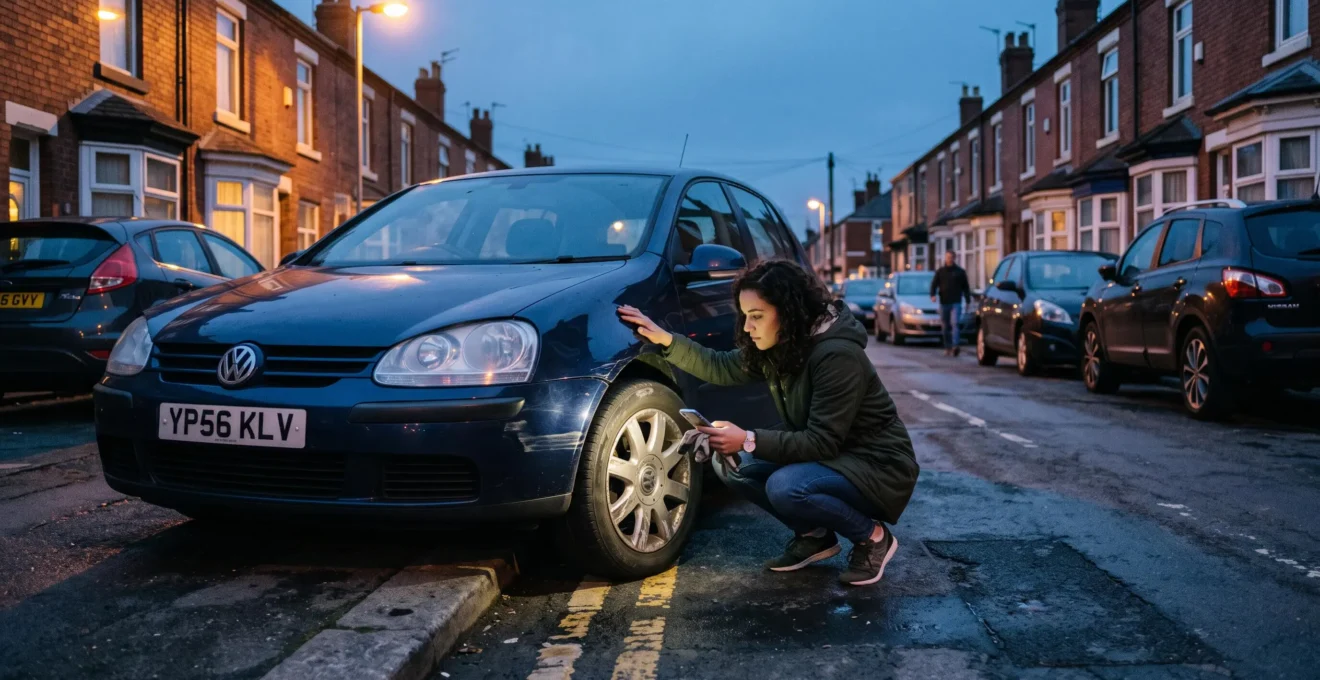
Parking on the street every night exposes a car to risks that a secure garage may reduce: kerbed alloy wheels, scratched paintwork, vandalism, theft and the inconvenience of a breakdown outside the house. Yet buying every protection add-on offered at the dealership rarely makes financial sense.
The useful distinction is between damage you can reasonably afford to repair and a loss that could seriously disrupt your finances. Cosmetic and alloy protection may help with repeated minor damage, while GAP insurance addresses a different risk: the financial shortfall following a total loss. Key cover and roadside assistance solve practical problems that may already be covered elsewhere.
The right combination depends on your parking conditions, vehicle value, finance agreement and existing insurance. Policy exclusions, excesses and claim limits matter more than reassuring product names. Although the principles apply across English-speaking markets, the regulatory evidence discussed below comes from the United Kingdom; insurance terminology, consumer rights and eligibility rules vary by country.
Street Parking Protection: The Short Answer
- Prioritise major financial exposure: consider GAP when a total-loss insurance settlement could leave a substantial finance shortfall.
- Buy cosmetic, alloy or key cover selectively: compare realistic repair or replacement costs against premiums, excesses and claim limits.
- Check existing benefits before paying: motor insurance, manufacturer packages and bank accounts may already provide overlapping protection.
- Why Do Protection Add-Ons Feel Worth It Until You Try to Claim?
- How to Choose Protection Add-Ons Using Your Real Risk Profile in 5 Minutes
- GAP Insurance or Key Cover: Which Matters More in the First 24 Months?
- The Duplicate Cover Mistake That Makes You Pay Twice for the Same Protection
- When Should You Buy Protection Add-Ons So You Don’t Overpay at Checkout?
- How to Spot the 5 Exclusions That Make an Extended Warranty Useless
- Manufacturer Cover or Standalone Provider: Which Works Better for Older Cars?
- Which Roadside Assistance Cover Actually Gets You Recovered in Under 90 Minutes?
Why Do Protection Add-Ons Feel Worth It Until You Try to Claim?
Protection add-ons feel valuable at purchase because they turn an unpleasant possibility into a seemingly manageable monthly payment. Their value becomes less convincing when a claim falls outside the policy’s damage definitions, exceeds a payout limit or triggers an excess. The deciding question is not whether damage might happen, but whether the contract would actually pay for it.
Consider a driver who regularly parks on a narrow residential street. Scratched alloy wheels, vandalised paintwork and a stolen car key all sound plausible. At the dealership, each product appears to remove a separate worry. But these are different risks, with different claim conditions and potential costs.
Cosmetic protection might cover a qualifying superficial scratch but exclude damage requiring a full-panel respray. Alloy wheel insurance may cover specified accidental scuffs while excluding structural damage, corrosion or particular wheel finishes. Key cover could include replacement but restrict claims involving keys left unattended.
These are examples of possible contractual restrictions, not universal exclusions. The actual policy wording determines what qualifies.
The claims administrator also matters. A dealer-sold add-on may be administered or underwritten by a separate provider, rather than your main motor insurer. This can mean a different claims telephone number, evidence requirements, authorisation process and complaint route.
Market-wide data explains why the purchase price alone is a poor measure of value.
53%
Claims costs represented 53% of premiums for standalone GAP insurance in the UK during 2025. This is an aggregate market measure, not an individual consumer’s payout probability. The regulator cautions that recent GAP figures were affected by market interventions and may not yet represent normal product performance.
FCA general insurance value measures for 2025, Financial Conduct Authority.
Apply a simple pre-purchase test. Describe one realistic incident, such as an overnight scrape that damages two adjacent body panels. Ask whether the policy covers the cause of damage, both affected panels, the proposed repair method and the full cost after the excess.
Then convert the advertised payment into a total cost. In a purely hypothetical example, an add-on priced at £8 per month for 48 months costs £384 before any additional finance charges. Compare that figure with the cover’s maximum useful payout and the cost of handling an ordinary incident yourself.
An add-on can be appropriate even if you never claim, particularly when it protects against an unaffordable loss. But a reassuring sales pitch is not evidence that the financial protection is worthwhile. Your actual parking exposure provides a better starting point.
How to Choose Protection Add-Ons Using Your Real Risk Profile in 5 Minutes
Choose protection add-ons by matching the risks of your normal overnight parking location to losses your existing policy does not adequately cover. Start with the motor insurance schedule, then assess parking conditions, vehicle value, finance exposure and likely repair costs. Products that do not address a meaningful uncovered risk can usually be removed from consideration immediately.
Spend the first two minutes reviewing your current insurance documents. Look for theft, vandalism, accidental damage, keys, locks, glass and wheels. Record the excess and whether making a claim could affect future premiums or no-claims benefits. A comprehensive motor policy may already address some serious losses, even if minor repairs are uneconomical to claim.
Next, assess the place where the car actually spends most nights. A tightly parked terraced street creates a different risk profile from a wide, well-lit residential road. Local theft and vandalism patterns matter, but they should be supported by credible local information rather than assumptions about a neighbourhood.
The following matching table provides a practical first filter.
| Parking or financial situation | Add-on worth examining | Reason to decline or reconsider |
|---|---|---|
| Frequent minor scrapes in tight parking spaces | Cosmetic damage protection | Repairs are inexpensive, or multi-panel damage is excluded |
| Regular kerb contact and expensive wheel finishes | Alloy wheel protection | Low damage exposure or restrictive wheel and repair eligibility |
| Elevated key-loss or theft concern | Key replacement cover | Existing key benefits already meet replacement and recoding costs |
| Newer or financed vehicle with possible settlement shortfall | Appropriate GAP insurance | Little or no realistic gap between settlement and relevant financial obligation |
| Older vehicle with limited breakdown support | Suitable roadside assistance | Equivalent assistance is already active |
Vehicle age also changes the calculation. Cosmetic cover may make less sense for an older car whose minor marks do not meaningfully affect its value, while expensive replacement parts can make key protection more relevant. A financed vehicle can have a substantial total-loss exposure even when parked on a relatively quiet street.
Drivers alternating between street and garage parking should not assess themselves solely on their safest nights. Use the typical overnight arrangement, then consider whether the less frequent location creates an unusually severe risk. Insurers assess individual incidents against policy conditions, not an average parking score.
Your Five-Minute Add-On Screening Checklist
- Check the main insurance schedule: produce a short list of existing benefits, exclusions and applicable excesses.
- Describe your usual parking conditions: record the principal overnight location, kerb exposure and any documented local theft or vandalism concerns.
- Identify potential losses: write down realistic cosmetic, wheel, key, total-loss and breakdown scenarios that could affect your car.
- Match products to uncovered risks: create a shortlist containing only add-ons that address a meaningful gap in existing protection.
- Calculate the net benefit: record each shortlisted product’s total premium, maximum payout, excess and relevant exclusions before deciding.
The objective is not to eliminate every possible expense. It is to avoid paying premiums for small or already-insured risks while keeping serious financial exposure manageable. The clearest example is the choice between GAP insurance and key cover.
GAP Insurance or Key Cover: Which Matters More in the First 24 Months?
GAP insurance generally deserves closer examination during the first 24 months when a financed or recently purchased car could be written off for less than the relevant finance balance or replacement benchmark. Key cover protects against a different, usually smaller expense. Compare the largest plausible financial shortfall with the actual cost of replacing and recoding your keys.
GAP, or Guaranteed Asset Protection, is designed to address a specified difference following a qualifying total loss. It does not replace ordinary motor insurance. Key protection, by contrast, may cover replacement keys, fobs, programming and associated services, depending on the contract.
The first two years are a useful review window, not a universal GAP purchase deadline. A relatively new car may lose value while finance obligations remain substantial, but depreciation and outstanding balances vary by model, deposit, loan structure and market conditions.
Consider a hypothetical buyer whose vehicle has an outstanding finance balance of £19,000 and receives a £16,500 total-loss settlement from the main insurer. The potential finance shortfall is £2,500 before considering any GAP exclusions, settlement adjustments or finance terms. A policy with adequate finance GAP benefits could be more financially consequential than reimbursing one lost key.
Now consider a buyer who made a large deposit and owes substantially less than the car’s current insured value. Finance GAP may offer little practical benefit. Key cover could be the more relevant product if replacement and recoding would be expensive and no existing benefit applies.
GAP policies also use different settlement calculations. Choosing the wrong variant can leave the exact risk you intended to insure unprotected.
| GAP variant | What it generally compares | Who should examine it |
|---|---|---|
| Finance GAP | Main insurer’s settlement versus qualifying outstanding vehicle finance | Borrowers concerned about a finance settlement shortfall |
| Return-to-invoice GAP | Main insurer’s settlement versus the original vehicle purchase price | Eligible purchasers concerned about losing part of their original investment |
| New-car or vehicle-replacement GAP | Main insurer’s settlement versus an eligible replacement vehicle benchmark | Buyers concerned about replacement costs rather than only finance clearance |
The Financial Ombudsman Service information on GAP insurance explains these distinctions and describes disputes involving rejected claims, settlement calculations, mis-selling and cancellation refunds.
Before paying, check whether the main motor policy provides new-car replacement during an initial eligibility period. Also investigate any manufacturer or insurer key benefits. Finance GAP may exclude negative equity carried over from an earlier vehicle, and key cover may impose restrictions on unattended keys or theft circumstances.
GAP is potentially valuable because of the size of one qualifying loss, not because a total loss is inevitable. Key cover may be more useful for a driver with limited finance exposure and costly vehicle keys. Either decision can be undermined by protection you already own.
The Duplicate Cover Mistake That Makes You Pay Twice for the Same Protection
Duplicate protection occurs when two or more policies address substantially the same expense without providing an equivalent increase in useful benefits. Street parkers can encounter overlap in key replacement, wheel repairs, roadside assistance and total-loss protection. The solution is to compare the actual benefits and exclusions of every existing policy before paying for another.
Start with your main motor policy. It may contain key and lock benefits, vandalism protection or accidental-damage cover that already addresses some incidents marketed through separate add-ons. However, equivalent labels do not guarantee identical protection. Excesses, claim limits and the effect of making a motor claim may differ.
Cosmetic and alloy policies can also overlap around a kerb-related incident. One product might cover an eligible surface scuff while another addresses wheel refinishing, but the damage definitions may not align. Neither policy should be assumed to pay for the same repair twice.
GAP requires a different audit. A finance agreement may contain settlement protections or contractual arrangements relevant to a total loss, but such provisions do not automatically duplicate GAP insurance. Compare the actual amount payable under each arrangement and account for outstanding negative equity, deposits and settlement exclusions.
The easiest benefits to overlook are often outside the car insurance folder: packaged bank accounts, vehicle purchase packages, manufacturer assistance, warranties and certain card-related benefits. Availability varies by provider and country.
Create a simple audit table with four columns: existing provider, insured event, maximum benefit and exclusions. Compare each proposed add-on against every relevant row. Where cover overlaps, identify whether the additional product improves the payout, reduces the excess or provides a genuinely different service.
Two premiums do not mean two reimbursements for the same loss. Insurance and benefit providers may apply coordination, contribution or other-insurance clauses. Some policies can provide complementary benefits, so assess the written arrangements rather than assuming all duplication is useless.
There is also a financing trap. If a dealer add-on is financed alongside the vehicle, cancellation of the protection does not necessarily mean every associated borrowing cost disappears automatically. The finance contract, cancellation date and applicable consumer rights determine the adjustment.
Where an unwanted policy has already been purchased, obtain the cancellation and refund provisions in writing. Cooling-off rights and complaint procedures differ by jurisdiction and product type; a full or proportionate refund should not be assumed.
Removing a duplicate is often a more reliable saving than negotiating a marginally cheaper premium. Once existing protection is mapped, the next decision is when to buy any genuinely necessary add-ons.
When Should You Buy Protection Add-Ons So You Don’t Overpay at Checkout?
Buy protection add-ons only after comparing the dealership’s total price with suitable standalone alternatives and checking eligibility deadlines. Purchasing immediately can be necessary for some products, but the dealership checkout is not automatically the best place to buy. The sensible approach is to verify eligibility early, then use whatever comparison window the contract permits.
There are three practical purchase windows, each with different trade-offs.
| Purchase window | Potential advantage | Main risk to check |
|---|---|---|
| At the dealership | Convenient arrangement alongside vehicle purchase | Limited comparison time and possible finance interest on the premium |
| Standalone provider after comparison | Opportunity to compare pricing, claims rules and cover depth | Eligibility or cover commencement may differ |
| Post-purchase or renewal | Better knowledge of actual driving and parking needs | Waiting periods, purchase-date restrictions or gaps in protection |
Standalone insurance can cost less than a dealer offer, but it should not be assumed cheaper or equivalent. Compare policy duration, claim limits, excesses, exclusions, administration and provider eligibility on a like-for-like basis.
Some GAP products require purchase within a specified period after acquiring the vehicle. Others permit later entry subject to conditions. Warranty products may depend on an active manufacturer warranty, vehicle age, mileage, inspection or service history. Delay the spending decision only after confirming the deadline.
For a hypothetical price comparison, suppose the same eligible protection is offered at £400 upfront or is financed at a total contractual cost of £480 over the relevant period. The £80 difference is part of the cost of obtaining that protection through finance. The example illustrates the calculation rather than suggesting a typical market price or interest rate.
Ask the dealer for the full cash price of the add-on, the total financed cost, and an itemised explanation of whether interest or fees apply. A small change to the vehicle’s monthly repayment can conceal a material overall expense.
Two contractual terms can change the purchase decision if you expect to sell or replace the vehicle early.
- Transferability: does the protection stay with the original car, transfer to its next owner or permit a qualifying replacement vehicle?
- Cancellation refunds: does the provider offer any refund after the cooling-off period, and how is the amount calculated?
Do not assume a pro-rata refund simply because a policy has unused time remaining. Claims history, product structure, contract conditions and local law can affect the outcome.
Where immediate protection is important, arrange suitable cover to start when required rather than creating an uninsured interval merely to chase a lower price.
A carefully timed purchase can avoid unnecessary financing costs without sacrificing important eligibility rights. However, a low premium still has little value if an extended warranty excludes the repairs that are most likely to matter.
How to Spot the 5 Exclusions That Make an Extended Warranty Useless
An extended warranty can offer little practical protection when its exclusions remove common failures, its servicing conditions are difficult to satisfy or its payout limits are too low. Before purchasing, examine five areas: wear and tear, pre-existing faults, consequential damage, repair limits and servicing obligations. The relevant question is whether a likely expensive repair would qualify.
Extended warranties generally concern specified mechanical or electrical faults. They are not substitutes for cosmetic, alloy or vandalism insurance. A car parked outside every night may face bodywork risks that remain entirely outside the mechanical warranty.
The five exclusion families deserve separate checks.
- Wear and tear: routine deterioration, consumables and ageing components may be excluded or covered only under defined failure conditions. Ask how the provider distinguishes ordinary wear from a sudden insured breakdown.
- Pre-existing faults: known defects, symptoms present before cover begins or faults discovered during an initial inspection may not qualify. Disclose relevant history and request clarification where necessary.
- Consequential damage: the warranty may cover one failed component but exclude additional damage caused by that failure, or apply a narrower definition of the insured event.
- Claims caps and excesses: a low per-repair limit, maximum labour rate or substantial excess may leave the owner funding much of an expensive repair.
- Servicing and authorisation: missed service intervals, insufficient records, ineligible repairers or work undertaken before approval can affect claims.
The Motor Ombudsman‘s advice on used-car warranties identifies these contractual issues, including wear-and-tear restrictions, service conditions, claim limits, excesses and repair authorisation.
For the wear-and-tear boundary, choose three relevant components based on your vehicle’s age, mileage and known maintenance needs. Request written answers explaining whether a sudden failure, gradual deterioration and resulting damage would qualify for each component.
Service compliance deserves equal attention. Keep dated invoices showing the vehicle, work performed, mileage and relevant parts or fluids, along with any required service-book entries. Check the manufacturer’s servicing intervals and whether the warranty permits independent repairers.
A servicing stamp alone may not provide all the evidence requested during a disputed claim. Equally, a missing stamp does not necessarily prove that maintenance was not performed if other reliable documentation exists.
Hypothetical Example: The Excess-and-Cap Trap
Imagine a warranty with a £150 claim excess and a £300 per-claim payout cap. An otherwise eligible repair costs £600. If the contract deducts the excess from its capped payment, the provider contributes only £150 and the owner pays £450.
The calculation depends on how the contract applies its cap and excess. A different policy might calculate them in another order. Obtain a written settlement illustration before purchasing.
For UK dealership purchases, a warranty is also separate from applicable statutory consumer rights. The existence of a warranty does not remove a dealer’s obligations under relevant consumer legislation. Other English-speaking jurisdictions have their own rules.
A warranty should be assessed by the repairs it can fund, not by the number of components listed in its advertising. Once those terms are understood, it becomes easier to compare manufacturer-backed and standalone protection for an ageing vehicle.
Manufacturer Cover or Standalone Provider: Which Works Better for Older Cars?
Manufacturer-backed cover may suit an older car with continuous eligible warranty protection and well-documented servicing, while a standalone warranty may be worth considering when manufacturer eligibility has ended or greater repairer flexibility is needed. Neither category is automatically better. Coverage depth, age and mileage restrictions, claims administration and actual repair limits determine the result.
For a vehicle approaching the end of its original manufacturer protection, continuity can be valuable. An eligible manufacturer extension may provide familiar servicing requirements, access to authorised repair facilities and coverage aligned with the brand’s specified components.
But ageing vehicles can face stricter mileage limits, altered eligibility or exclusions. Do not assume the coverage available for a relatively new car remains unchanged as it gets older.
Standalone providers may offer different entry criteria and repairer arrangements. Some accept vehicles that no longer qualify for manufacturer-backed policies, while others impose restrictive mileage caps, waiting periods or maximum labour rates. Acceptance must be checked for the specific registration, age, mileage and vehicle specification.
| Comparison factor | Manufacturer-backed cover | Standalone provider |
|---|---|---|
| Age and mileage eligibility | Check manufacturer-specific limits | Check individual provider acceptance rules |
| Repairer network | May require authorised facilities | May permit broader repairer choice |
| Covered components | Check changes from original warranty | Compare explicit component lists and exclusions |
| Claim authorisation | Confirm approval and diagnostic procedures | Confirm administrators and pre-approval rules |
| Repair cost limits | Check applicable caps and conditions | Check claim caps, excesses and labour rates |
| Renewal and continuity | Confirm eligibility before expiry | Check new waiting periods and inspection rules |
A vehicle with full dealer service records and continuing manufacturer eligibility may be a straightforward candidate for manufacturer-backed protection, provided the important components remain covered. For a high-mileage or discontinued model, a standalone contract with genuinely flexible repairer access might be more practical.
However, repairer choice has limited value if the policy caps labour rates below those charged by suitable local workshops. Similarly, a prestigious manufacturer label is not useful when a likely failure falls outside the extended coverage.
Before switching, check whether a lapse triggers fresh eligibility checks, an inspection or a period during which specified claims are excluded. These conditions vary; they are not automatic consequences of every warranty change.
Renewal price stability also matters. Request the current renewal conditions, but do not assume that a future premium or eligibility decision is guaranteed unless the contract expressly provides it.
For older street-parked cars, mechanical reliability protection and emergency recovery solve related but distinct problems. Even a strong warranty may pay for an eligible repair without arranging prompt assistance when the vehicle refuses to start outside the house.
Key Takeaways Before Choosing Breakdown Cover
- Confirm the exact street-parking location qualifies for assistance; roadside-only cover may treat breakdowns near home differently.
- Compare what happens after the technician arrives, not just how quickly assistance is dispatched.
- Check whether manufacturer, bank account or existing insurance benefits already provide an active recovery service.
Which Roadside Assistance Cover Actually Gets You Recovered in Under 90 Minutes?
No roadside assistance policy can be assumed to recover a vehicle within 90 minutes simply because it advertises a rapid response. Attendance depends on operator availability, location, safety priority, traffic, weather and the type of breakdown. For a street-parked car, the better choice is cover that includes assistance near home and provides suitable recovery if an immediate repair fails.
Two promises need to be separated: technician attendance and completed recovery. A provider might arrive quickly but need additional time to diagnose the fault, organise transport or reach an appropriate garage.
A 90-minute target therefore needs a precise definition. Does it refer to initial contact, attendance at the vehicle, roadside repair or arrival at the final recovery destination? Is the target contractually guaranteed, or simply an advertised operational objective?
The Financial Ombudsman Service recognises delayed attendance as a source of breakdown-cover complaints. Its guidance on vehicle breakdown cover explains that advertised response times, the circumstances of an incident, priority needs and external factors can be relevant when assessing disputes.
Network coverage can influence attendance. A provider with available nearby operators may reach an urban location quickly, while rural recovery can involve longer travel distances. Nevertheless, geography alone does not establish actual performance: demand, staffing and prioritisation can change the result.
Drivers should compare the assistance that follows an unsuccessful roadside repair.
| Cover feature | Why it matters for street parking |
|---|---|
| Roadside-only assistance | May exclude breakdowns at or near the registered home address |
| At-home assistance | Can cover an eligible failure where the vehicle is normally parked overnight |
| Local recovery | May transport the vehicle only to a nearby eligible garage |
| Extended or nationwide recovery | May provide a wider choice of recovery destination, subject to policy limits |
| Onward travel or replacement vehicle | May help occupants continue their journey when repairs cannot be completed promptly |
At-home eligibility is particularly important. A car parked on the public road directly outside its owner’s home may still fall within a policy’s home-area restriction. Read the geographical definition rather than assuming that being on a public road makes the breakdown eligible.
Ask the provider how it prioritises unsafe situations, motorway incidents, vulnerable occupants and non-urgent local breakdowns. Safety prioritisation is appropriate, but it means that an otherwise convenient urban callout may not receive immediate dispatch.
Next, confirm the recovery destination. Transport to the nearest suitable garage can solve the immediate problem, but it may not be your preferred repairer or a workshop capable of handling a specialist vehicle. Check mileage limits, destination choices, additional charges and whether onward travel is included.
Owners of newer vehicles should verify manufacturer assistance expiry dates. Some purchase packages include time-limited roadside services, and an older car may no longer have active benefits even if the original sales material advertised them.
Finally, distinguish breakdown assistance from accident recovery. A mechanical-breakdown policy does not necessarily provide the service needed following a collision or insured total loss.
Check your current policy for home-start eligibility, obtain the provider’s written response-time terms, confirm the recovery destination and save the correct emergency contact details on your phone. Only buy additional assistance if this review reveals a meaningful gap. The goal is dependable help when something goes wrong, not an unsupported promise that every vehicle will be recovered within 90 minutes.
Does parking on the street automatically increase the price of protection add-ons?
Not necessarily. Some providers may use parking arrangements or location as pricing or eligibility factors, while others price particular add-ons using different information. Check each provider’s underwriting questions and disclose your usual parking location accurately. Do not assume that every cosmetic, alloy, GAP or key policy charges more for street parking.
Can a cosmetic protection plan cover deliberate vandalism?
Only if its wording includes the specific damage and cause. Some products focus on limited accidental cosmetic repairs and may exclude malicious damage, deep scratches or full-panel repainting. Comprehensive motor insurance may provide a separate route for qualifying vandalism claims, subject to its excess and other conditions. Check both contracts before assuming a scratch is covered.
Is alloy wheel insurance worthwhile for an older car?
It can be worthwhile when the wheels remain expensive to repair, kerb damage is a realistic recurring risk and the policy provides sufficient eligible repairs. It is harder to justify where minor cosmetic marks have little practical effect, repair costs are modest or the contract excludes the wheel type or damage involved. Compare the full premium with realistic independent repair quotations.
What happens if the car is sold before an add-on policy expires?
The outcome depends on the product’s transfer and cancellation conditions. Some policies may allow transfer to a new owner or eligible replacement vehicle, while others end when the insured vehicle is sold. A refund is not always automatic or proportionate to unused time. Review the policy wording and request a written explanation before selling or replacing the car.
Should protection add-ons be reconsidered every year?
An annual review is sensible, particularly when the car’s value, finance balance, mileage, parking location or existing insurance benefits have changed. Review the contracts at renewal and before any major vehicle transaction. Multi-year policies may have fixed terms, so checking their continuing value does not necessarily mean they can be cancelled or replaced without cost.