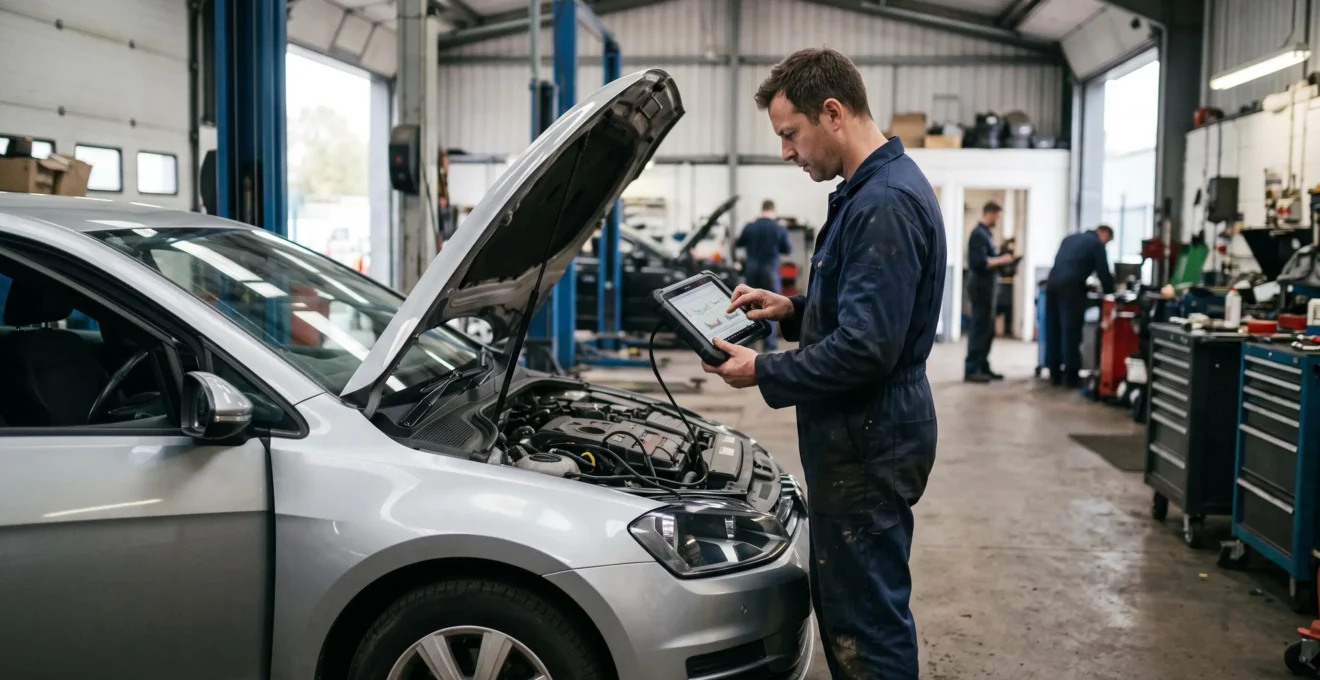
Two garages can inspect the same car, retrieve the same fault code and recommend entirely different repairs. One might replace a sensor immediately. The other might investigate its electrical supply, compare live readings and discover that the sensor itself is working correctly.
The difference is not necessarily the price of the diagnostic scanner. It is whether the garage has the right equipment, technical information and testing skills to establish the underlying cause before asking you to pay for parts.
Modern vehicle diagnostics can involve several distinct stages: reading fault codes, examining operating data, testing electrical or mechanical components, and performing manufacturer-specific procedures. Not every problem needs every stage, but stopping too early can turn a plausible suspicion into an expensive mistake.
If you have already paid for a repair that did not solve your problem, understanding these differences can help you choose a better-equipped garage, ask more useful questions and recognise when additional diagnostic work is justified.
Garage diagnostic equipment: the essentials
- A fault-code scan is not a confirmed diagnosis. It identifies information that can guide further investigation, not necessarily the part that needs replacing.
- Equipment must match the fault. Professional scanners, oscilloscopes, circuit-testing equipment and calibration systems answer different questions.
- Pay for demonstrated diagnostic progress. Ask what has been tested, which causes remain possible and how the proposed repair will be verified.
- Why Does One Garage Find the Fault in an Hour While Another Cannot Find It at All?
- The ‘Just a Scan’ Misunderstanding That Keeps Your Fault Unfixed
- Why Does the Warning Light Turn Off Before the Garage Can Find Anything?
- Brand-Specific Diagnostics or Multi-Brand Tools: Which Works Better for Your Car?
- Main Dealer or Independent: Which Has the Equipment You Actually Need for This Repair?
- Why Some Repairs Fail Without Specialised Equipment Even When the Parts Are New
- How to Ask About Diagnostic Tools Before Booking Without Sounding Clueless
- When Should You Ask for a Diagnostic Report So You Are Not Paying for Guesswork?
Why Does One Garage Find the Fault in an Hour While Another Cannot Find It at All?
One garage may identify a fault quickly because its technician has the relevant equipment, vehicle information and a clear testing strategy. Another may struggle despite owning an expensive scanner. Diagnostic success depends on selecting tests that distinguish between possible causes, not simply retrieving more information or using the most sophisticated device available.
Different diagnostic tools answer different questions. A basic OBD-II code reader can retrieve standardised emissions-related trouble codes from supported vehicle systems. A professional scan tool may access additional electronic modules, manufacturer-specific information and live operating data. An oscilloscope can capture electrical signals too brief or irregular for a conventional meter to reveal.
A smoke tester serves a completely different purpose: it can help locate certain intake or evaporative-emissions leaks when used with the correct system-specific procedure.
Consider a hypothetical engine-misfire investigation. Both garages retrieve a code indicating a misfire associated with one cylinder.
The first garage assumes the ignition coil has failed and replaces it. The engine continues misfiring because the actual problem is elsewhere.
The second garage checks relevant live data, examines the ignition waveform where appropriate and performs targeted mechanical or fuel-system tests. Depending on the results, the technician may investigate wiring, an injector or insufficient cylinder compression before recommending a repair.
The second approach does not guarantee a faster diagnosis, but it can provide stronger evidence for the eventual decision.
The ASE automobile technician study guide identifies code retrieval, freeze-frame analysis, electrical measurements, ignition testing, fuel-system diagnosis and repair verification as distinct technical competencies. It also recognises the need to investigate problems that occur without stored trouble codes.
Equipment alone is insufficient. Manufacturer wiring diagrams, technical service bulletins, service history and known-fault information help technicians choose meaningful tests. An advanced scanner used without a clear hypothesis can produce plenty of data without identifying the cause.
Nor should an hour be treated as a universal diagnostic benchmark. Intermittent symptoms, previous repairs, vehicle complexity and access to specialist equipment all affect investigation time.
A useful measure of progress is whether the technician can explain which possible causes have been tested and eliminated. That distinction becomes especially important when a garage advertises a low-cost diagnostic scan.
The ‘Just a Scan’ Misunderstanding That Keeps Your Fault Unfixed
A diagnostic scan retrieves information recorded by the vehicle’s electronic systems, but it does not necessarily establish why a malfunction occurred. A trouble code is a diagnostic clue, not an instruction to replace a particular component. Confirming the cause may require examining operating conditions, commanding components to operate or performing independent electrical and mechanical measurements.
For example, a sensor-related fault code can arise from a defective sensor, damaged wiring, an inadequate power supply or another condition that produces an unexpected reading. Replacing the sensor solely because its name appears in a code description may leave the original fault untouched.
Professional diagnosis progresses through different levels of investigation, depending on how much uncertainty remains.
| Diagnostic level | What the technician does | What remains uncertain |
|---|---|---|
| 1. Basic code retrieval | Reads available trouble codes from supported systems. | The underlying cause and sometimes the affected component. |
| 2. System-wide scan and stored-data review | Checks accessible modules, code status and available freeze-frame information. | Whether the recorded conditions establish a specific cause. |
| 3. Live-data analysis | Compares sensor readings and operating behaviour with expected values. | Whether an abnormal reading originates in the component or elsewhere. |
| 4. Functional testing | Uses supported bidirectional commands to activate components or perform tests. | Which underlying defect explains an unsuccessful response. |
| 5. Targeted physical measurements | Tests relevant circuits, signals, pressures or mechanical conditions. | Any remaining causes not resolved by the selected tests. |
This is a framework for understanding diagnostic depth, not a mandatory sequence for every vehicle. A technician should stop when the available evidence adequately supports the repair decision, rather than charge for tests that add no useful information.
The distinction between observing a fault and testing its cause is particularly important. A scan tool may show an abnormal sensor reading, while a multimeter can help verify the power supply or ground circuit. An oscilloscope may be needed to inspect a changing signal or intermittent electrical disturbance.
The appropriate follow-up depends on the manufacturer’s specifications and the behaviour of the particular system.
A cheap code-reading appointment is not automatically poor value. It may be entirely suitable for preliminary screening, particularly when you want to establish which systems have recorded faults.
The problem begins when a limited scan is presented as a definitive diagnosis without supporting tests. Before accepting a proposed repair, establish whether the charge covers only code retrieval or includes further investigation.
It also explains why an intermittent warning can be challenging: when the symptom has disappeared, the technician may need to reconstruct the conditions rather than simply observe the failure.
Why Does the Warning Light Turn Off Before the Garage Can Find Anything?
A warning light can switch off because the vehicle’s monitoring system no longer detects the condition that triggered it. That does not necessarily mean the underlying fault has been permanently resolved. Depending on the vehicle and system, stored codes, pending information, fault history or other diagnostic evidence may remain available after the light disappears.
Vehicle monitoring systems continually or periodically evaluate particular operating conditions. Some faults occur only when the engine is cold, during acceleration, at a specific temperature or under an unusual electrical load.
If the triggering condition is no longer present, the warning may disappear before your appointment.
The US Environmental Protection Agency‘s EPA fact sheet on on-board diagnostics explains this behaviour for emissions-related monitoring. Published in 1997, it provides useful historical context but should not be treated as a complete description of contemporary fault-memory rules or all dashboard warning systems.
Modern diagnostic tools may retrieve relevant stored information even when the warning light is off. Where supported, freeze-frame data can record operating conditions associated with a fault, such as engine temperature, load or vehicle speed.
However, not every event produces useful freeze-frame information. Recorded conditions can help reproduce a problem without revealing which component actually failed.
You can make an intermittent fault easier to investigate by documenting what happens when it occurs naturally. Record the exact warning message, visible symptoms, approximate driving circumstances, weather conditions and whether the problem appears during cold starts, acceleration, braking or longer journeys.
Photograph the dashboard only when safely stationary. Do not deliberately reproduce a potentially dangerous fault while driving.
This information allows the garage to select appropriate monitoring, data-logging or road-test methods. It can also help distinguish a repeatable fault from one that appears only under specific circumstances.
Avoid clearing fault codes or disconnecting the battery before diagnostic evidence is collected unless safety instructions or an appropriate repair procedure require it. Clearing information can remove useful clues and reset certain monitoring states, although what remains recoverable varies by vehicle.
An extinguished warning light is not proof of a completed repair. Similarly, a flashing check-engine light can indicate a serious misfire with a risk of component damage. Other severe warnings or major drivability problems may require stopping safely and obtaining assistance. Follow the vehicle manufacturer’s instructions rather than waiting for the warning to return.
Once useful fault information has been preserved, the next question is whether the garage has sufficient electronic access to investigate the affected system on your particular vehicle.
Brand-Specific Diagnostics or Multi-Brand Tools: Which Works Better for Your Car?
Neither manufacturer-specific diagnostic software nor a professional multi-brand scanner is automatically the better choice. The right system is the one that supports the required diagnostic and repair functions on your exact vehicle. A multi-brand platform may handle routine investigations effectively, while certain programming, adaptation or security-related procedures may require additional manufacturer-compatible access.
Manufacturer-specific systems are generally designed around a vehicle maker’s electronic architecture and supported service procedures. Professional multi-brand tools aim to cover several manufacturers through a common platform.
Actual capabilities vary by tool model, software version, subscription, vehicle generation and the specific control module involved.
For ordinary engine diagnostics, a capable multi-brand scanner may provide the necessary fault codes, live-data readings and functional tests. A newly introduced electronic module or specialised adaptation procedure may require manufacturer-specific software or another supported solution.
| Capability | Manufacturer-specific platform | Professional multi-brand platform |
|---|---|---|
| Vehicle coverage | Focused on supported vehicles from a particular manufacturer. | Designed for vehicles from multiple manufacturers. |
| Fault-code and live-data access | May offer manufacturer-defined information and guided procedures. | Can provide extensive access, but coverage varies by vehicle and system. |
| Actuator and functional testing | Depends on the supported manufacturer procedure. | Depends on the tool’s implemented functions for that vehicle. |
| Programming and adaptations | May support relevant factory service functions with required access. | May support some functions directly and require other solutions for the rest. |
| Security-sensitive operations | May require authorised credentials or online access. | May also require credentials, validation or manufacturer permissions. |
Instead of asking whether a garage has a particular scanner brand, use a vehicle-and-procedure compatibility test. Establish the make, model, model year, affected system and required operation.
For example, a workshop might diagnose an electronic steering problem but lack the access needed for the prescribed configuration procedure after replacing a particular component.
Some operations depend on more than hardware. Current software, service-information subscriptions, compatible communication interfaces, online authentication and security permissions may all matter.
In the United States and Canada, the NASTF scan-tool security validation FAQ describes credential requirements for certain supported security-related operations, including key and immobiliser functions. These arrangements should not be generalised to every diagnostic task or to countries with different access systems.
A garage can also combine equipment. It might use a multi-brand scanner for the initial investigation and obtain manufacturer-specific access through licensed software, qualified remote support or a specialist partner.
That arrangement can be appropriate if responsibilities are clear. Ask whether outside support adds charges, delays or a separate appointment, and which business will confirm that the completed procedure works correctly.
This principle also changes how to choose between a franchised main dealer and an independent garage: the badge over the workshop entrance matters less than its demonstrated ability to complete your particular repair.
Main Dealer or Independent: Which Has the Equipment You Actually Need for This Repair?
A main dealer is not automatically better equipped for every fault, and an independent garage is not automatically less capable. A franchised dealer typically concentrates on its manufacturer’s vehicles, while a well-equipped independent specialist may combine relevant manufacturer software, advanced testing equipment and extensive experience with particular faults. The decisive factor is capability for the exact repair.
Three workshop categories are worth distinguishing.
- General independent garage: Often suitable for routine servicing and common engine, braking or electrical diagnostics when the relevant equipment and expertise are available.
- Independent marque specialist: May offer deeper experience with a particular manufacturer, its recurring problems and specialised service procedures.
- Franchised main dealer: May provide a suitable route for manufacturer-specific investigations, supported programming and procedures requiring particular factory systems or access arrangements.
None of these categories guarantees an accurate diagnosis. A workshop may have the correct software but limited experience with an unusual fault. Another may be highly skilled in electrical testing yet unable to perform a restricted programming operation.
For a straightforward sensor or ignition problem, an independent equipped to verify circuits and mechanical conditions may be entirely appropriate. A vehicle requiring a particular module configuration, software procedure or controlled calibration calls for a more specific capability check.
There is also a financial complication that owners often discover too late: diagnostic fragmentation.
A garage might identify the likely defective module but need another business to programme its replacement. You could then face additional transport arrangements, a second inspection charge, separate programming costs or disagreement about who should resolve a remaining fault.
Before approving work, ask which business will diagnose the problem, supply and fit the part, perform any necessary configuration and verify the result. If more than one workshop is involved, establish how the diagnostic findings will be transferred.
A second opinion can be more useful than immediately authorising another component replacement. Where the first garage cannot establish the cause, request its recorded findings, tests completed and outstanding uncertainties.
The next specialist can then decide which evidence remains valid and which tests need repeating. Existing results may save duplicated work, but they should not be accepted uncritically if the original testing was incomplete or unreliable.
Even after the correct fault has been identified and a replacement part installed, some vehicles need additional electronic or physical procedures before the repair is genuinely complete.
Why Some Repairs Fail Without Specialised Equipment Even When the Parts Are New
A new component does not always restore full vehicle functionality immediately after installation. Some electronically controlled systems require manufacturer-specified coding, initialisation, adaptation, software programming or calibration. If those procedures are applicable but omitted or performed incorrectly, the original complaint may persist, new faults may appear or a safety-related function may remain improperly configured.
These requirements vary substantially between vehicles and components. A replacement sensor may work immediately on one model but require an adaptation or calibration on another.
Three repair situations illustrate why the equipment matters.
- ADAS camera or radar work: Certain repairs require calibration targets, precise positioning, specified workshop conditions or an approved driving procedure.
- Electronic steering or suspension: Some component replacements require prescribed initialisation, configuration or position-related procedures.
- Electronic control-module replacement: Applicable manufacturer instructions may require compatible programming software, authorised access and a stable external power supply during the operation.
The technician must establish which procedure applies using the vehicle’s specific repair instructions. A general claim that every replacement module must be coded, or every camera replacement requires the same calibration method, would be unreliable.
Electronic communication and physical calibration are not the same thing. A scan tool may communicate successfully with an ADAS module and report no relevant trouble codes even though the manufacturer’s required alignment or calibration procedure has not been completed.
Where specified, software cannot replace correctly positioned calibration targets, alignment equipment or controlled working conditions.
I-CAR‘s professional ADAS collision repair guidance distinguishes identifying relevant faults, consulting manufacturer instructions, completing applicable calibration or aiming procedures, and carrying out post-repair checks. That framework is particularly relevant to electronically controlled safety systems, although it does not establish universal requirements for every repair.
A credible repair-completion process should establish four things:
- The installed component is suitable for the specific vehicle and intended application.
- All applicable manufacturer-specified installation, programming and calibration procedures have been performed.
- Relevant system status and diagnostic information have been checked after the work.
- Any prescribed operational checks or road-test verification have been completed under appropriate conditions.
A new part and an extinguished warning light are not, by themselves, sufficient proof that a safety-related electronic system is functioning as intended.
The practical challenge is obtaining these answers without needing to understand automotive diagnostic software yourself. A few well-chosen booking questions can reveal much more than asking which scanner the garage owns.
How to Ask About Diagnostic Tools Before Booking Without Sounding Clueless
You do not need to know diagnostic equipment brands or technical terminology to assess a garage. Describe your vehicle, its symptoms and any warning message, then ask whether the appointment is intended to investigate the underlying cause or simply retrieve fault codes. A competent garage should be able to explain its proposed approach and limitations in understandable language.
A useful opening question is:
« My car has this symptom and warning message. Can you diagnose the underlying cause, or is the appointment mainly for reading fault codes? »
The response establishes whether you are booking preliminary screening or a more substantial investigation.
Then tailor the discussion to the symptoms. For an intermittent electrical fault, ask whether the garage can monitor operating data and test relevant circuits when the problem occurs. For an electronically controlled system, ask whether it can communicate with the affected module and perform the functional tests required.
You do not need to demand an oscilloscope, smoke tester or manufacturer scanner for every problem. The garage should select equipment according to the evidence.
Be equally clear about spending authorisation:
« What is included in the initial diagnostic charge, what happens if the cause is still uncertain, and will you contact me before carrying out additional testing? »
An initial investigation may not reach a conclusive answer within the agreed scope. That can be reasonable if the garage communicates its findings and seeks authorisation before extending the work.
A credible response describes the diagnostic process, relevant experience and any equipment limitations without guaranteeing success before the car has been examined.
Be cautious if a garage claims its computer will automatically identify the faulty part, promises that a basic scan will solve every problem or recommends expensive replacement work without explaining the supporting evidence.
Your five-step diagnostic booking checklist
- Prepare your vehicle details. Record the make, model, model year and relevant repair history in a short booking note.
- Describe the fault precisely. Save the exact warning message, symptoms and circumstances in a written summary, with a photograph where safely available.
- Confirm the investigation scope. Obtain a clear statement explaining whether the appointment covers code retrieval only or further diagnostic testing.
- Establish the spending boundary. Record the initial charge, what it includes and the point at which the garage must request approval for additional work.
- Agree on the findings you will receive. Request a written explanation of relevant test results, the recommended next step and any remaining uncertainty.
Once testing has begun, the same principle applies to the results: a clear explanation of the evidence is more valuable than a confident repair recommendation unsupported by recorded findings.
Key takeaways before authorising a repair
- Ask what specific finding supports the proposed repair, especially when the component is expensive or several causes remain possible.
- Request enough documentation to distinguish tested conclusions from possibilities that have not yet been investigated.
- Agree how the garage will check the original symptom after the work, including any necessary programming, calibration or operational verification.
When Should You Ask for a Diagnostic Report So You Are Not Paying for Guesswork?
Ask for documented diagnostic findings before approving an expensive or uncertain repair, when several possible causes remain, or when the vehicle needs to be referred to another specialist. A useful report should explain which tests were performed, what their results indicate and what remains unconfirmed. A printed list of fault codes alone rarely provides that level of assurance.
A diagnostic report does not have to be elaborate. For a straightforward investigation, a concise written explanation may be sufficient. For a complicated electrical fault, recurring repair failure or costly electronic component replacement, more detailed results can make a significant difference.
The most useful documentation usually includes:
- The original customer complaint and the conditions under which the symptom occurs.
- Relevant fault codes, their recorded status and any available contextual data.
- The electrical, mechanical or functional tests performed and their meaningful results.
- The conclusion supported by those findings, including competing causes that have been reasonably excluded.
- Any unresolved questions and the proposed method for verifying the repair.
For example, consider a hypothetical vehicle with a fault code associated with an expensive electronic sensor.
A report that merely lists the code and recommends replacing the sensor provides limited justification. A stronger report might document that the appropriate power and ground circuits were tested, relevant signal behaviour was compared with manufacturer specifications, and the results support a sensor fault rather than a wiring defect.
Those findings would not eliminate every conceivable alternative, but they would provide a more defensible repair decision.
Before accepting the recommendation, ask: « Which test result shows this component is faulty, and how will you confirm that replacing it fixes my complaint? »
The answer should identify relevant evidence rather than rely on the general reputation of a scanner or the frequency with which that component fails on similar vehicles.
Documentation also matters if the first repair is unsuccessful. Comparing the pre-repair measurements, work performed, post-repair tests and original symptom helps distinguish several possibilities.
The original diagnosis may have been incorrect. The diagnosis may have identified one genuine fault while another remained. Or the component replacement may have been appropriate, but an additional installation, programming or calibration procedure may still be necessary.
A report cannot guarantee that a repair will work, and an inconclusive report is not necessarily evidence of poor practice. An accurately documented uncertainty can be more useful than an unsupported claim of certainty.
Where a dispute arises, retain the estimate, diagnostic findings, authorised work description and final repair documentation. Consumer rights and dispute procedures differ between countries, so any formal claim should be assessed under the rules applicable to the repair.
Before authorising the next repair, ask the garage to identify the evidence supporting its conclusion, clarify what remains uncertain and explain how success will be checked. If those answers are unavailable, consider obtaining a documented second opinion from a workshop with the specific equipment and expertise your vehicle requires.
Can a garage diagnose a car without any stored fault codes?
Yes. A fault may not trigger a stored code, or the relevant information may no longer be available. A technician can investigate the reported symptoms using mechanical checks, electrical measurements, live-data monitoring and other suitable tests. The absence of codes does not establish that every vehicle system is functioning correctly.
Should a garage charge for diagnosis if it cannot identify the fault?
Diagnostic labour can involve legitimate testing even when the cause remains uncertain. Whether a charge is appropriate depends on the work authorised, the agreed terms and applicable consumer law. Ask what was actually tested, what was established and whether further investigation was approved before it was performed.
Is a Bluetooth OBD-II reader enough to diagnose a modern car?
A compatible Bluetooth reader can be useful for retrieving supported fault codes and viewing certain operating data. However, its functionality depends on the adapter, software and vehicle. It may lack access to some control modules, functional tests or manufacturer-specific procedures, and it cannot replace physical testing where required.
Can a garage use remote diagnostic support instead of owning manufacturer equipment?
In some circumstances, a garage can obtain supported diagnostic or programming functions through a qualified remote service. Suitability depends on vehicle compatibility, access permissions, connection requirements and the exact procedure. Before approving the work, establish who performs it, what it costs and who is responsible for final verification.
Does a successful post-repair scan prove that the car is fixed?
Not necessarily. A scan showing no relevant trouble codes is useful evidence, but some defects require additional operational testing or manufacturer-specified calibration. The repair should be checked against the original complaint and any applicable verification procedures, particularly for electronically controlled safety-related systems.