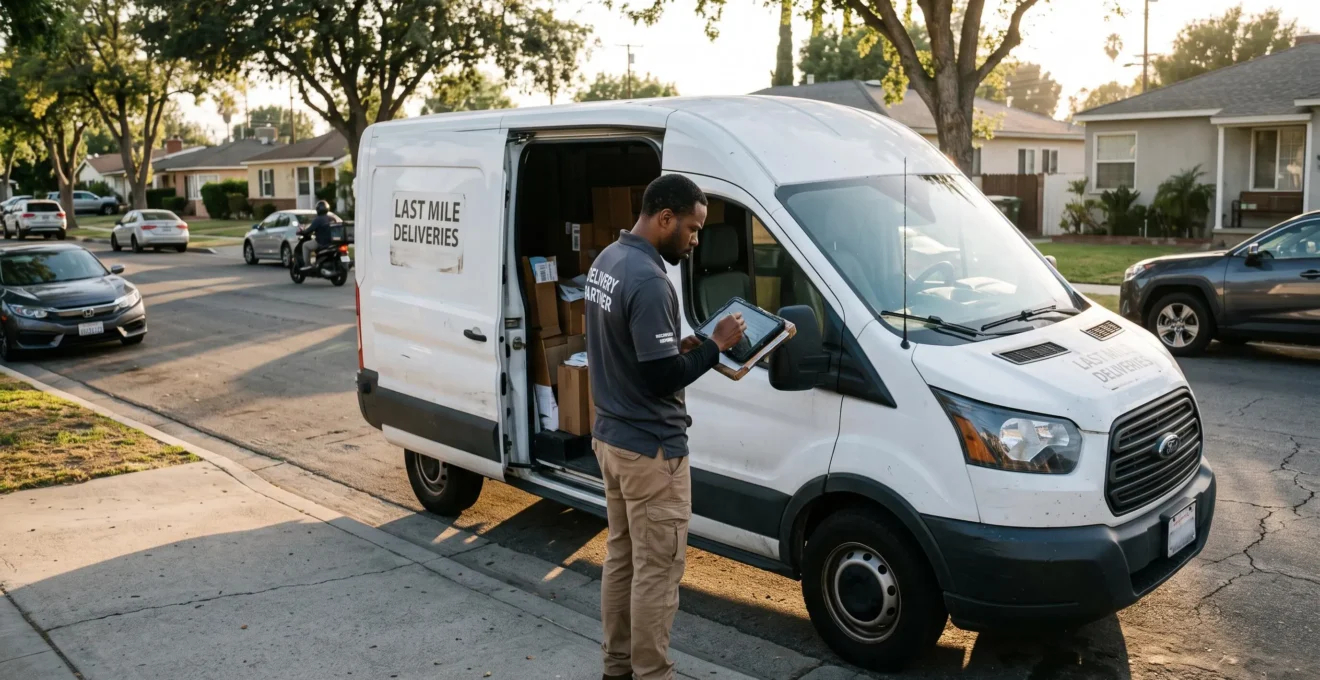
A blocked entrance at stop four. An incorrect address at stop seven. A damaged parcel discovered halfway through the route. Delivery problems rarely arrive when there is time to investigate them. Each exception forces a decision while the remaining stops, customer windows, and depot deadlines keep moving.
The solution is not to fix every issue in three minutes. It is to develop a three-minute problem-solving habit that establishes what happened, chooses a safe next action, and records what the next person needs to know. A driver who makes a clear decision can move forward without leaving an unresolved problem hidden in the route.
Use the first 90 seconds to assess the situation, the next 60 seconds to select and communicate an action, and the final 30 seconds to record the outcome. These are practical training targets, not official safety standards. If a hazard needs more time, safety takes priority and the clock stops being relevant.
The 3-minute delivery problem-solving habit
- Diagnose before reacting: check safety, the chance of completing the delivery, and the effect on the remaining route.
- Choose one clear action: resolve, defer under policy, or escalate rather than repeatedly improvising.
- Record the evidence: capture the problem, decision, and next action so recurring failures can be corrected.
- Why the Same 4 Delivery Problems Keep Repeating Every Week
- How to Triage a Delivery Issue in 90 Seconds Without Derailing Your Route
- Reattempt Later or Return to Depot: Which Is Better After 2 Failed Drops?
- The Quick Fix That Makes Your Route Worse by the Third Stop
- When Should You Escalate Recurring Delivery Issues So They Stop Happening?
- The Minor Dashboard Light Drivers Ignore That Can End Your Shift Early
- How to Book a Service Slot So the Garage Can’t ‘Guess’ the Time Needed
- How Advanced Workshop Scheduling Cuts Waiting Time by 40% Without More Staff
Why the Same 4 Delivery Problems Keep Repeating Every Week
The same delivery problems repeat because their underlying conditions often remain unchanged. Incorrect address details, restricted building access, unavailable customers, and unresolved vehicle faults can produce the same exceptions across multiple shifts. Recording the last three occurrences helps drivers identify a potential pattern and determine whether they can fix it or need support from dispatch, the depot, or maintenance.
Consider four common sources of repeated disruption:
- Address problems: incorrect entrances, incomplete unit numbers, or inaccurate map pins.
- Access problems: locked gates, broken intercoms, or delivery entrances restricted to certain hours.
- Customer availability: signature-required deliveries attempted outside a workable receiving window.
- Vehicle problems: repeated warning lights, unreliable equipment, or faults that remain unresolved between shifts.
The important distinction is between an isolated exception and a condition likely to produce another failure. A customer who unexpectedly leaves home is different from a commercial building that never accepts deliveries after a certain time.
Research published in Production and Operations Management supports treating unsuccessful deliveries as a routing problem rather than merely a driver-level inconvenience. In a field experiment with a delivery company in Singapore, researchers reported reduction in the share of failed delivery attempts of 10 % and an average reduction of $13 in delivery cost per route when using their proposed routing algorithm. These were results from a specific research setting, not guaranteed savings for other fleets.
10%
Average reduction in failed-delivery-attempt share reported for the experimental routing algorithm in a Singapore field experiment. The result does not measure the effectiveness of a three-minute driver habit.
Research on predicting failed delivery attempts in route planning, Lim, Wang and Webster, published in 2022.
At the driver level, the simplest evidence-gathering method is a three-occurrence log. For each incident, record the date, stop, problem category, and attempted solution. Three entries are a useful review trigger, not statistical proof that a pattern exists.
For example, three hypothetical delivery attempts at the same building might reveal that the loading entrance is locked after 4 p.m. That information is more useful than three separate notes saying « access failed. »
Recurring problems also create compounding route delays. An unsuccessful attempt consumes time that was allocated to a stop. Additional calls, handling, and route changes can then reduce the flexibility available for later deliveries. The precise cost depends on the route, but leaving a known obstacle unresolved increases exposure to another disruption.
Drivers can often correct a parcel’s position in the van or clarify an approved access instruction. They usually cannot permanently change customer master data, repair faulty fleet equipment, or rewrite delivery windows. Those issues need the team that controls the underlying process.
Once a possible pattern is visible, the next step is a faster decision at the point of disruption. That is where the 90-second triage comes in.
How to Triage a Delivery Issue in 90 Seconds Without Derailing Your Route
To triage a delivery issue in 90 seconds, ask three questions in order: Is anyone at risk? Can the delivery still succeed today? Will fixing it now protect the remaining route? Stop and follow the relevant safety procedure if there is danger. Otherwise, use the answers to decide whether to act, defer, or escalate without allowing the diagnosis to become open-ended.
The 90-second target applies to the initial assessment, not to the time required to perform a repair, make a safe delivery, or contact emergency assistance.
- Seconds 0–30 — Safety: identify any immediate danger involving the vehicle, people, parcel contents, or delivery location. If there is a suspected safety-critical defect or other immediate hazard, stop the task safely and follow the applicable procedure.
- Seconds 30–60 — Feasibility: determine whether the delivery can still be completed today within customer requirements, access conditions, and company policy.
- Seconds 60–90 — Route impact: assess whether taking action now prevents more disruption or whether an authorized reattempt or escalation is more appropriate.
Suppose a customer is absent from a signature-required delivery. The driver checks the approved contact method, confirms that the required recipient is unavailable, and reviews whether another authorized delivery window exists. If there is no permitted immediate solution, the driver records the failure and follows the reattempt procedure rather than waiting indefinitely.
For a vehicle problem, the safety assessment works differently. A quick observation while safely returning to a parked van may reveal an illuminated warning light, an obvious tyre problem, leaking fluid, or shifted cargo. These observations can trigger a more thorough check, but they do not replace the required pre-journey vehicle inspection.
The UK’s Driver and Vehicle Standards Agency explains the importance of checking warning lights, fluid levels, tyres, and load security before setting off. Its guidance also instructs drivers who discover defects during a journey to stop safely, assess the issue, and report it. Dangerous defects must be repaired before the journey continues.
For vehicles operating in England, Scotland, and Wales, consult the DVSA guidance on daily van safety checks. Drivers elsewhere should follow the applicable local requirements, vehicle manufacturer’s instructions, and fleet safety procedures.
The remaining 90 seconds of the three-minute habit can be used to implement the decision and capture a concise record, provided the situation is safe and the work can reasonably be completed within that time.
The five-action delivery issue checklist
- Identify the exception: record the stop or vehicle reference and a specific problem category. Deliverable: one identifiable incident record.
- Check immediate safety: identify any hazard and the required protective action. Deliverable: a recorded safety decision or safety escalation.
- Confirm delivery feasibility: check relevant customer requirements, route constraints, and company rules. Deliverable: a documented delivery option.
- Select and communicate the action: resolve, defer, or escalate through an approved channel. Deliverable: a recorded decision and any necessary notification.
- Close the information loop: record the outcome, next owner, and any required follow-up. Deliverable: a complete exception note for dispatch or the next shift.
The checklist is a practical driver-training tool. It does not authorize drivers to shorten mandatory checks, bypass reporting requirements, or continue operating an unsafe vehicle.
Once the immediate problem has been assessed, the next decision is often whether a failed delivery deserves another attempt or should return through the depot process.
Reattempt Later or Return to Depot: Which Is Better After 2 Failed Drops?
After two failed drops, a same-day reattempt is generally worth considering when customer availability is confirmed, the address is accessible, and the detour fits within the remaining route and working-time limits. Returning parcels to the depot is more appropriate when another attempt is unlikely to succeed, a handling requirement cannot be met, or company policy requires a return. Two failures alone do not determine the correct decision.
A failed delivery can create two kinds of additional work: the immediate time spent managing it and the later work required to complete or return the shipment.
Before choosing, compare the actual constraints rather than relying on the number of unsuccessful stops.
| Decision factor | Reattempt later | Return to depot |
|---|---|---|
| Remaining route length | More suitable when the detour fits without jeopardizing other commitments. | More suitable when the remaining schedule cannot accommodate another attempt. |
| Distance from failed address | More practical when the driver will pass nearby again. | More practical when a return trip would cause a substantial detour. |
| Customer availability | Preferable when an authorized recipient confirms a suitable window. | Preferable when access or recipient availability remains uncertain. |
| Parcel requirements | Possible when perishable, controlled, or signature-required goods can still be handled compliantly. | Required when applicable handling rules or company instructions prevent another attempt. |
| Depot cut-off | Viable when a reattempt still allows compliance with required return or handover times. | Preferable when further delay risks missing a mandatory depot deadline. |
| Working hours | Appropriate only if the additional journey fits within applicable driving and working-time requirements. | Appropriate when the reattempt would exceed an applicable limit or authorized shift. |
Consider a hypothetical driver with several remaining deliveries and two failed parcels. One recipient confirms they will be available when the driver returns along an already planned road. The other address is a substantial detour with no confirmed access. Reattempting the first may be reasonable; returning the second may protect the remainder of the shift.
The hidden cost of a reattempt is the route flexibility it consumes. A short detour can leave less room for traffic, loading delays, or a later customer exception. An early depot return may avoid that detour but generally leaves the undelivered parcel requiring another authorized handling or delivery step.
Neither option guarantees a better outcome. The driver’s decision should account for customer instructions, parcel-specific restrictions, local rules, and the dispatcher’s operational view.
When personal judgment conflicts with company policy, do not silently substitute a preferred method. Contact dispatch for an authorized decision when needed. Record the attempted delivery, reason for failure, proposed alternative, instructions received, and final parcel status.
That documentation provides a traceable explanation if the outcome is questioned. It does not automatically remove the driver’s responsibility to follow safety rules or company procedures.
The best choice protects safe delivery outcomes across the whole shift, not merely the next parcel. The same principle applies to seemingly harmless shortcuts.
The Quick Fix That Makes Your Route Worse by the Third Stop
The most damaging delivery shortcut is one that saves a few seconds now but creates more handling, uncertainty, or risk later. Leaving parcels unscanned, skipping required vehicle checks, ignoring warning indicators, or postponing a delivery decision without recording it can turn a manageable exception into several new problems. A useful quick fix eliminates work; a harmful one merely moves it downstream.
Imagine a hypothetical driver who places an unscanned parcel in the cab to save 30 seconds at the first stop. At the second stop, the parcel blocks access to another item. At the third, the driver must reconcile the missing scan and confirm which delivery was completed.
The original shortcut did not remove a task. It postponed it while introducing additional uncertainty. The 30 seconds saved at the beginning may be outweighed by the later handling and verification work. This example illustrates a possible failure mechanism, not a measured industry-wide delay.
Three other shortcuts deserve particular attention:
- Skipping vehicle safety checks: a missed defect can become a serious safety issue during the route. Mandatory inspections must not be sacrificed to recover schedule time.
- Mentally dismissing warning lights: a fault that is not assessed or reported may remain unresolved and could worsen.
- Deferring an attempt without updating its status: dispatch or the next driver may receive incomplete information, creating avoidable follow-up work.
A better response is to perform the required task once, correctly, at the earliest safe opportunity. Record the parcel status before moving to the next delivery. Follow the prescribed vehicle inspection procedure before departure. If an unexpected fault appears during the journey, stop safely and assess it rather than assuming it can wait.
For every proposed shortcut, ask: Does this remove work, or move it? If it moves work, identify where it will reappear and who will have to recover it.
There is also a difference between avoiding unnecessary steps and bypassing essential controls. Combining compatible administrative tasks may improve efficiency. Omitting required scanning, load security, vehicle checks, or customer authorization does not become acceptable because the route is late.
The objective is consistent execution, not constant acceleration. A small amount of structured thinking at an early stop can prevent a larger administrative problem later in the shift.
When the same workaround keeps appearing, the problem is no longer just about an individual driver’s decisions. It is a signal that the underlying process may need attention.
When Should You Escalate Recurring Delivery Issues So They Stop Happening?
Escalate a recurring delivery issue when it presents a safety risk, repeatedly disrupts stops, or requires a workaround that the driver cannot permanently resolve. A practical team review trigger is three documented occurrences, but this is a suggested operational threshold, not an industry rule. Safety-critical faults and serious incidents require prompt reporting regardless of how often they have occurred.
Escalation works best when it is based on evidence rather than frustration. Dispatch can act on a specific access restriction; fleet maintenance can investigate a fault with a clear symptom history. Neither can do much with a message saying the route or vehicle is « always bad. »
Use three levels of urgency:
- Immediate escalation: suspected safety-critical defects, unsafe loading, serious hazards, or other issues requiring urgent action under applicable procedures.
- Repeated operational disruption: the same address, access restriction, or vehicle symptom affecting several shifts or multiple deliveries.
- One-off routine exception: an isolated failed attempt that can be closed through the normal exception-handling process, unless its seriousness requires reporting.
For recurring non-critical issues, a useful report includes the location or vehicle identifier, dates of occurrences, specific symptoms, affected deliveries, estimated operational impact, actions already attempted, and the team that needs to investigate.
Consider a hypothetical escalation: « Vehicle V-24 displayed the same amber warning during three shifts. The warning appeared after restarting the engine. The issue was recorded on each occasion, and no repair has been confirmed. Please arrange a maintenance assessment and advise whether the vehicle can remain in service. »
That message does not diagnose the mechanical fault. It gives the maintenance team information to assess it and makes the unresolved status visible.
Documentation matters for safety as well as efficiency. The UK’s Health and Safety Executive recommends training work-related drivers to recognize road risks, carry out relevant safety checks, and report incidents and defects. It also advises employers against delivery-target pressure that could encourage unsafe driving.
The HSE guidance on keeping work-related drivers safe provides the UK context for these expectations. Other English-speaking countries have their own regulatory frameworks and employer obligations.
A documented escalation creates a record of what the driver observed, when it was reported, and which team was informed. It helps establish accountability and enables follow-up, but it does not transfer all legal or safety responsibility away from the driver.
For recurring problems, request a named owner and a review point through the approved operational process. A problem marked « reported » is not necessarily a problem marked « resolved. »
Vehicle warning lights are an especially important example because treating a recurring mechanical symptom as routine can have consequences beyond delivery performance.
The Minor Dashboard Light Drivers Ignore That Can End Your Shift Early
A seemingly minor dashboard light can interrupt a delivery shift when it indicates a developing vehicle fault that is not assessed promptly. An amber warning is not automatically safe to ignore, and a red warning is not the only reason to stop. The correct response depends on the warning’s meaning, the vehicle manufacturer’s instructions, accompanying symptoms, and fleet safety procedures.
Drivers under delivery pressure may treat a familiar warning light as background noise, particularly when the van still feels normal. That familiarity is not evidence that the vehicle is safe.
Warning indicators do not follow one universal rule across all vehicle makes. The appropriate response should be based on the actual symbol and its documented meaning rather than a broad assumption about colour.
When a warning appears, follow this decision sequence:
- Identify the warning: consult the vehicle manual or an approved fleet reference. Do not guess what an unfamiliar symbol means.
- Check for immediate danger: follow any instruction to stop, shut down the engine, or avoid further driving. If a defect develops during a journey, stop in a safe place to assess and report it.
- Report the defect: use the fleet’s approved channel and provide the warning description and relevant symptoms.
- Confirm the next action: continue only when doing so is consistent with the manufacturer’s instructions, applicable roadworthiness requirements, and authorized fleet procedures.
Warnings associated with braking, steering, overheating, oil pressure, or other safety-critical systems may require immediate action. Some non-critical maintenance notices can be handled through a planned service appointment, but only after their meaning and urgency have been established.
If a warning disappears after an engine restart or reset, do not assume the underlying fault has been corrected. Record the symptom and any relevant operating conditions. A warning that reappears should be treated as a recurring issue requiring appropriate follow-up.
Where a vehicle is safe to operate and a non-urgent service appointment is authorized, raising the issue during an available planning gap can help maintenance prepare before the next shift. The timing of that appointment must never take priority over a required immediate safety response.
For fleet vehicles, the most useful defect report includes the warning symbol, the time and conditions when it appeared, whether it persisted, and any accompanying noise, performance change, or unusual behaviour. These details are more informative than « dashboard light on. »
The driver’s responsibility is to observe, respond safely, and report accurately. Mechanical diagnosis and repair belong to appropriately qualified personnel, which makes the quality of the service booking important.
How to Book a Service Slot So the Garage Can’t ‘Guess’ the Time Needed
To help a garage allocate suitable service time, provide a specific symptom brief before booking: what happens, when it happens, the conditions that trigger it, how long it has persisted, and any relevant warnings or noises. Ask about the expected diagnostic process, vehicle availability, and contingency arrangements. Accurate information improves planning, although it cannot guarantee a diagnosis or an exact repair duration.
A vague request such as « the van makes a strange noise » gives a workshop little basis for deciding which technician, equipment, or initial diagnostic slot may be needed.
A more useful description might be: « A rattling noise occurs during low-speed turns after the van has been driven for some time. The noise has appeared on three shifts. No cause has been confirmed. »
This second description identifies a repeatable symptom without pretending to know which component is faulty. That distinction matters: drivers should report what they observe, not invent mechanical diagnoses.
Before contacting the garage, prepare a short fault brief containing the vehicle identifier, recorded symptoms, date of first observation, frequency, operating conditions, and any previous inspections or repairs. Include photographs or fault records only when permitted and safely obtained.
A complete booking discussion should cover the following questions:
- Is the initial appointment for diagnosis, repair, or both?
- What duration is provisionally allocated, and what could change that estimate?
- Is the required diagnostic equipment or appropriately qualified technician expected to be available?
- Could any parts be identified or ordered in advance, subject to confirmation of the fault?
- Is a courtesy or replacement vehicle available for shift work?
- What happens if the fault cannot be reproduced during the appointment?
- Who will communicate any delay and confirm the collection window?
Insufficient booking detail can contribute to a second visit when the initial appointment is not equipped to investigate the reported symptom. However, even a thorough description cannot guarantee that an intermittent fault will reproduce or that the necessary replacement parts will be available.
For a hypothetical intermittent warning light, a garage might need additional diagnostic time rather than a short routine service slot. Providing the circumstances in which the warning appears helps the workshop decide what investigation to schedule.
If the first appointment does not identify the fault, ask whether the diagnostic work can continue within an agreed follow-up slot and whether the recorded symptoms will be retained. Confirm how the vehicle’s safe operating status will be determined before it returns to duty.
The workshop should communicate realistic expectations, and the fleet manager should coordinate any replacement vehicle or shift adjustment. The driver contributes reliable evidence rather than attempting unauthorized repairs.
Good fault descriptions reduce uncertainty at the booking stage. Their full value becomes clearer when workshop scheduling also accounts for technician availability, repair-station constraints, and the sequence of incoming jobs.
Key takeaways before planning workshop downtime
- Accurate fault descriptions help workshops allocate diagnostic resources instead of relying only on generic appointment lengths.
- Useful scheduling information includes drop-off windows, expected collection arrangements, and prompt notification when a repair is delayed.
- Driver-level triage and workshop-level planning work together: reliable incident records improve the information available for maintenance decisions.
How Advanced Workshop Scheduling Cuts Waiting Time by 40% Without More Staff
Advanced workshop scheduling can substantially reduce vehicle turnaround time by assigning repair work to suitable stations, coordinating capacity, and sequencing jobs more effectively. A 2026 automotive repair-shop scheduling study reported an approximately reduction in total vehicle flow time of 42 % compared with a manual schedule in its evaluated setting. That result is not a universal 40% reduction in customer waiting time, nor proof that every garage can achieve it without additional staff.
For delivery operations, the distinction matters. A vehicle spending less time moving through a workshop may become available sooner, but actual driver waiting time depends on drop-off arrangements, repair complexity, parts supply, collection logistics, and communication.
Traditional workshop schedules may rely on broad appointment categories without fully accounting for the resources required by individual jobs. Two vehicles booked for the same duration may need different technicians, diagnostic equipment, repair stations, or parts.
More structured scheduling can consider several operational factors:
- Repair-station capacity: assigning vehicles to suitable bays or stations without creating avoidable conflicts.
- Job sequencing: determining an efficient order for diagnostic and repair tasks.
- Technician and equipment availability: coordinating work with the resources actually required.
- Parts readiness: preparing known requirements in advance where the diagnosis is sufficiently established.
- Communication: providing realistic drop-off, progress, and collection information.
These practices can support more predictable maintenance operations, although the quantitative benefit of each individual practice depends on the workshop and cannot be inferred from a combined optimization result.
≈42%
Reduction in total vehicle flow time reported for an optimization-based scheduling model compared with manual scheduling in the evaluated automotive repair-centre setting. This measures vehicle flow time, not customer waiting-room time.
Utrecht University research record on automotive workshop scheduling, Behbahani, Izadbakhsh and Izadbakhsh, 2026.
The study, published in Decision Analytics Journal, examined scheduling across specialized automotive repair stations. It used an optimization model and evaluated the approach using synthetic instances and a real-world repair-centre case study in Iran. Alongside the approximate 42% reduction in total vehicle flow time, the researchers reported a 47% reduction in repair-station idle-time and overtime costs compared with the manual schedule.
These results demonstrate the potential of optimization-based scheduling under the studied conditions. They do not establish an identical improvement for fleets in the United Kingdom, United States, Canada, Australia, or other markets.
Workshop size, job mix, technician availability, equipment constraints, and parts shortages can all affect outcomes. A small garage handling unpredictable breakdowns faces different planning conditions from a larger maintenance centre with regular fleet appointments.
For drivers, the most useful operational improvements are practical rather than mathematical: a confirmed appointment window, a clear indication of when the van should be left and collected, timely notification of delays, and a replacement-vehicle arrangement when one is available.
Those arrangements help dispatch plan around vehicle downtime instead of leaving a driver uncertain about the next shift. Faster workshop processing does not automatically mean recovered paid hours; that outcome depends on staffing, employment arrangements, route allocation, and the timing of vehicle availability.
The connection to the three-minute habit is direct. A driver who records a recurring fault clearly gives fleet maintenance better information. Maintenance can then provide a more informative booking request, and the workshop can assess which resources and appointment duration are appropriate.
Successful scheduling also closes the feedback loop. Once the vehicle returns, the fault record should show what was inspected or repaired and whether further monitoring is required. If the symptom reappears, that new occurrence belongs in the same issue history rather than being treated as an unrelated problem.
On the next shift, start with the simplest improvement: identify the exception, make the safe decision, and record the result before moving on. Repeat the habit whenever a problem interrupts the route. Consistent decisions and usable records give drivers, dispatch, and maintenance a better chance of fixing the conditions that keep causing delays.
Does every delivery problem need the full three minutes?
No. The three-minute structure is a training target, not a mandatory minimum or maximum. A straightforward exception may take less time to assess and record. A safety issue, difficult customer situation, or mechanical fault may require considerably longer. Never rush a required safety procedure to meet the target.
What should a driver record when there is no mobile signal?
Use the company’s approved offline recording procedure, if one exists. Capture the stop or vehicle reference, time, observed problem, action taken, and required follow-up. Synchronize or submit the record when connectivity is restored, following company requirements. Do not use unauthorized personal systems to store customer information.
Can a driver diagnose a vehicle fault without visiting a mechanic?
A driver can identify symptoms, check the vehicle manual, perform authorized inspections, and report an issue. That does not mean the driver can reliably determine the mechanical cause or certify a vehicle as safe after a suspected dangerous defect. Diagnosis, repair, and return-to-service decisions must follow applicable requirements and fleet procedures.
How should a delivery driver handle conflicting customer and dispatcher instructions?
Follow applicable safety rules and company policy, then seek clarification through the approved dispatch channel when instructions conflict. Do not leave a signature-required parcel without the necessary authorization or accept an unsafe delivery arrangement. Record the conflicting instructions, the clarification received, and the final action.
How can a team lead tell whether the problem-solving habit is helping?
Compare consistently defined measures before and after introducing the habit, such as exception-record completeness, repeat incidents at the same locations, unresolved vehicle reports, and time spent handling failed deliveries. Review route conditions and workload changes before attributing improvements to the habit. The purpose is to identify better decisions and fewer unresolved problems, not to pressure drivers into unsafe speed.