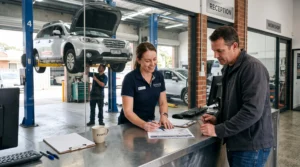
Your car needs a service, its brakes are nearly due, and a warning light has appeared. Three separate bookings might solve those problems, but they could also mean three journeys, three sets of arrangements and several days without reliable transport. For drivers balancing work, school runs and family commitments, the disruption can cost more than the repairs themselves.
One-stop automotive servicing brings diagnostics, scheduled maintenance, parts sourcing and repair coordination together under one accountable provider. The practical advantage is fewer handovers, better opportunities to combine jobs and a clearer process when something goes wrong.
Can this approach reduce downtime by 30%? Potentially, in an individual situation where several avoidable visits can be eliminated. However, the available evidence does not establish a universal 30% reduction. The figure is best treated as a planning target rather than a guaranteed result.
The most effective approach is to measure actual vehicle unavailability, choose a workshop equipped for the vehicle and coordinate upcoming work without paying prematurely for unnecessary maintenance.
One-stop automotive servicing: what matters most
- Combine compatible maintenance, diagnostics and inspections to reduce separate bookings and unnecessary return visits.
- Choose providers based on first-time repair capability, documented warranties and total downtime—not labour rates alone.
- Keep complete service records and use qualified specialists when vehicle technology makes general servicing insufficient.
- Why Repeat Repairs Happen After 2 Garage Visits for the Same Issue
- How to Vet a ‘Full-Service’ Garage in 15 Minutes Without Knowing Cars
- Dealership Servicing or Independent Service Centre: Which Works Better After 5 Years?
- The Paperwork Mistake That Can Void Coverage After 1 Missed Service Stamp
- When to Bundle Maintenance Jobs to Avoid 2 Extra Garage Trips in 30 Days
- Why Does Lane Assist Switch Off in Heavy Rain Even on a New Car?
- Why Can a Single Van Breakdown Trigger 3 Late Deliveries in One Day?
- When Specialised Maintenance Is Worth It—Even If It Costs 20% More Up Front
Why Repeat Repairs Happen After 2 Garage Visits for the Same Issue
Repeat repairs usually indicate that the original intervention did not fully resolve the fault, that an intermittent problem could not be reproduced, or that a replacement part was unsuitable or defective. A second garage visit is not automatically evidence of poor workmanship. The important step is to identify which explanation applies before authorising more repairs.
Misdiagnosis occurs when a symptom is treated without identifying its underlying cause. Replacing a sensor, for example, may not resolve a warning light triggered by damaged wiring. The appropriate response is to request the diagnostic evidence behind the original recommendation and ask what alternative causes have been investigated.
Intermittent faults are different. A problem occurring only during cold starts or heavy rain may disappear when the vehicle reaches the workshop. Here, detailed observations are often more useful than immediately changing providers.
Finally, an incorrect or defective component can reproduce the original symptom even after an otherwise reasonable diagnosis. The owner should request the replacement part’s identification, specification and warranty details before agreeing to another charge.
Before every appointment, record the following information:
- When the symptom appears: during startup, acceleration, braking or particular weather conditions.
- Vehicle speed, approximate engine temperature and any relevant warning lights.
- Photographs or short recordings, captured safely while stationary or by a passenger.
- Previous diagnostic trouble codes, repair invoices and parts replaced.
- Whether the symptom improved, disappeared temporarily or remained unchanged.
The FTC guidance on choosing an auto repair shop recommends written estimates and completed repair orders identifying the work, replacement parts, labour charges and vehicle mileage. These documents create a useful evidence trail when a repair needs further investigation.
Fragmented servicing introduces another problem: unclear responsibility. One provider diagnoses the fault, another supplies the part and a third installs it. If the repair fails, determining who should investigate or cover the corrective work becomes difficult.
A capable one-stop provider reduces this coordination problem by managing diagnosis, sourcing, installation and follow-up through one contact. That does not eliminate technical uncertainty, but it makes accountability easier to establish.
The strongest potential downtime saving comes from avoiding an entire unnecessary return visit, rather than making a scheduled service marginally quicker.
A reliable repair process starts with traceable decisions. The next challenge is finding a garage that can deliver that process without requiring the driver to become a mechanical expert.
How to Vet a ‘Full-Service’ Garage in 15 Minutes Without Knowing Cars
A driver can conduct a useful 15-minute garage screening by checking technician qualifications, diagnostic capability, subcontracted services, repair guarantees and who manages the job from booking to collection. This is a preliminary assessment, not proof of repair quality. The goal is to eliminate providers whose advertised full-service offering depends on poorly coordinated external workshops.
Start with technician competence. In the United States, Automotive Service Excellence (ASE) certification is a relevant credential. In the United Kingdom, qualifications from the Institute of the Motor Industry (IMI) may help establish competence in specific technical disciplines. Other English-speaking markets have their own professional and industry accreditation systems.
Qualifications should match the actual work. A workshop experienced in routine servicing is not necessarily equipped to diagnose complex transmission electronics, calibrate driver-assistance cameras or repair high-voltage EV systems.
Next, ask whether the provider has appropriate manufacturer-compatible diagnostic equipment, access to technical information and the ability to perform necessary software procedures on your particular model.
Two questions reveal whether the garage is genuinely integrated:
- Which services are completed elsewhere, including wheel alignment, bodywork, windscreen repairs, emissions testing or electronic calibration?
- Who remains responsible for the vehicle if an outsourced job is delayed or a completed repair fails?
Subcontracting is not necessarily a disadvantage. A workshop that books a qualified specialist, manages the appointment and accepts responsibility for coordination may offer a better experience than a garage attempting unfamiliar work in-house.
Online reviews can help identify patterns, especially repeated mentions of unresolved faults, poor communication or successful first-time repairs. In the UK, official MOT history can provide inspection-related context, although it does not measure garage repair quality. In the US, inspection-record availability varies by state.
Your 15-minute garage screening checklist
- Check qualifications: identify the relevant technician certification and record the credential or qualification claimed.
- Confirm vehicle compatibility: ask about experience with your make, model and relevant diagnostic systems; record the response.
- Map subcontracting: obtain a written or emailed list of services handled by external providers.
- Verify accountability: identify the case contact and obtain the applicable parts-and-labour warranty terms.
- Compare appointment costs: record the earliest booking date, expected completion window and whether multiple jobs can be completed together.
A low hourly rate can be misleading if it comes with a long booking delay, repeated journeys and separate appointments for related work. Ask for an estimated completion date, not just a labour quotation.
Once a garage passes these checks, its suitability still depends on the vehicle’s age, manufacturer systems and remaining warranty obligations.
Dealership Servicing or Independent Service Centre: Which Works Better After 5 Years?
For a vehicle more than five years old, neither dealership servicing nor an independent service centre is automatically better. The practical decision depends on parts availability, diagnostic access, technician competence, booking delays and remaining coverage. A well-equipped independent may offer convenient routine maintenance, while a dealership may be better positioned to resolve certain manufacturer-specific problems.
Vehicle age changes the decision because manufacturer warranty coverage may have ended, while extended warranties or service contracts can remain active. Five years is a useful comparison point, not a universal warranty expiry date.
The following decision grid distinguishes typical considerations from guarantees. Actual availability varies by provider, manufacturer and location.
| Decision factor | Dealership | Independent service centre |
|---|---|---|
| Routine maintenance | Uses brand-specific procedures and systems | Often suitable when specifications and equipment match |
| Manufacturer-specific diagnostics | Usually has direct brand-specific systems and support | Capability depends on software access, equipment and training |
| Parts availability | May stock common manufacturer-specific components | May source parts from multiple channels but need special orders |
| Booking convenience | Depends on local workshop capacity | May offer more flexible scheduling |
| Service history | May integrate with manufacturer records | Requires dependable invoices and compatible digital records |
| EV and hybrid repairs | Depends on appropriately trained technicians | Requires verified system-specific competence |
Dealerships may have specialised parts available while requiring advance booking. Independent garages may schedule sooner but need time to obtain a proprietary component. Neither pattern should be assumed without checking the actual providers.
Complete service history also matters for resale. Buyers can inspect a consistent record of maintenance, replacement parts and mileage regardless of which type of workshop carried out the work. The value of that record depends on its credibility and the vehicle’s condition; a dealership stamp alone does not establish that a car is mechanically sound.
Software-dependent vehicles complicate the traditional comparison. A garage may handle mechanical servicing correctly while lacking access to particular manufacturer diagnostic functions, programming procedures or software-related repairs.
For EVs and hybrids, distinguish routine maintenance from work involving high-voltage components. The latter requires appropriate competence and safety procedures, which can be found at qualified dealerships or specialist independent facilities.
A useful approach is to retain one primary servicing provider and arrange manufacturer-specific intervention when necessary. The primary provider should coordinate the work rather than leaving the driver to manage disconnected referrals.
Whichever option you choose, the most expensive administrative mistake may be failing to preserve evidence that the required maintenance was completed.
The Paperwork Mistake That Can Void Coverage After 1 Missed Service Stamp
A missing service stamp does not automatically void a vehicle warranty. The consequences depend on the type of coverage, its written conditions and whether the owner can demonstrate that required maintenance was completed correctly. Manufacturer warranties, extended warranties and used-car service agreements may apply different rules. Missing documentation becomes risky when it prevents the owner from proving compliance.
In the United States, the Magnuson-Moss Warranty Act provides important protections concerning warranty-related restrictions. The FTC explanation of auto warranties and service contracts clarifies that independent routine servicing does not automatically invalidate a manufacturer’s warranty.
However, coverage for damage caused by defective parts or improper installation may be denied when the required causal relationship is established. Separately purchased service contracts may impose further restrictions, including approved repairers or prior authorisation.
In the UK, motor vehicle competition rules also provide protections relevant to independent servicing, subject to their scope and applicable warranty conditions. Rights and contractual requirements differ across Australia, Canada, New Zealand and other English-speaking markets, so US and UK rules should not be applied universally.
The safest practical approach is to maintain a complete evidence trail for every service:
- Date of the appointment and recorded odometer mileage.
- Itemised work performed against the applicable maintenance schedule.
- Parts and fluids used, including relevant specifications.
- Workshop identity, invoice and payment confirmation.
- Any associated inspection findings, fault codes or recommendations.
Store photographs or digital copies of the documents in a folder organised by service date. Keep the originals when possible, and ask the workshop to update the manufacturer’s digital service record where supported.
Detailed invoices may help resolve a missing-stamp dispute, but they are not guaranteed substitutes under every contract. Before relying on alternative records, ask the warranty provider what evidence it accepts.
If a claim is rejected, request the reason in writing and identify the specific contractual condition allegedly breached. Compare that condition with the actual service history, then submit missing invoices, parts records or workshop confirmation where relevant.
If the dispute remains unresolved, consider the applicable complaint process, consumer protection authority or independent dispute-resolution scheme in the relevant jurisdiction.
One-stop providers can simplify this process by maintaining a consistent history of maintenance and repairs, but responsibility for retaining accessible records still belongs with the vehicle owner.
Reliable records have another operational benefit: they show which maintenance tasks are approaching, making it easier to combine work before separate appointments become necessary.
When to Bundle Maintenance Jobs to Avoid 2 Extra Garage Trips in 30 Days
Bundling maintenance is worthwhile when several jobs can be completed during one scheduled workshop visit without compromising safety or replacing components unnecessarily early. The greatest benefits come from compatible operations, shared access requirements and coordinated inspections. Two extra journeys within 30 days may be avoidable if upcoming work is identified before the first appointment.
The starting point is labour overlap. Certain repairs require removal of components that another scheduled job also needs removed. When both jobs are genuinely due, combining them may reduce duplicated dismantling and reassembly.
For example, on vehicles where the timing belt drives the water pump, replacing both during a suitably scheduled repair can avoid repeating substantial access work later. The decision still depends on the engine design and the manufacturer’s recommendations.
Other jobs may offer scheduling benefits rather than significant shared labour. Brake-pad work and brake-fluid replacement can sometimes be performed during the same workshop visit, although they involve distinct procedures. A cabin-filter replacement does not necessarily share meaningful access work with dashboard repairs.
Ask the garage to distinguish labour savings from simple appointment consolidation before approving a package.
To build a practical maintenance bundle, review the manufacturer’s service schedule and every known advisory item for the next 12 months. Separate essential work, condition-dependent repairs and discretionary maintenance.
Then compare those items with planned inspections, tyre changes and existing garage appointments. Depending on local requirements, an annual inspection or seasonal tyre change may provide an opportunity to coordinate unrelated but due maintenance.
| Job combination | Possible advantage | Important condition |
|---|---|---|
| Timing belt and water pump | Potential shared access labour | Engine layout and replacement intervals must justify both jobs |
| Brake pads and brake-fluid service | One scheduled visit | Each operation must be independently due or necessary |
| Tyres and wheel alignment | Coordinated appointment | Alignment must be justified by measurements or vehicle condition |
| Routine service and required inspection | Fewer bookings and journeys | Workshop must be authorised where inspections require approval |
Bundling becomes counterproductive when components with substantial remaining service life are replaced solely to create a convenient package. It can also extend a booking beyond what the driver’s schedule allows.
A one-stop garage should therefore offer a written work plan identifying what must be done now, what can be brought forward sensibly and what should remain scheduled for later.
Hypothetical example: coordinating three maintenance needs
A driver has a routine service booked, an inspection approaching and tyres that require assessment. Instead of making three independent appointments, the driver asks one provider to check inspection availability, tyre condition and parts requirements before confirming the booking.
If all work is appropriate and can be coordinated, the driver may complete it during one visit. This hypothetical scenario illustrates how two extra journeys might be avoided; it does not demonstrate a measured reduction in downtime or guarantee that every job can be completed together.
Efficient maintenance is not limited to mechanical parts. Modern driver-assistance systems create another category of service requirement that can be overlooked until a warning appears.
Why Does Lane Assist Switch Off in Heavy Rain Even on a New Car?
Lane assistance may switch off in heavy rain because its forward-facing camera cannot reliably detect lane markings through rainfall, spray or reduced visibility. Depending on the vehicle, the system may warn the driver, limit functionality or deactivate. This can be expected behaviour, but not every shutdown is harmless, and degraded performance can occur without any warning.
Lane-keeping systems generally rely on camera images to identify road markings and determine the vehicle’s position. Some broader driver-assistance functions also use radar or other sensors, but radar does not eliminate the camera’s need for visible lane boundaries.
Heavy rain reduces image contrast. Spray from surrounding vehicles, condensation, dirt near the camera and worn road markings can make the lane difficult to identify. A new vehicle is not immune to these limitations.
Controlled testing by AAA illustrates why reduced visibility matters.
69%
In AAA closed-course tests using simulated rainfall, vehicles with lane keeping assistance crossed lane markers in 69% of the reported test runs. This describes the tested vehicles and experimental conditions—not the real-world probability of lane assistance switching off.
Importantly, the tested conditions did not produce system deactivation warnings. Poor performance and automatic disengagement are therefore different risks. Drivers should not interpret the absence of an alert as proof that lane assistance is operating effectively.
A temporary unavailable message during poor visibility may be consistent with system limitations. However, faults deserve investigation when they persist after conditions improve, recur in clear weather or affect multiple camera-dependent functions.
Practical checks include cleaning the windscreen around the camera housing, removing condensation and consulting the vehicle manual. If warnings persist, arrange professional diagnostics rather than attempting sensor adjustment.
Camera calibration is an important maintenance consideration after windscreen replacement, camera removal or work that changes sensor alignment. Some procedures require manufacturer-specific equipment, controlled workshop conditions or specialist training.
Not every small windscreen chip repair automatically requires recalibration. The correct requirement depends on the vehicle, repair location, manufacturer procedure and whether relevant components were disturbed.
Before booking glass work, ask whether the chosen one-stop provider can perform or coordinate any necessary calibration and verify system operation afterward.
Neither abandoning driver assistance entirely nor relying on it beyond its operating limits is a sensible response. The driver remains responsible for steering and monitoring road conditions whenever the system is unavailable or unreliable.
For private drivers, these precautions protect safety and prevent unnecessary diagnostic visits. For commercial operators, an unresolved vehicle problem can also disrupt an entire day’s business.
Why Can a Single Van Breakdown Trigger 3 Late Deliveries in One Day?
A single van breakdown can cause several late deliveries because one immobilised vehicle removes capacity from an interconnected delivery schedule. Parcels must be reassigned, replacement transport arranged and downstream delivery windows adjusted. Three late deliveries are a plausible scenario for a small operator, although the actual number depends on route density, spare capacity and the duration of the breakdown.
A small delivery operation often has limited redundancy. If a van fails during a route, its remaining stops cannot simply disappear. Other drivers may need to divert from their own schedules, increasing journey time and delaying previously planned commitments.
For a self-employed courier or small business, the financial impact extends beyond the repair invoice.
Total downtime cost may include:
- Lost or delayed delivery revenue.
- Contractual penalties, refunds or customer compensation where applicable.
- Extra driver hours and route redistribution.
- Replacement transport, towing or temporary vehicle hire.
- Potential loss of repeat customers following unreliable service.
A useful calculation separates expenses caused by the breakdown from ordinary operating costs.
Downtime cost = lost contribution from disrupted work + incremental recovery expenses + applicable penalties and compensation.
Lost contribution means revenue that cannot be recovered, less the variable costs avoided by not completing that work. This avoids overstating the cost by treating every missed sales amount as pure profit loss.
Hypothetical example: one van, three disrupted commitments
A small delivery business operates a van with several scheduled stops. The vehicle breaks down before completing its route, leaving three time-sensitive deliveries outstanding.
The operator moves one delivery to another driver, hires backup transport for the next and reschedules the third. Each intervention creates a different cost or service consequence. The scenario illustrates the possible cascade from one failure; it is not a documented fleet study or evidence that every breakdown causes three late deliveries.
Small operators can reduce this exposure through a practical mitigation hierarchy. First, schedule preventive maintenance during predictable off-peak delivery periods and address safety-critical defects promptly.
Second, establish a breakdown-day plan that identifies a backup courier, rental option or approved recovery provider. Confirm availability and contractual conditions before an emergency occurs.
Third, agree on a maintenance relationship with a garage that understands commercial vehicle scheduling. Priority diagnosis, suitable parts sourcing and coordinated repairs may be more valuable than a marginally cheaper hourly rate.
A one-stop service arrangement also reduces administrative handovers when a van requires inspection, mechanical repairs, tyres and follow-up work. Nevertheless, a single garage should not become an operational single point of failure: maintain a credible alternative for urgent repairs.
For business vehicles, compare quotes using the total expected time off the road. A slower repair can become more expensive even when its invoice is lower.
The same cost comparison is useful for private drivers with demanding schedules. It becomes especially important when deciding whether specialist expertise warrants a higher initial quotation.
Key takeaways before choosing a specialist
- Compare repair options by expected vehicle unavailability and the consequences of a failed first attempt, not just their quoted prices.
- Verify whether the repair requires manufacturer-specific software, safety credentials or calibrated equipment that a general workshop may lack.
- Retain a primary service contact, but confirm who performs specialised work, who guarantees it and how follow-up problems are handled.
When Specialised Maintenance Is Worth It—Even If It Costs 20% More Up Front
Specialised automotive maintenance can justify a 20% higher upfront quote when the specialist has relevant capabilities that reduce diagnostic uncertainty, repeat visits or safety risks. The premium is not automatically worthwhile. Drivers should compare the complete expected cost of each option, including possible additional appointments, towing, transport disruption and the warranty conditions attached to the repair.
A specialist’s main advantage is not the title itself. It is access to knowledge, equipment and procedures needed for a specific vehicle system.
Three situations make specialist capability particularly relevant.
- High-voltage EV and hybrid repairs: work involving high-voltage components requires appropriate safety training, equipment and technical competence.
- Advanced driver-assistance calibration: camera or sensor work may require controlled measurements, dedicated targets and manufacturer-compatible procedures.
- Manufacturer-specific electronic faults: proprietary diagnostic systems and software functions may be necessary to identify or resolve particular failures.
For example, the UK Institute of the Motor Industry publishes a dedicated Level 4 qualification for diagnosis, testing and repair of electric and hybrid vehicle high-voltage systems. Its scope helps identify the type of specialised competence worth investigating. Holding a qualification is not, by itself, evidence that every repair will be successful.
A practical cost comparison should account for the likelihood and consequences of further work rather than assume a specialist always fixes problems on the first attempt.
| Decision factor | Specialist premium more defensible | General service provider often sufficient |
|---|---|---|
| Repair complexity | Unusual electronic, high-voltage or calibration work | Standardised routine maintenance |
| Diagnostic equipment | System-specific tools are essential | Appropriate tools already available locally |
| Technical credentials | Verified competence directly matches the repair | No specialised qualification is necessary for the task |
| Repeat-repair exposure | Failure would cause substantial additional downtime | Low-complexity work with clear, established procedures |
| Repair warranty | Clear coverage and accountable follow-up | Comparable protection already offered by generalist |
Consider an explicitly hypothetical comparison: a general garage quotes £500 and a specialist quotes £600 for the same repair, a 20% premium. The specialist option is economically attractive only if its additional £100 is outweighed by a credible reduction in expected repeat-repair costs, disruption or other relevant risks. The figures illustrate the decision method, not typical market prices.
Credentials must also be relevant. A qualification in EV high-voltage diagnostics does not establish competence in every manufacturer software system, and a garage advertising ADAS services may still subcontract calibration.
Before accepting the premium, obtain a breakdown of the work, confirm who performs it and compare parts-and-labour warranties. Check any applicable manufacturer warranty or service-contract requirements before authorising non-routine repairs.
For straightforward oil changes, common brake repairs and other standardised maintenance, paying more solely for specialist branding is difficult to justify when a competent general garage can complete the work correctly.
The most practical arrangement may be an integrated service provider that manages routine maintenance while using verified specialists for genuinely complex jobs. This preserves one accountable point of contact without assuming every technician must be an expert in every system.
For your next booking, gather the vehicle’s service history, list upcoming maintenance and unresolved symptoms, then request one coordinated quote showing available dates, subcontracted work, warranty coverage and expected vehicle unavailability. Compare that plan with your current servicing arrangement. Reducing avoidable journeys and uncertain handovers—not purchasing the largest service package—is the practical objective.
How should drivers measure whether one-stop servicing actually reduces downtime?
Record vehicle-unavailable hours, separate garage visits, booking delays and unexpected return appointments over a consistent period. Compare those figures after switching to a consolidated service arrangement, accounting for differences in repair complexity. A 30% reduction should only be claimed for a particular situation when its measured results support that figure.
Does a one-stop automotive package have to include roadside assistance?
No. One-stop servicing describes a coordinated service model, not a standardised package. Roadside recovery, replacement vehicles, tyres, inspections and repairs may be included, optional or excluded. Ask for a written description of services, limits, exclusions and the parties responsible for providing them.
Can one garage maintain vehicles from several different manufacturers?
Yes, provided the workshop has the necessary equipment, technical information and competent staff for the required work. Routine servicing across multiple brands may be straightforward, while software programming, high-voltage repairs and advanced calibration can require additional resources. Verify capabilities for each vehicle rather than assuming universal coverage.
Is a maintenance subscription better than paying for individual services?
It depends on which services are included, how frequently the vehicle needs maintenance and whether the subscription improves scheduling or reduces administrative effort. Compare the total contract cost against realistically expected servicing needs. Check exclusions, cancellation terms, mileage restrictions and whether unused services expire. Predictable payments do not necessarily mean lower overall expenditure.
What should drivers do if a one-stop garage cannot finish every repair in one appointment?
Request a revised completion estimate, a written explanation of the delay and confirmation of who is coordinating outstanding parts or specialist work. Ask whether the vehicle can be safely returned temporarily and whether alternative transport is available. An effective one-stop provider does not promise that every job will finish immediately; it manages unavoidable delays transparently and keeps responsibility clear.