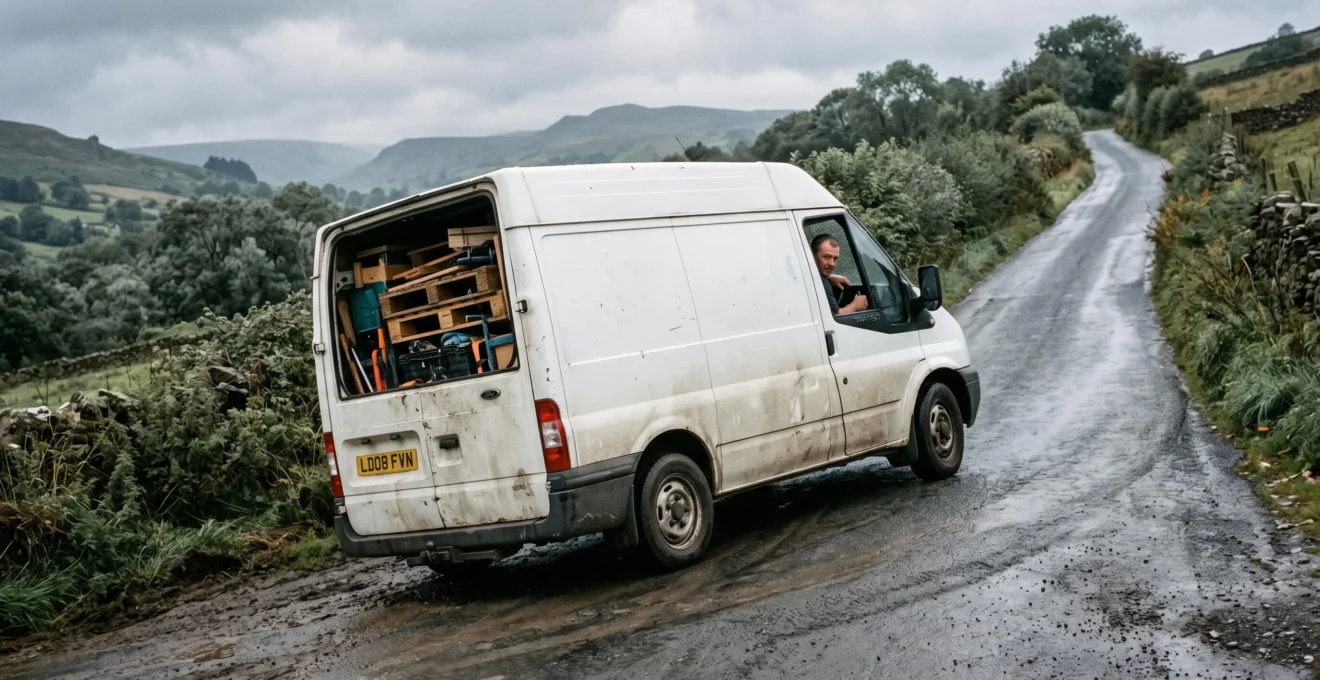
A vehicle can carry its advertised payload legally and still be unsuitable for the work. A heavily loaded van may struggle on steep gradients, an electric delivery vehicle may lack sufficient range in winter, and a high-capacity van may be unable to enter a customer’s loading bay. The problem is not necessarily the vehicle’s quality. It is the mismatch between its specifications and the actual delivery operation.
For owner-drivers and fleets operating 20–60 vehicles, choosing the wrong class creates recurring costs: additional journeys, inefficient loading, accelerated component wear, missed delivery windows and potential enforcement penalties.
The correct vehicle specification starts with the workload, not the vehicle catalogue. Establish the maximum loaded weight, axle distribution, cargo volume, route gradients, access restrictions, delivery frequency and realistic energy requirements. Then compare vehicles against those constraints using their individual configurations rather than headline manufacturer figures.
This approach works whether the operation requires a passenger car for compact city deliveries, a medium-sized diesel van for mixed routes or an electric van serving a predictable urban circuit.
Vehicle selection: the essential decisions
- Calculate usable payload: Account for the actual vehicle weight, occupants, fuel, fittings and equipment before accepting a manufacturer’s advertised capacity.
- Validate the complete route: Check hills, road surfaces, physical access, daily distance, charging opportunities and delivery-site restrictions.
- Select for operational efficiency: Match cargo weight and volume to drop density, then reassess the specification whenever the workload changes.
- Why Does a Van Struggle on Hills Even When You’re « Under the Payload Limit »?
- How to Calculate Real Payload in 5 Minutes — Including Driver and Fuel Weight
- Diesel or EV: Which Handles Heavy Stop-Start Loads Better on 60-Mile Routes?
- The Route Constraint People Forget That Makes a « Perfect » Van Useless
- When Should You Re-Spec Your Vehicle After a Contract Change to Avoid Undercapacity?
- Why Does Your Car Feel Unstable After Loading 200 lb of Goods in the Boot?
- Why Can a Small Car Complete More Drops in City Centres Than a Van?
- How to Use a Small Car for Deliveries Without Running Out of Space by Midday
Why Does a Van Struggle on Hills Even When You’re « Under the Payload Limit »?
A van can remain below its maximum permitted weight yet struggle uphill because legal payload capacity does not guarantee adequate climbing performance. Heavy loads increase the force required to climb, while engine output, gearbox ratios, available traction and axle weight distribution determine how effectively the vehicle responds. A van suited to flat roads may therefore perform poorly on steep delivery routes.
Gross vehicle weight (GVW) is a legal ceiling, not a performance benchmark. The maximum permitted loaded weight includes the vehicle, fuel, driver, passengers and cargo. Staying below that limit establishes only part of the operating requirement: individual axle limits must also be respected.
The UK’s Driver and Vehicle Standards Agency explains these obligations in its DVSA guidance on van weight limits and loading. The guidance also warns that overloading a vehicle or its individual axles affects safety and performance.
On a gradient, gravity creates additional resistance proportional to vehicle mass and road steepness. Increased weight consequently demands more tractive force. The vehicle’s engine or motor must deliver that force through a gearbox and tyres capable of maintaining grip.
Drivetrain layout matters. On a front-wheel-drive van, weight transfer uphill can reduce the proportion of load carried by the driven front axle, potentially limiting traction on wet or slippery surfaces. A rear-wheel-drive layout may benefit from additional rear-axle loading, but its performance still depends on tyre grip, axle loading, gearing and the particular vehicle design.
Engine and gearbox specifications are another common source of mismatch. Two vans with identical bodies and payload ratings can offer different power outputs, torque characteristics and transmission ratios. The lowest-output engine may be economical on level roads but less suitable for repeated climbs near maximum operating weight.
Before deciding that the van needs a more powerful engine, establish whether the existing vehicle is loaded correctly. Weigh it in its working configuration, obtain individual axle readings and compare them with the manufacturer’s permitted axle weights. Moving cargo forward or redistributing it may improve balance, provided no axle limit is exceeded and the load remains properly restrained.
A useful pre-purchase assessment includes the route’s steepest sustained climb, typical departure weight, wet-weather traction requirements and whether the vehicle can restart safely on a hill.
The next question is whether the load itself has been calculated accurately. Brochure payload figures can conceal meaningful differences between seemingly identical vehicles.
How to Calculate Real Payload in 5 Minutes — Including Driver and Fuel Weight
Real usable payload is the weight remaining after subtracting the vehicle’s actual operating weight from its permitted gross weight. That operating weight must account for the driver, passengers, fuel, fitted equipment and permanent modifications wherever they are not already included in the stated kerb weight. The calculation should use the individual vehicle, not the lightest configuration advertised in a brochure.
The central equation is straightforward:
Usable payload = permitted GVW − actual vehicle weight before loading delivery cargo.
Alternatively, begin with a documented kerb weight and subtract every additional item not included in that figure. Kerb-weight conventions differ between manufacturers and markets: some figures include a driver and a specified fuel level, while others do not. Avoid counting the same weight twice.
A practical five-minute estimate follows these steps:
- Find the vehicle’s permitted GVW on its identification plate and confirm the relevant registration or manufacturer documentation.
- Establish its actual kerb weight, including factory options and conversions. Prefer a recent weighbridge measurement when available.
- Add any operating weights not already included: driver, passengers, tools, racking, shelving, bulkheads and other permanent equipment.
- Account for fuel not included in the starting weight. Diesel or petrol can be estimated at roughly 0.75–0.85 kg per litre, depending on the fuel. For an EV, the installed traction battery is already part of vehicle weight.
- Subtract the resulting operating weight from GVW and compare the remainder with the heaviest expected delivery load.
Hypothetical example: checking usable payload
Consider a van with a permitted GVW of 3,500 kg and a hypothetical measured weight of 2,450 kg before the driver, tools and delivery cargo are added. Assume that the measurement already includes the normal fuel load and permanent fittings.
If the driver weighs 85 kg and the additional tools weigh 65 kg, the usable payload is 3,500 − 2,450 − 85 − 65 = 900 kg. A proposed 850 kg cargo load would leave 50 kg below the GVW ceiling, but individual axle weights would still need verification. This is an illustrative calculation, not a model-specific carrying-capacity claim.
The common purchasing mistake is treating advertised maximum payload as a guaranteed allowance. Optional air conditioning, tow bars, internal partitions, racking and body conversions can change the usable capacity considerably.
For a used van or converted vehicle, request the individual Certificate of Conformity where available, check modification records and obtain a current weighbridge ticket. The vehicle’s recorded mass may differ from another example of the same model and year.
Keep a working margin for load variation and foreseeable changes in the contract. There is no universally appropriate percentage: the allowance should reflect the quality of load-weight data, the operating conditions and the consequences of exceeding capacity.
Once the weight requirement is established, the next decision concerns how the vehicle will move that load efficiently over the actual route.
Diesel or EV: Which Handles Heavy Stop-Start Loads Better on 60-Mile Routes?
An electric van can be well suited to a predictable 60-mile stop-start route because electric motors provide strong low-speed torque and regenerative braking can recover energy during deceleration. Diesel remains a practical alternative where charging is unavailable, daily distance changes substantially or detours are frequent. The correct choice depends on verified loaded range, charging time, terrain and operating flexibility.
A 60-mile route is approximately 97 km, but distance alone does not establish powertrain suitability. The relevant duty cycle includes the cargo weight at departure, number of stops, vehicle speed, gradients, weather and energy consumed by heating or cooling.
Electric motors generally provide responsive acceleration from low speed, which can improve drivability in repeated stop-start operation. Regenerative braking is also advantageous on urban routes where deceleration occurs frequently.
However, regenerative braking cannot recover all the energy used for acceleration, and climbing gradients or carrying additional mass increases energy demand. The U.S. Department of Energy information on electric-vehicle range identifies heavy loads, significant inclines and extreme temperatures among the factors that can reduce range.
Certified EV range figures should therefore be treated as standardised comparison values rather than guaranteed working distances. Additional payload can reduce real-world range, but the size of that reduction depends on the vehicle and duty cycle. A universal percentage reduction, or a disproportionately large decline near maximum payload, cannot be assumed without vehicle-specific evidence.
For diesel vans, rapid refuelling and the established availability of fuel can simplify irregular operations. Nevertheless, diesel consumption also increases under demanding conditions, and no powertrain guarantees a fixed range regardless of load, traffic or terrain.
The following decision grid helps identify which vehicle deserves closer testing.
| Operating condition | Electric van | Diesel van |
|---|---|---|
| Predictable 60-mile route | Strong candidate if verified loaded range covers the route and reserve | Suitable, particularly where charging cannot be arranged |
| Frequent urban stops | Benefits from regenerative braking and responsive low-speed torque | Can perform the route but may consume more fuel in stop-start operation |
| Heavy cargo and steep gradients | Requires loaded-range and grade-performance testing | Requires adequate engine, gearbox and cooling specifications |
| Cold weather | Assess heating demand, battery conditions and realistic range | Check cold-weather operation and fuel consumption |
| Unpredictable additional mileage | Requires reliable charging options and sufficient energy reserve | May offer greater operational flexibility through rapid refuelling |
| Overnight depot parking | Attractive when charging capacity and dwell time are sufficient | Does not require charging infrastructure |
The decisive EV test is a representative loaded route. Record departure and arrival battery levels, energy consumption, weather, traffic conditions and any charging required. Repeat testing under conditions that reflect the operation’s demanding days, not just its easiest shifts.
Charging capability must also support the full fleet. The available overnight window, charger power, simultaneous charging demand and actual energy needed between shifts determine whether vehicles can reliably depart on schedule.
A diesel-versus-EV comparison should ultimately include operating cost per completed route, expected downtime, charging or refuelling arrangements and the consequences of an unplanned additional journey.
Even a vehicle with adequate payload and dependable range may still fail the operation if it cannot physically reach the delivery point.
The Route Constraint People Forget That Makes a « Perfect » Van Useless
Physical access is often the overlooked constraint in vehicle selection. A van may offer sufficient payload, appropriate cargo volume and adequate range but still be excluded by a low entrance, narrow street, weight-restricted bridge or undersized loading bay. Before purchasing, operators must establish whether the vehicle can safely reach and service every required delivery location.
The distinction is between the vehicle the load requires and the vehicle the route permits. These are not always the same.
Common restrictions include car-park height barriers, underground loading docks, narrow access roads, bridge weight limits, turning-space limitations and customer-specific delivery requirements. Vehicle mirrors, roof-mounted equipment, wheelbase and turning circle can matter as much as basic body dimensions.
The UK’s Health and Safety Executive addresses these considerations in its HSE workplace guidance on vehicles and route restrictions. Its guidance recommends assessing vehicle dimensions, clearances, weight, manoeuvrability and the suitability of workplace traffic routes.
Access problems become particularly expensive when discovered after a contract begins. A van unable to enter a loading area may require goods to be carried farther by hand, transferred to another vehicle or delivered through an alternative entrance.
These constraints affect both direct costs and service reliability. The vehicle may technically complete the journey but lose enough time at a difficult site to disrupt subsequent delivery windows.
A pre-purchase route audit should use actual delivery addresses, not an idealised route generated solely from distance or journey time. Customer premises may impose restrictions that are absent from general road mapping.
Five checks before approving a vehicle specification
- Document the heaviest working load: Produce a load sheet showing cargo, occupants, equipment and calculated usable payload.
- Verify vehicle and axle weights: Obtain a weighbridge ticket or equivalent reliable measurement and compare the results with the vehicle’s permitted limits.
- Audit physical access: Create a route register recording confirmed height, width, weight and manoeuvring restrictions at each constrained location.
- Test demanding operating conditions: Produce a route-test record covering gradients, traction, loaded range or fuel consumption and delivery access.
- Record the selection decision: Create a specification comparison showing which candidate vehicles satisfy every mandatory load, access and operating requirement.
If the preferred van cannot access a particular stop, compare three possible responses: change the route or access arrangement, divide the delivery into smaller trips, or select a vehicle with different dimensions.
Downsizing is not automatically the safest answer. A smaller van that fits the entrance but cannot legally carry the cargo merely replaces an access problem with a loading problem.
The selected configuration should also remain suitable as contracts evolve. A route that works today may exceed the vehicle’s operating limits after a change in delivery demand.
When Should You Re-Spec Your Vehicle After a Contract Change to Avoid Undercapacity?
A vehicle should be re-evaluated whenever a contract materially changes cargo weight, volume, daily distance, route characteristics or delivery frequency. Reassessment should occur before the revised workload becomes routine, not after suspension problems, repeated additional trips or missed deliveries appear. The objective is to determine whether the existing vehicle still operates within legal limits and practical performance capacity.
For a small fleet, contract changes can gradually alter the workload without producing an obvious warning. Additional drops, heavier parcels or new delivery zones may make the original vehicle specification inefficient even though the vehicle itself remains mechanically sound.
The key monitoring variables are:
- Maximum cargo weight and actual axle loading on representative routes.
- Daily cargo volume, including bulky items and packaging.
- Number of delivery stops and average distance between them.
- Daily mileage, detours and time spent accessing customer sites.
- Fuel consumption or EV energy use under the revised load.
- Frequency of overflow journeys, missed delivery windows and capacity-related disruptions.
Compare current manifests and measured load weights with the calculated usable payload of the actual vehicle. A portable axle-weighing system may support operational monitoring when used correctly, but measurements must be sufficiently reliable for the decisions being made.
Repeated operation at or beyond permitted weight limits is not a sustainable capacity strategy. Excessive loading can affect handling and braking, increase demands on tyres and suspension, and create enforcement exposure.
In England, Scotland and Wales, the DVSA guidance already discussed identifies enforcement consequences for exceeding permitted vehicle or axle weights. Rules and penalties differ across English-speaking countries, so operators must verify the requirements in their jurisdiction.
An overloaded vehicle can also create insurance and liability complications after an incident. However, whether a policy responds depends on its terms, the facts of the event and applicable law. Overloading should not be described as automatically invalidating every insurance policy.
Before replacing a vehicle, assess graduated responses. Occasional overflow may be handled through a short-term rental. Routes might be divided differently, departure loads reduced through more frequent depot collections, or delivery requirements renegotiated with the customer.
A permanent move to a higher-capacity class becomes more compelling when compliant loading cannot be maintained through reasonable operational adjustments or when the cost of repeated workarounds becomes unacceptable.
Maintain a contract-change review record connecting each revised demand to the vehicle’s payload, volume, range and access constraints. This makes the eventual replacement decision evidence-based rather than reactive.
The same principle applies below the van category. Passenger cars can be efficient delivery vehicles, but their available carrying capacity and load distribution require equally careful assessment.
Why Does Your Car Feel Unstable After Loading 200 lb of Goods in the Boot?
A car may feel less stable after adding 200 lb of goods because the cargo changes its weight distribution, suspension position and tyre loading. The effect is particularly noticeable when heavy items sit behind the rear axle, where they can increase rear loading while reducing front-axle load. Whether the car remains safe depends on its actual limits, cargo position and driving conditions.
Two hundred pounds is approximately 91 kg. That amount is not inherently excessive for every passenger car, but it must be considered alongside the combined weight of the driver, passengers, other luggage and installed accessories.
Passenger cars are designed to accommodate occupants and luggage within specified limits. Their permitted payload varies considerably by model and configuration, so a universal carrying-capacity assumption is unreliable.
Load position can matter as much as load weight. Cargo placed well behind the rear axle creates a leverage effect that can reduce front-axle loading. This may change steering feel, headlight aim and the way the suspension responds to bumps or braking.
The vehicle’s brakes still have to manage the increased total mass. Front-axle unloading can also affect available front-tyre grip, but the actual change in braking behaviour depends on vehicle design, braking systems, road conditions and how the cargo is positioned.
For safer loading, place heavy items low and as far forward in the boot as practicable, preferably against the rear-seat bulkhead. Prevent movement with appropriate restraints and avoid concentrating loads at the extreme rear.
Check the manufacturer’s permitted vehicle weight, axle ratings and tyre-pressure guidance. Where a full-load tyre-pressure specification is provided, use the appropriate setting for the actual loading condition rather than guessing at an increased pressure.
Rear suspension squat can also raise the headlight beam and create glare for other road users. Check headlight levelling where the vehicle provides an adjustment system.
Unsecured objects present an additional hazard in sudden braking or a collision. Cargo placed in the passenger compartment must not obstruct visibility, controls, occupants or safety systems.
If the car repeatedly feels unstable, confirm its actual loaded weight and have the tyres, suspension and load arrangement checked rather than assuming the symptoms are normal.
A small car is not necessarily the wrong delivery vehicle, however. In dense urban operations, its compact dimensions can provide productivity advantages that a larger van cannot match.
Why Can a Small Car Complete More Drops in City Centres Than a Van?
A small car can complete more deliveries per hour than a van when individual parcels are compact and delivery points are densely clustered. Easier parking, less manoeuvring and shorter kerbside unloading times can reduce the time spent at each stop. However, this advantage disappears when the car requires frequent restocking or cannot safely accommodate the required cargo volume.
Urban delivery efficiency depends on the time required to reach, park at and service each stop. Vehicle carrying capacity is only one part of that calculation.
For small parcels, a compact car may fit into parking spaces that are impractical for a long-wheelbase van. It may also require less room for turning and unloading, particularly where opening large rear cargo doors would obstruct a narrow loading area.
Access rules are location-specific. Certain streets, loading zones or vehicle-restricted areas may favour smaller vehicles, but a car does not automatically qualify for every restricted road or loading bay. Similarly, congestion charges and low-emission-zone requirements depend on local regulations, emissions classification and vehicle type.
The productivity mechanism becomes clearer when stop time is measured.
Hypothetical example: parking time across 40 drops
Suppose a small car saves an average of 45 seconds per delivery through easier parking and unloading compared with a van. Across 40 stops, that would save 1,800 seconds, or 30 minutes.
This is a hypothetical time calculation, not evidence that small cars consistently achieve that advantage. Real performance depends on parking availability, parcel size, building access, restocking requirements and driver procedures.
The important variable is average drop size. A car may outperform a van when deliveries consist of small, lightweight parcels collected from a nearby depot. A van becomes more attractive when orders are larger, bulkier or too numerous to fit into a single compliant car load.
Operating costs must also be assessed per completed delivery rather than per mile alone. Fuel or charging expenditure, parking charges, additional depot returns, driver hours and restricted-zone charges all influence the outcome.
A compact vehicle’s apparent efficiency can disappear if a second journey becomes necessary to deliver goods that a van could have carried in one run.
Measure actual stops per hour, average cargo volume per drop and total daily delivery cost before changing vehicle class. A representative operational trial is more dependable than assuming either vehicle category is inherently faster.
For a small car to remain productive throughout the day, its loading plan must address both cargo volume and permitted weight before the first delivery begins.
Key takeaways before selecting a small delivery car
- Calculate capacity in two dimensions: A load must fit within both the usable cargo space and the remaining permitted payload.
- Plan replenishment deliberately: A scheduled depot return can work for dense routes, but unplanned restocking erodes the benefit of a compact vehicle.
- Recognise the class boundary: If compliant loading or reliable delivery coverage repeatedly requires extra trips, reassess the vehicle class rather than compressing more cargo into the car.
How to Use a Small Car for Deliveries Without Running Out of Space by Midday
A small car can support reliable delivery work when route planning accounts for cargo volume, actual payload and the order in which parcels are unloaded. Measure usable storage space, check the vehicle’s maximum permitted weight and group deliveries into loads that can be carried safely. When daily demand exceeds one trip, schedule a deliberate restock or divide the route rather than improvising midway.
Begin with two separate constraints: the weight the vehicle can legally carry and the physical space available for goods. Passing one test does not guarantee that the load passes the other.
A car may accommodate bulky but lightweight packages by volume while remaining within its mass limit. Conversely, compact dense products may exceed the available payload long before the boot is full.
Measure the usable boot volume and any additional manufacturer-approved cargo space in litres. Account for the dimensions of the actual packages, not just their combined nominal volume: irregular shapes, protective packaging and access to individual parcels reduce practical storage efficiency.
The weight calculation must include the driver, any passengers, delivery equipment and any other items carried. Check the permitted gross weight and relevant axle limits, and verify that cargo can be secured safely.
Never treat available cabin space as unrestricted cargo capacity. Folding rear seats may create additional loading length where the manufacturer permits it, but loads must remain restrained and must not interfere with occupants, visibility, seat-belt systems or vehicle controls.
For an efficient loading routine, organise parcels according to both destination and physical characteristics:
- Group deliveries geographically to reduce unnecessary travel between stops.
- Use appropriately sized, secure stackable containers to limit unused space and cargo movement.
- Separate heavy, compact goods from bulky, lightweight goods when planning individual runs.
- Position items so that unloading earlier deliveries does not destabilise the remaining cargo.
- Schedule a midday depot or micro-hub collection when the full day’s demand exceeds safe one-trip capacity.
The DVSA’s guidance on securing loads in cars and goods vehicles advises positioning car cargo against the boot bulkhead where possible and preventing items from moving. For multi-drop van operations, it also recommends checking that loads remain secure between deliveries. These principles support a loading process based on restraint and reassessment, not simply maximising the number of parcels carried.
For a small fleet, route manifests can make capacity planning repeatable. Record the expected weight and volume of each delivery batch, the planned restocking point and the vehicle assigned to the route.
When a vehicle repeatedly runs out of capacity, compare the cost of an additional collection with the cost of assigning a larger vehicle. Include driver time, travel distance, parking access and whether the larger vehicle can legally and physically service the same stops.
Delivery vehicles also have jurisdiction-specific requirements covering commercial use, insurance, vehicle classification and permitted loading. Operators working across the UK, United States, Canada, Australia or other English-speaking markets should apply the rules relevant to the vehicle’s registration and operating location.
The practical next step is to prepare a specification sheet for the busiest representative delivery day: record load weight, cargo volume, route distance, gradient, access limitations and drop density. Test the proposed vehicle against every constraint, then repeat that assessment whenever the delivery contract changes.
Is a vehicle’s advertised payload the same as the weight it can carry in daily operation?
No. Advertised payload may reflect a particular vehicle configuration and kerb-weight convention. Actual usable payload depends on the individual vehicle’s weight, fitted equipment, occupants and fuel allowance. Always confirm what the published figure includes and compare the fully loaded vehicle with its permitted gross and axle weights.
Can a van be overloaded on one axle while remaining below its gross vehicle weight limit?
Yes. Gross vehicle weight and individual axle limits are separate requirements. Cargo concentrated toward one end of a van can exceed an axle rating even when the total vehicle weight remains below GVW. A suitable weighbridge assessment can identify this problem, after which cargo positioning and restraint should be reviewed.
Should a delivery fleet choose a vehicle with more payload than its heaviest current load?
Some additional capacity may be appropriate to accommodate realistic load variation, future contracts and uncertainty in estimated weights. However, a larger vehicle can introduce access, running-cost and manoeuvrability disadvantages. The appropriate margin should be justified by measured demand and the operational consequences of capacity shortages rather than an arbitrary universal percentage.
Do manufacturers’ electric van range figures account for maximum payload and severe weather?
Standardised range figures are measured under defined test conditions and should not be assumed to represent a fully loaded van operating on steep roads in extreme temperatures. Operators should examine the applicable test method, request relevant loaded-range evidence and conduct representative trials with a suitable energy reserve.
When is renting a larger vehicle preferable to replacing an existing delivery vehicle?
Temporary rental can be reasonable when excess demand is occasional, seasonal or associated with a short contract. Compare rental charges, additional journeys, driver hours and operational disruption with the full cost of acquiring a larger vehicle. Permanent replacement becomes more relevant when the existing vehicle repeatedly cannot meet the workload within its legal and practical limits.