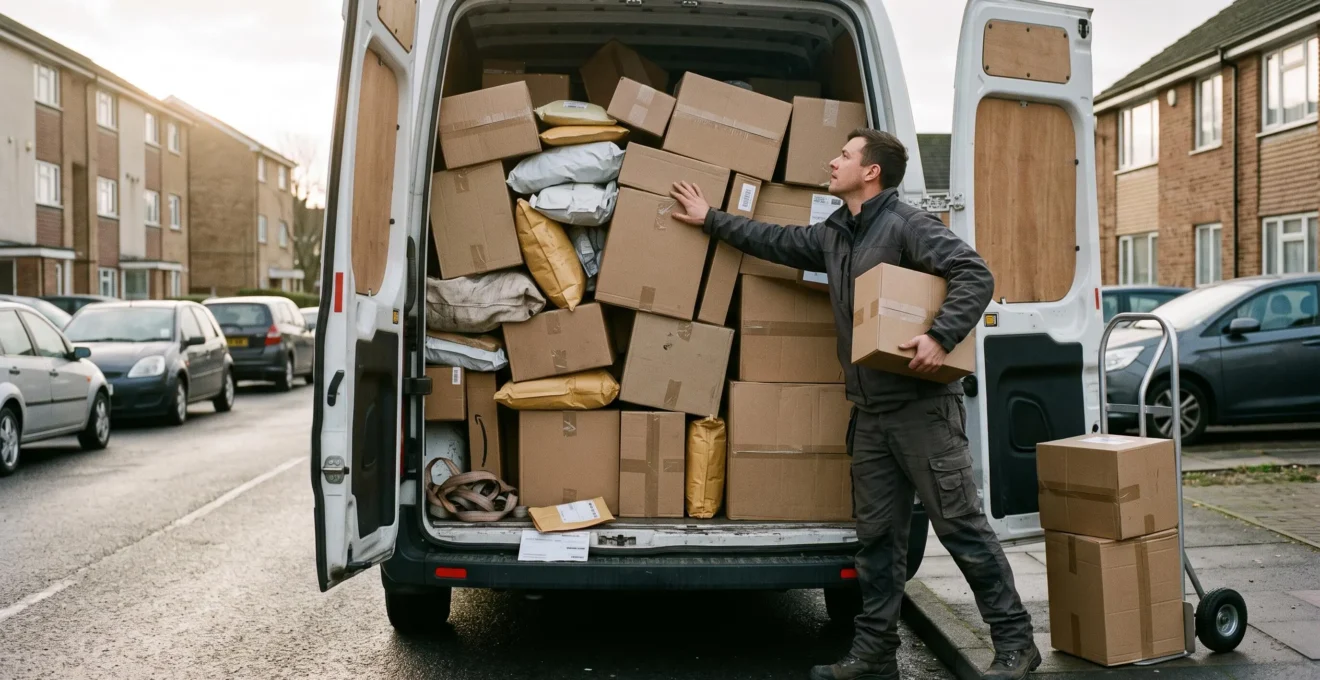
A vehicle that comfortably handled yesterday’s deliveries can become frustratingly cramped when online orders change the number, size and timing of parcels arriving each day. The problem is not necessarily that cars and vans have become smaller. It is that e-commerce has changed the workload expected of them.
Online retail now represents a substantial share of consumer spending. In the United States, the Census Bureau estimated seasonally adjusted e-commerce sales of $340.2 billion in the second quarter of 2026, equivalent to 17.1% of total retail sales. Those figures describe sales value, not parcel counts, but they illustrate the commercial scale behind modern home-delivery operations.
For independent couriers and small retailers, the challenge extends beyond finding room for another box. More deliveries can mean tighter customer expectations, repeated stops, additional loading decisions and less tolerance for unexpected delays. A vehicle might have enough theoretical capacity yet still be impractical for the route it serves.
The solution starts with understanding three connected constraints: usable cargo space, the time required to complete each stop and the operating cost of the vehicle carrying the load.
What changing delivery demand means for your vehicle
- Parcel count alone does not determine vehicle suitability. Package dimensions, loading access and route density matter just as much.
- Better loading and realistic stop-time estimates can recover capacity and reduce delays without immediately upgrading a vehicle.
- When overflow, repeated reloading and missed delivery windows persist, compare vehicle alternatives using actual route costs and workload records.
- Why Has « Delivery Anxiety » Increased as Online Orders Rise?
- How to Estimate Parcel Volume So You Don’t Overfill Your Car by Mid-Shift?
- Personal Car or Hired Van: Which Makes Sense After 25 Parcels a Day?
- The Packing Oversight That Causes Damage Claims Even on Short Trips
- When Should You Switch From Ad-Hoc Deliveries to Planned Routes to Avoid Burnout?
- Why Do 5-Minute Stops Turn Into 15 Minutes on Urban Delivery Routes?
- Panel Van or Pickup: Which Works Better if You Carry Tools and 1 Passenger Daily?
- Which Van Setup Avoids the « Always Full, Always Late » Problem After 30 Days
Why Has « Delivery Anxiety » Increased as Online Orders Rise?
Delivery anxiety increases when the number of parcels, complexity of stops and expectations for timely arrival exceed what a driver’s vehicle and schedule can reliably support. The pressure has two dimensions: physical uncertainty about fitting and protecting the load, and time uncertainty about completing deliveries. When both occur together, even a familiar route becomes difficult to manage.
The growth of online commerce provides important context. The U.S. Census Bureau quarterly e-commerce sales report recorded estimated seasonally adjusted year-over-year e-commerce sales growth of 12.2 % in the second quarter of 2026, compared with 6.7% for total retail sales. These figures cannot establish equivalent growth in parcel numbers or vehicle workloads, and this release was subsequently marked as no longer the most up-to-date estimate.
For couriers, the operational pressure appears when additional orders must fit into an unchanged vehicle or shift. A driver may accept more parcels because demand is available, without checking whether those parcels introduce bulky items, scattered destinations or difficult delivery windows.
17.1%
E-commerce’s estimated share of seasonally adjusted U.S. retail sales in Q2 2026, according to the August 2026 Census Bureau release. This measures retail sales value, not parcel volume or delivery-vehicle utilization.
U.S. Census Bureau, Quarterly Retail E-Commerce Sales, August 18, 2026.
Physical stress develops when the load is difficult to organize, parcels obstruct access or fragile items cannot be protected properly. Time stress emerges when uncertain parking, customer availability and promised delivery windows leave little room for disruption.
These pressures can reinforce each other. An anxious driver may pack extra orders into every available gap to avoid a second collection trip. That decision can slow parcel retrieval, increase handling and raise the risk of selecting the wrong package. Customer complaints then create additional pressure to rush.
A simple weekly diagnostic can reveal the dominant problem. Record parcels left behind because of insufficient space, the number of stops requiring cargo rearrangement, missed delivery windows and the reasons for delays. Frequent overflow points toward a capacity or loading issue. Late arrivals despite comfortable loading suggest a route-timing problem. Both patterns together require a broader operational review.
Once the source is clear, the next question is whether the parcels physically fit in the available cargo space—not simply whether the vehicle looks large enough.
How to Estimate Parcel Volume So You Don’t Overfill Your Car by Mid-Shift?
Estimate parcel volume by measuring the space actually available for freight, categorizing parcels by their packed dimensions and comparing the required loading space with your vehicle’s usable cargo area. Include room for safe access and load restraints rather than relying on advertised capacity alone. Then arrange the parcels around the delivery sequence to expose overloading before departure.
A vehicle manufacturer’s cargo-volume figure describes a geometric capacity under defined conditions. It does not automatically represent the volume usable during a multi-stop route with shelving, equipment, awkward packages or necessary access space.
Start by identifying the cargo dimensions and any areas occupied by fixed equipment. Estimate the space taken by shelves and other obstructions, and reserve room for loading access where required. Do not subtract the driver’s cabin twice if the published cargo figure already excludes it.
Next, use your manifest to categorize items by their actual packed dimensions. A small rigid box, a large carton and a padded envelope do not behave identically when stacked. Multiplying their dimensions gives a starting volume estimate, but irregular shapes and gaps reduce the amount that can fit safely.
Hypothetical example: A driver with 25 parcels could have 20 small cartons and five bulky packages, or 25 consistently compact items. Both routes involve the same parcel count, but their space requirements may be very different. The driver’s own package dimensions determine the result.
Once the available volume has been estimated, organize parcels in reverse delivery order where the vehicle layout permits. Later deliveries go into deeper or less immediately accessible positions, while earlier deliveries remain close to the appropriate door. The arrangement must still respect safe weight distribution, restraint requirements and access.
This method makes a capacity shortfall visible during loading. If the last packages cannot fit without obstructing safe access or displacing secured cargo, the route needs a different loading plan, fewer parcels or additional capacity.
Volume and weight are separate limits. A load of lightweight but bulky products might exhaust cargo space long before reaching the vehicle’s permitted payload. Dense goods may create the opposite problem. Check actual loaded weight and axle limits where relevant; neither a volume calculation nor visual inspection proves that a vehicle is within its weight limits.
Five checks to complete before accepting a full delivery load
- Measure usable cargo space: record the main load-area dimensions and the space occupied by fixed equipment in a vehicle-capacity note.
- Classify today’s packages: group manifest items by measured packed dimensions and produce a parcel-size tally.
- Compare load requirements: create a volume estimate that accounts for stacking gaps, access and restraint space.
- Check permitted weight: compare the planned load with available payload and applicable axle limits, recording any unresolved weight information.
- Validate loading order: arrange parcels for the route, secure them appropriately and sign off a departure checklist identifying any overflow.
Overfilling also creates a less obvious downstream cost: parcels repeatedly moved to reach other deliveries experience additional handling, with more opportunities for packaging damage.
If the load still cannot fit safely after organization improves, the next decision is whether to change the vehicle arrangement rather than continually reduce or divide the route.
Personal Car or Hired Van: Which Makes Sense After 25 Parcels a Day?
After 25 parcels a day, choosing between a personal car and a hired van depends more on package size, delivery geography and reloading frequency than the parcel count itself. A car may remain economical for compact deliveries in a concentrated area. A hired van becomes more attractive when additional capacity prevents costly return trips, reduces handling and supports a more predictable route.
The number 25 should be treated as a decision prompt, not an industry-wide switching threshold. Twenty-five padded envelopes can require far less room than 25 large cartons. Equally, a route with nearby stops and accessible parking imposes different vehicle demands from one involving dispersed addresses and awkward unloading locations.
Before comparing options, distinguish daily vehicle cost from total route cost. Using a personal car can avoid rental charges but still involves fuel, maintenance, depreciation, additional journeys and potentially different insurance arrangements.
A hired van adds a rental commitment, and possibly additional fuel, parking and insurance costs. Its value comes from what it saves elsewhere: collection trips, loading time, driver hours or deliveries that could not otherwise be completed.
The comparison should include the following operating conditions.
| Decision factor | Personal car | Hired van |
|---|---|---|
| Parcel size | Better suited to compact, manageable loads | More suitable when bulk exceeds the car’s safe cargo space |
| Stop density | Can suit concentrated routes with limited loading demands | Useful for larger multi-drop loads, subject to access constraints |
| Reloading | May require additional collection journeys | Can reduce returns if the full load fits safely |
| Daily expense | Existing ownership costs plus incremental commercial use | Rental charges and associated operating costs |
| Utilization | Flexible when courier activity is occasional | More attractive when capacity is used consistently |
| Urban access | Often easier to maneuver in constrained spaces | May face greater parking and access limitations |
A practical break-even comparison calculates the additional daily cost of hiring a van, then subtracts the personal-car costs avoided. Compare that net difference with the value of working time saved, additional feasible deliveries and avoided return journeys, using actual records rather than assumed earnings.
Hypothetical decision: If a car route regularly requires a second depot visit, calculate the extra driving, waiting and loading time. If avoiding those activities is worth more than the net additional van cost, hiring may make financial sense. If demand only spikes occasionally, renting solely for those days may be preferable.
Intermediate solutions deserve scrutiny too. A compatible roof box may offer limited extra storage, but roof-load limits, secure attachment, weather resistance and parcel security must be verified. A trailer adds capacity while introducing towing, parking and licensing considerations. Partial-day van hire may work where rental availability and collection logistics align with the route.
Insurance and loading rules depend on jurisdiction. The UK government guidance on driving and loading vans explains permitted loaded weight, business-use insurance disclosure and relevant towing considerations for van operations in Great Britain. Drivers elsewhere must check their own applicable requirements and policy terms.
Whichever vehicle is selected, protecting the contents remains essential: more cargo space does not automatically mean that parcels are safely packed.
The Packing Oversight That Causes Damage Claims Even on Short Trips
The packing oversight most likely to create avoidable damage exposure is failing to secure parcels because the journey is short. Cargo can move during braking, cornering or evasive maneuvers regardless of how close the destination is. Proper load distribution, gap control and suitable restraints protect packages while reducing risks to vehicle occupants and other road users.
Short urban routes can involve repeated acceleration, braking and turns. A loosely stacked box may shift against another parcel or fall when the cargo door is opened. Fragile packaging becomes particularly vulnerable when heavier objects are placed above it or when items can move freely.
The important distinction is between filling available space and creating a secure load. A vehicle packed to its apparent maximum may leave insufficient room to use the restraints, containers or separation needed to keep cargo stable.
The UK’s Driver and Vehicle Standards Agency addresses these risks in its DVSA guidance on securing loads in cars and vans. It recommends positioning loads against suitable bulkheads where possible, containing smaller items and securing heavier objects. It also emphasizes reassessing the remaining load during multi-drop deliveries.
A practical departure routine can be organized as a short visual and physical inspection:
- Place heavier items low, distribute their weight appropriately and position them against suitable structural support where recommended.
- Keep fragile goods protected from heavier objects, using appropriate packaging and separation.
- Fill or contain unsupported gaps where suitable and apply restraints designed for the vehicle and load.
- Confirm that cargo does not obstruct doors, controls, visibility or required access.
- Recheck the remaining load after deliveries change the way parcels support one another.
This can be used as a brief pre-departure routine, but no universal three-minute inspection duration guarantees safety. Complex or heavy loads may require more detailed checks and specialized equipment.
Damage also has consequences beyond the replacement value of one parcel. A customer discovering a crushed product at the door may raise a dispute. The retailer then has to determine responsibility, process a possible return or refund and address the resulting service complaint. Actual liability depends on contractual arrangements, evidence and applicable consumer law.
Overloading makes prevention harder. When packages are wedged into every gap, drivers may struggle to separate fragile goods, retrieve parcels without disturbing adjacent items or maintain effective restraints as the route progresses.
Once loads are stable, the remaining challenge is scheduling enough time to deliver them without turning every unexpected stop into additional pressure.
When Should You Switch From Ad-Hoc Deliveries to Planned Routes to Avoid Burnout?
Switch from ad-hoc deliveries to planned routes when unpredictable assignments repeatedly cause unpaid extra hours, incompatible delivery commitments, fatigue or inconsistent customer arrival times. The goal is not to eliminate flexibility entirely. It is to establish a manageable workload, group compatible stops and protect enough time for the disruptions that routinely occur during last-mile delivery.
Ad-hoc delivery work can be useful when order volume is low or highly variable. Drivers can accept jobs as opportunities appear, while retailers can arrange occasional deliveries without committing to fixed schedules.
That flexibility becomes more difficult to sustain when each new order changes an already crowded route. Accepting a delivery without checking its location, promised window or space requirement can make several existing commitments harder to meet.
The warning signs are observable rather than subjective:
- Shifts regularly continue beyond the time originally allowed.
- Drivers accept jobs before checking whether they fit the existing route.
- Breaks are repeatedly shortened or missed to compensate for delays.
- Customers receive noticeably inconsistent delivery times.
- Fatigue carries over into subsequent shifts, even when daily parcel counts remain similar.
Planned routes replace some spontaneous decisions with advance commitments. Orders are consolidated geographically, realistic service windows are agreed with senders or platforms, and stops are arranged to reduce unnecessary travel and backtracking.
However, route planning is not simply a mapping exercise. A schedule that looks efficient on screen may be unrealistic if it assumes immediate parking, unrestricted building access and every customer being available.
Build operational slack into the plan. Estimate stop durations using previous route records, allow for known access difficulties and preserve break times. When working with retailers or platforms, negotiate delivery commitments around the route’s realistic capacity rather than accepting every requested time window.
For small retailers, consolidating orders into delivery zones or defined dispatch periods can make driver workloads more predictable. The approach should still reflect the customer service promise: a business cannot silently replace an agreed delivery window with a slower arrangement.
Planned routes can create their own fatigue if the schedule is overcommitted. Fixed stops and strict deadlines leave little protection against traffic, parking restrictions, unexpected returns or unavailable recipients. A robust plan is therefore not the timetable with the shortest theoretical driving time; it is the one that can tolerate ordinary variation without repeatedly extending the working day.
Accurate planning requires a closer look at stop time, because the minutes spent outside the vehicle can matter more than the distance driven between addresses.
Why Do 5-Minute Stops Turn Into 15 Minutes on Urban Delivery Routes?
A delivery stop expected to take five minutes can stretch to fifteen when parking, building access, parcel retrieval and customer interaction are counted alongside the handover. These activities vary considerably by address. In dense urban areas, repeated small delays can create substantial route overruns even when driving distances between customers are short.
The handover itself may be straightforward, but reaching the customer often is not. A driver might spend time locating a permitted parking space, walking from the vehicle, using an intercom, waiting for access or finding a unit without convenient lift access.
Parcel retrieval introduces another delay when the load was arranged without reference to the route. If a box intended for the next stop is buried behind later deliveries, the driver must move other items to reach it. That process may also disturb the remaining cargo and require a new securing check.
Consider a hypothetical 20-stop route. If each stop takes three minutes longer than planned, the additional time is 60 minutes across the route, before considering any secondary effects such as rescheduling or missed connections. This is a calculation illustrating accumulation, not an observed average for delivery drivers.
Urban parking is a measurable operational constraint. Researchers from the University of Washington examined whether real-time curbside availability information could reduce the time delivery drivers spent searching for parking.
Seattle delivery parking experiment
A controlled experiment in a Seattle study area compared delivery activity with and without real-time curbside parking availability information delivered through the OpenPark application.
According to the University of Washington study on delivery-driver parking, access to this information reduced time spent cruising for parking by 27.9% and parking-search distance by 12.4%. The 2022 findings concern parking-search behavior in that study area, not total delivery-stop duration or an expected improvement for every city.
For recurring urban stops, drivers can record reliable loading locations, legal parking options, building-entry instructions and known access restrictions. Retailers can help by collecting accurate customer access information before dispatch.
Where permitted and appropriate, proof-of-delivery photographs or approved electronic confirmations can reduce ambiguity at the doorstep. Personal-data obligations, platform rules and recipient privacy still apply. When a delay becomes unavoidable, notifying customers through the agreed communication channel can prevent unnecessary waiting and failed handovers.
Repeated overruns can encourage drivers to skip breaks or rush later deliveries. That may increase fatigue and opportunities for mistakes, although the exact consequences depend on workload and operating conditions. Reducing stop friction is therefore a service-quality and workload-management measure, not merely an effort to drive faster.
These constraints also influence vehicle selection: a larger cargo area can help with parcel organization, but its size and access points must suit the streets and stops where it will operate.
Panel Van or Pickup: Which Works Better if You Carry Tools and 1 Passenger Daily?
A panel van generally offers better enclosed protection and organized access for tools and parcels, while a pickup can suit bulky equipment and outdoor working conditions. If a driver carries one passenger every day, suitable approved seating is the first requirement. The final choice depends on cab configuration, security, weather exposure, loading access and parking conditions.
Passenger accommodation should be established before comparing cargo volumes. Many panel vans have a front passenger seat, so carrying a driver and one additional passenger does not automatically require a crew van or double-cab pickup.
However, additional occupants, specialist equipment or a need to separate work activities may change the configuration required. Check the actual number of approved seats, occupant restraints and cargo separation. Never treat the load compartment as an informal passenger area.
For valuable tools, an enclosed van provides useful weather protection and the possibility of fitted storage, while tool security still depends on locking systems and operating practices. An open pickup bed typically requires suitable weatherproof and lockable storage solutions.
A pickup may accommodate some awkward or outdoor equipment more conveniently, but exposed cargo requires careful restraint. A covered pickup bed can improve protection, although its usable dimensions, security and access characteristics must be evaluated rather than assumed.
When tools share space with parcels, load separation becomes particularly important. Dense metal equipment should not be allowed to move into fragile packages during braking or cornering. Shelving, suitable containers, approved anchor points and restraints can help organize mixed loads.
Daily delivery frequency matters as much as nominal capacity. Side-door access can be valuable on frequent multi-drop routes, while repeated access to a pickup bed or secured toolbox may involve different handling demands.
Use the following selection grid to match the vehicle to the actual task.
| Daily requirement | Panel van | Pickup |
|---|---|---|
| One passenger | Suitable if an approved passenger seat is fitted | Suitable if an approved passenger seat is fitted |
| Valuable or sensitive tools | Enclosed storage offers weather protection | Secure, weather-resistant storage may be necessary |
| Frequent parcel stops | Side and rear access can support organized retrieval | Access depends on bed layout, covers and storage boxes |
| Mixed tools and fragile parcels | Separated compartments or shelving can help | Requires appropriate containers and load segregation |
| Weather exposure | Enclosed cargo area | Protection depends on bed configuration |
| Constrained parking | Depends on van dimensions and turning characteristics | Depends on pickup dimensions and turning characteristics |
Neither body style is automatically easier to park or more economical. Actual length, width, turning circle, payload, cargo dimensions and local parking rules are more meaningful than the broad vehicle category.
For mixed delivery and trade work, compare the usable secured storage area after accounting for tools and passengers. A pickup that appears spacious may offer too little protected parcel space, while a compact van with effective shelving may handle the same workload more efficiently.
Whether the preferred setup is a car, van or pickup, its suitability should be tested against actual route performance rather than decided permanently from a single busy day.
Key takeaways before reviewing your vehicle setup
- Persistent overflow after safe loading improvements is stronger evidence of a capacity mismatch than a high parcel count alone.
- Repeated delays at particular addresses call for access and scheduling changes before a larger vehicle is considered.
- Vehicle decisions should account for reliability, loading safety, operating cost and customer commitments together.
Which Van Setup Avoids the « Always Full, Always Late » Problem After 30 Days
The best van setup after 30 days is the one that consistently accommodates the real parcel mix safely, allows efficient retrieval and supports achievable delivery windows without unnecessary operating costs. Review a month’s route records to identify whether late arrivals result from insufficient cargo space, poor organization, unrealistic scheduling or a combination of these constraints.
Thirty days is a practical observation period, not a scientifically established threshold. A month of regular deliveries can provide useful evidence across different weekdays, customer locations and order mixes. Highly seasonal businesses may need a longer or more representative period before making a permanent vehicle decision.
Start with a simple shift log recording parcel count, approximate load volume, overflow incidents, extra loading or collection trips, cargo rearrangements, late arrivals and reasons for significant delays.
Separate patterns by day and route. Overflow occurring mainly on peak dispatch days may justify flexible rental capacity. Overflow on nearly every normal shift, even after safe and organized loading, provides stronger grounds for considering a different vehicle.
Late arrivals with spare cargo room indicate another issue. Review estimated stop durations, geographical grouping, customer access problems and delivery promises before spending money on additional cargo space.
A useful review considers four adjustments together:
- Cargo organization: improve shelving, parcel grouping, retrieval access and restraint arrangements without sacrificing safe loading.
- Route sequencing: organize deliveries geographically and align loading order with planned stops.
- Vehicle arrangement: compare the existing vehicle with temporary or permanent alternatives using actual payload, volume and route costs.
- Service commitments: adjust delivery acceptance rules and negotiate feasible customer windows where agreements permit.
Use the pattern of recorded problems to select the next change instead of replacing everything at once. If parcel retrieval causes repeated delays, test a different organization method. If the vehicle fills safely but parking access dominates stop time, a larger van may make the problem worse rather than better.
For a small retailer, the same review can inform dispatch policies. Order cut-off times, parcel consolidation and realistic delivery promises may reduce pressure more effectively than continually expanding vehicle capacity.
When evaluating a vehicle upgrade, check whether the proposed configuration offers usable space for the actual parcel mix, adequate permitted payload, workable access and acceptable operating costs. Additional volume alone does not prove that the whole operation will improve.
The central test is consistency. If overflow remains frequent despite improved loading, the vehicle may genuinely be too small. If lateness persists despite manageable loads, the schedule or delivery process remains the more likely constraint. When both problems continue, the solution may require coordinated changes to capacity, routing and service commitments.
For the next operating cycle, choose one measurable improvement—such as reducing overflow incidents, eliminating avoidable depot returns or improving on-time arrival consistency—and compare the results with the previous month’s log. Upgrade the vehicle only when the evidence shows that additional capacity addresses the remaining constraint.
Does an increase in online shopping always mean more parcels per delivery route?
No. E-commerce sales growth measures the value of online retail transactions, not necessarily the number of parcels handled by each courier. Package consolidation, average order value, delivery-network arrangements and changes in consumer purchasing patterns can affect the relationship. A driver’s own manifest and route history provide more direct evidence of workload changes.
Can a smaller delivery vehicle outperform a larger van in a city?
Yes, under suitable conditions. A smaller vehicle may be easier to maneuver and park along constrained routes, especially when parcels are compact and stops are concentrated. A larger van can be preferable when its extra cargo capacity prevents return journeys. The better option is the one that completes the route safely and economically within the required delivery windows.
Should a courier use advertised cargo volume to decide how many parcels will fit?
Advertised cargo volume is a starting point, not a guaranteed parcel capacity. Shelving, loading access, package dimensions, stacking limitations and restraints affect usable space. Vehicle payload and axle-weight limits must also be respected independently of available volume.
What should a small retailer check before promising same-day delivery?
Confirm that the order can be prepared, loaded and delivered within the proposed window. Consider existing route commitments, parcel size, driver availability, travel time, parking, building access and time buffers. A realistic delivery promise is more sustainable than accepting additional orders without confirming operational capacity.
Is renting a larger van always the safest response to seasonal parcel peaks?
No. Larger vehicles still require proper loading, suitable restraints, adequate payload capacity and compliance with applicable operating requirements. If peak-day demand is occasional, temporary capacity can be useful, but order consolidation, delivery-zone adjustments or revised dispatch schedules may also help. Compare these options using observed peak workloads and their full operating costs.