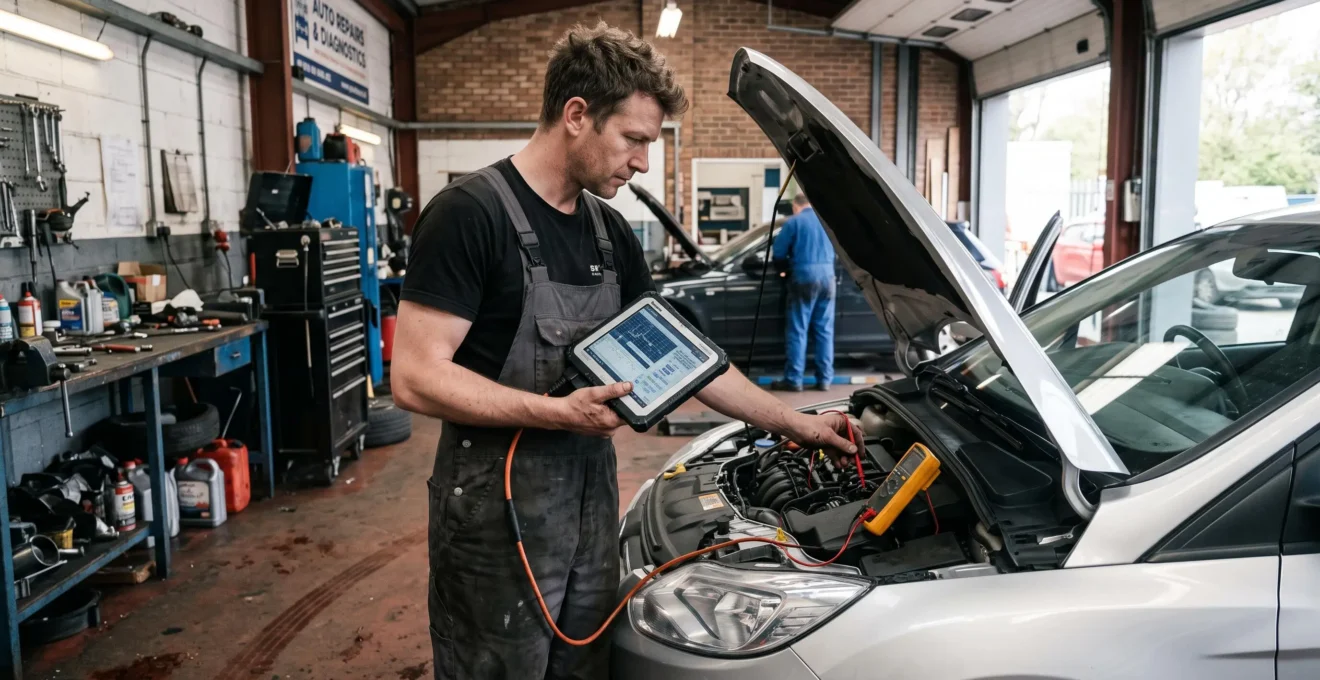
A warning light disappears before your garage appointment. The workshop scans the car, finds no obvious active fault and recommends replacing a sensor. Weeks later, the original problem returns. This frustrating sequence illustrates the difference between reading diagnostic information and establishing why a vehicle is malfunctioning.
Advanced diagnostic systems combine control-module scanning, guided fault-finding procedures, live-data analysis, electrical testing, supported programming functions and post-repair validation. Rather than identifying a suspicious component and replacing it immediately, they help technicians test competing explanations against measurable evidence.
These platforms are not automatic fault detectors, and even sophisticated equipment cannot guarantee an immediate answer. Their value lies in a structured process that can reduce unnecessary replacement decisions and document whether a repair has addressed the original problem.
For vehicle owners, the practical question is whether paying for diagnostic labour is preferable to funding another uncertain repair. For workshops, it is whether the necessary software, equipment, manufacturer information and technician expertise justify the investment.
Advanced vehicle diagnostics: the essentials
- A fault code identifies a detected condition, not necessarily the defective component. Guided tests establish whether the sensor, wiring, power supply, software or another system is responsible.
- A capable diagnostic workshop combines appropriate software, manufacturer information, electrical testing and trained technicians. Programming access and available functions must be checked for the specific vehicle.
- Diagnostic costs include specialist labour, equipment, subscriptions and sometimes manufacturer access fees. Repair validation provides evidence that the original fault has been addressed under relevant operating conditions.
- Why Modern Cars Need Guided Diagnostic Tests Instead of “Try a New Sensor”
- How to Tell if a Workshop Has True Advanced Diagnostics Before You Book
- Diagnostics First or Immediate Repair Attempt: Which Gets You Back on the Road Faster?
- The “No Validation” Mistake That Lets Faults Return After You Pay
- When to Escalate to Advanced Diagnostics After Two Failed Repair Attempts
- Why the Warning Light Turns Off Before the Garage Can Find Anything
- Why Sensor Readings Look Abnormal Even When Nothing Is Broken
- How to Read Live Diagnostic Data Without Misdiagnosing the Fault
Why Modern Cars Need Guided Diagnostic Tests Instead of “Try a New Sensor”
Modern cars need guided diagnostic tests because a single fault code can have several underlying causes. Sensors, control modules, wiring and communication networks interact, so replacing the component mentioned in a code description may leave the original defect untouched. Guided testing checks the relevant signals and circuits in sequence before a technician authorises a repair.
A modern vehicle can contain numerous electronic control units communicating through networks such as Controller Area Network (CAN) and Local Interconnect Network (LIN). An abnormal value detected by one module may originate in another subsystem, a shared electrical supply or the communication path connecting them.
For example, a fault code indicating an implausible pressure sensor signal does not automatically prove that the sensor has failed. The same indication could result from a damaged connector, an unstable reference voltage, an incorrect ground connection or a genuine pressure abnormality.
The crucial distinction is between a diagnostic trouble code (DTC), which describes a monitored condition, and a verified root cause, which explains why that condition occurred.
Manufacturer-guided fault finding provides a structured route between the two. Depending on the supported vehicle and software, a test plan may direct the technician to inspect a wiring diagram, measure supply voltage at a particular connector pin, compare an actual signal with an expected value, activate a component and proceed to a different test based on the result.
The official Bosch ESI[tronic] diagnostic software documentation describes guided troubleshooting, circuit diagrams, component tests, actual-value analysis and manufacturer repair information. However, these functions vary by software package, supported vehicle and access level.
The financial advantage comes from avoiding unverified replacement decisions. A diagnostic session carries an upfront labour cost, but repeatedly buying components, paying installation labour and returning for additional inspections can cost more without producing a reliable solution.
That advantage is conditional: the test plan must cover the relevant vehicle, the fault must be investigated correctly, and the technician must interpret the results accurately. Guided software supports professional judgement rather than replacing it.
Once the value of guided tests is understood, the next challenge is identifying a workshop capable of performing them rather than simply advertising diagnostic scanning.
How to Tell if a Workshop Has True Advanced Diagnostics Before You Book
A workshop offering true advanced diagnostics should be able to explain how it investigates faults beyond reading codes. Look for manufacturer-specific information, guided testing, appropriate electrical equipment, trained technicians and documented repair checks. If programming might be necessary, confirm that the workshop supports your exact vehicle and control module rather than relying on a generic equipment claim.
Start by asking which diagnostic software the workshop uses for your make, model and year. OEM software or a capable multi-brand platform can provide access to manufacturer-specific parameters, test routines, technical service information and wiring diagrams. A basic code reader may only expose standardised emissions-related information.
Next, establish whether the workshop can test the physical circuit. A sophisticated tablet is not a substitute for a multimeter, oscilloscope or suitable test leads when a fault involves intermittent wiring, ground quality or signal integrity.
Programming capability requires additional verification. SAE J2534 defines a standardised pass-through interface for compatible vehicle programming applications, principally covering emissions-related control modules within its stated scope. The official SAE J2534-1 pass-through programming standard explains that framework.
However, J2534 hardware alone does not guarantee programming access. The workshop may also need compatible manufacturer software, an active subscription, security authorisation and a suitable vehicle communication interface. Diagnostics over Internet Protocol (DoIP) is a separate vehicle communication technology, not another name for J2534.
Qualifications provide another useful signal. In the United States, ASE L1 certification relates to advanced engine performance diagnosis; in the United Kingdom, relevant IMI qualifications or accredited training can demonstrate professional development. Neither credential alone proves access to every vehicle system.
Five checks to complete before booking advanced diagnostics
- Ask, “Can you perform guided fault finding for my exact model and year?” Record the diagnostic platform and confirmation of vehicle coverage.
- Ask whether the technician can access wiring diagrams and manufacturer test procedures. Obtain confirmation that circuit testing is included when required.
- Ask, “Can you code or reprogram the relevant module if testing identifies that need?” Request a clear statement of supported functions or any specialist referral.
- Request a written breakdown of scan fees, diagnostic labour, authorisation limits and possible programming charges. Keep the estimate before approving work.
- Ask, “Will you validate the repair before I collect the car?” Obtain agreement on the report or test evidence provided at handover.
Listen carefully to how the workshop describes its pricing. A flat-fee scan may cover code retrieval and a brief report without identifying the cause. An hourly diagnostic rate usually reflects investigative work, although it does not guarantee a successful diagnosis.
A credible response separates initial assessment, further testing, repair authorisation and validation. Be cautious if the workshop cannot explain what its fee covers or immediately recommends a component without describing the evidence.
Once a workshop has demonstrated the right capabilities, the remaining decision is whether to fund investigation first or authorise a repair based on an apparently familiar symptom.
Diagnostics First or Immediate Repair Attempt: Which Gets You Back on the Road Faster?
Diagnostics first is generally the more defensible choice when a fault is intermittent, involves several systems or has returned after previous repairs. Direct replacement can be faster when the defect is visible, independently confirmed or supported by a reliable test. The correct comparison is total downtime and cost until the fault is resolved, not simply the duration of the first workshop visit.
Consider a vehicle with several warning lights following a battery replacement. A technician could replace a component implicated by one stored code, but that would not establish whether low voltage, an incomplete system initialisation or a communication problem caused the symptoms.
By contrast, a visibly damaged hose with a confirmed leak may justify straightforward replacement without an extended electronic investigation. The distinction is not whether diagnostic testing is always necessary, but how much evidence already exists.
The following decision grid helps separate those situations.
| Observed condition | Preferred approach | Reason |
|---|---|---|
| Intermittent warning lights or symptoms | Advanced diagnostics first | The fault may require stored-data analysis or recording under specific conditions. |
| Multiple unrelated electronic warnings | Full-system scan and network checks | A shared power, ground or communication fault may affect several modules. |
| Problems after battery disconnection or electrical work | Electrical and configuration checks | Voltage disturbances, resets or configuration issues may contribute. |
| Same symptom following a previous repair | Review the repair history and retest | The original diagnosis may have been incomplete or another cause may remain. |
| Visible damage with a confirmed failure | Targeted repair followed by verification | The defect is already supported by physical evidence. |
| Recognised failure pattern without independent confirmation | Focused confirmation before replacement | A common failure is still only a hypothesis until verified. |
The apparent attraction of a cheap scan is understandable. It provides an immediate answer about recorded codes, whereas investigative diagnostic labour may be charged even if the fault cannot be reproduced during the appointment.
However, a scan is not equivalent to root-cause testing. The customer should compare the scope of both services before choosing the lower advertised price.
Diagnostic pricing has several components: technician time, software subscriptions, equipment investment, manufacturer information access and, where required, programming or security-related charges. Workshops may also bill additional time for extended road tests or intermittent-fault recording.
There is no reliable universal diagnostic-session price across English-speaking markets. Local labour rates, vehicle complexity, specialist access and the investigation’s duration materially affect the quote. A sensible estimate therefore specifies the included time, work scope and approval threshold rather than presenting one fixed figure as typical everywhere.
Repeated unsuccessful repair attempts also create downtime through ordering parts, rebooking appointments and repeating disassembly. This makes an upfront diagnostic session economically reasonable when the likely alternative is another unverified replacement.
Regardless of which approach is selected, the vehicle should not be considered repaired simply because the warning light is absent when the technician finishes.
The “No Validation” Mistake That Lets Faults Return After You Pay
Repair validation means checking that the original fault condition no longer occurs, not merely clearing diagnostic codes or completing a short test drive. A fault can remain undetected until the vehicle reaches a specific temperature, speed, load or operating state. Without suitable post-repair checks, a workshop may return a car before it has gathered enough evidence to judge whether the repair worked.
Clearing a fault code resets recorded information but does not correct its underlying cause. Some codes can remain stored as historical records, others can be pending, and certain monitoring systems must complete defined operating conditions before indicating whether a fault is present.
A vehicle that drives normally around the workshop may therefore still exhibit the same problem during a cold start, sustained motorway journey or demanding acceleration.
The California Bureau of Automotive Repair OBD test reference explains that emissions-related readiness monitors may require particular speed, temperature, pressure and engine-load conditions. Its inspection rules apply to California, but the underlying principle of operating-condition-dependent monitoring is relevant to vehicle diagnosis more broadly.
A meaningful validation process should therefore match the original symptoms and the affected system. Depending on the fault, it can include repeating the diagnostic test plan, measuring the repaired circuit, checking relevant live parameters, reviewing pending and stored codes, and observing the vehicle through appropriate operating conditions.
Where safe and practical, the technician should reproduce the original trigger conditions. A repair involving cold-start behaviour cannot be completely assessed through a warm-engine idle test alone.
Validation does not always require every monitor or every subsystem to complete a full test cycle. Its scope should reflect the original defect, manufacturer instructions and any applicable inspection requirements.
At handover, ask for a concise before-and-after diagnostic report. It should identify the original fault, tests performed, repair completed, relevant measurements and any operating conditions that could not be reproduced.
Clarify the workshop’s stated warranty or comeback policy for the diagnosis and completed repair. Coverage varies by workshop, agreement and jurisdiction; a parts warranty should not automatically be interpreted as a guarantee covering every diagnostic decision.
Post-programming verification deserves particular attention. After software updates, module coding or configuration changes, the technician should perform applicable manufacturer-required checks, confirm communication and configuration status, and test affected functions. Some incomplete configurations produce delayed or condition-dependent symptoms.
When a workshop has already attempted repairs without resolving the complaint, those previous interventions become valuable evidence for a more structured investigation.
When to Escalate to Advanced Diagnostics After Two Failed Repair Attempts
After two unsuccessful repairs for the same unresolved symptom, pause further speculative parts replacement and request a structured diagnostic review. The previous repairs, fault records and conditions under which the problem persists should become the starting evidence. Advanced diagnostics can then test electrical, mechanical, communication and software-related causes systematically rather than repeating the same assumptions.
Two failed attempts are a practical escalation threshold, not a universal technical rule or guarantee that the original workshop made an error. A component may genuinely have been faulty while another contributing problem remained unresolved.
For example, a vehicle might have both an intermittent wiring fault and a marginal electronic module. Replacing one defective component may improve operation without eliminating every symptom.
The most productive response is to establish what has already been proven, which hypotheses were rejected and which tests remain outstanding.
A structured escalation should cover the following areas:
- Review the original complaint, invoices, replaced components and results of earlier tests.
- Perform a full-system scan of relevant control modules, preserving available stored, pending and historical information.
- Use manufacturer-specific guided procedures to investigate fault conditions rather than relying only on code descriptions.
- Check wiring continuity where appropriate, connector condition, power supplies and grounds under relevant loads.
- Capture and compare live signals when reproducing the original symptoms.
Where a fault cannot be reproduced during the appointment, extended data recording may be more useful than repeated stationary testing. Compatible advanced platforms can capture selected parameters over time, sometimes using a flight-recorder function or another event-recording capability.
Freeze-frame records, when supported and retained, may show operating conditions associated with a detected fault. These records are not universally available for every control unit or event, so the technician should confirm what the vehicle actually stores.
A constructive conversation with the original garage could begin: “The same symptom remains after both repairs. Could you review the test results and explain what has been ruled out before any further parts are ordered?”
This focuses the discussion on evidence rather than blame. It also creates an opportunity to agree on further diagnostic charges, any applicable remedy for previous work, and whether a specialist referral is more appropriate.
If the fault involves braking, steering or another safety-critical system, continued driving should not be used simply to reproduce symptoms without professional safety assessment.
Intermittent warning lights are a particularly common source of diagnostic uncertainty, because the fault may disappear from the driver’s view before the workshop inspects the car.
Why the Warning Light Turns Off Before the Garage Can Find Anything
A warning light can switch off when the vehicle’s control system no longer detects the condition that originally activated it. That does not necessarily mean the cause has disappeared. Depending on the vehicle and fault type, diagnostic records may remain available after the light goes out, allowing a technician to investigate what happened even when the symptom is temporarily absent.
Electronic control units monitor parameters against defined operating thresholds. A fault may appear during a cold start, voltage drop or particular driving condition and then stop meeting the warning criteria once conditions change.
Warning-light behaviour depends on the monitored system and the manufacturer’s fault logic. Some alerts clear after prescribed successful checks; others remain illuminated or require specific conditions before their status changes.
Importantly, an intermittent warning is not proof that the vehicle has repaired itself. A transient low-voltage event may never recur, while a corroded connector or deteriorating sensor may continue producing occasional abnormal signals.
The best immediate action is to record the circumstances while the information is fresh:
- Which warning appeared, and was it steady or flashing?
- Was the vehicle starting, idling, accelerating or cruising?
- What were the approximate speed, outside temperature and engine temperature?
- Were there other symptoms, such as hesitation, loss of power or unusual electrical behaviour?
- Did the warning follow recent servicing, battery work or exposure to wet conditions?
Arrange an appropriate diagnostic scan promptly, particularly when the symptom recurs. Avoid clearing codes or disconnecting the battery merely to extinguish a warning, because doing so can erase useful diagnostic information or reset monitoring status.
Where available, stored codes and freeze-frame records help reconstruct the conditions of the event. If those records are insufficient, a workshop may arrange controlled extended recording with suitable diagnostic equipment.
Data logging is useful only when the correct parameters are selected and the event is actually captured. It cannot guarantee that every rare or unpredictable fault will be identified during one recording period.
Even when the workshop captures the relevant data, an apparently abnormal sensor value still requires interpretation before it can be treated as evidence of component failure.
Why Sensor Readings Look Abnormal Even When Nothing Is Broken
Sensor readings can look abnormal because the vehicle is operating under conditions different from those assumed by the person interpreting the data. A sensor may also be correctly reporting a genuine problem elsewhere in the system. Before replacing it, the technician must establish expected values, examine related parameters and verify that the sensor’s power supply and signal circuit are functioning correctly.
Consider a hypothetical engine showing unusually positive fuel-trim values. The engine control unit may be adding fuel because it detects a lean condition, even though the oxygen sensor is accurately reporting the exhaust-gas response.
An intake air leak, for example, could contribute to the abnormal fuel-trim behaviour. Replacing the oxygen sensor without checking air leaks and related signals would leave the actual condition unresolved.
Live readings are also sensitive to test conditions. Engine temperature, idle state, electrical load, throttle position and whether fuel control is operating in open-loop or closed-loop mode can change what constitutes a normal value.
A generic reference value that seems plausible for one vehicle may be unsuitable for another engine design or control strategy. Units can also be misinterpreted, especially when different tools display pressure, temperature or airflow in different measurement formats.
Correlated parameters provide better evidence than isolated readings. For an airflow concern, a technician may examine mass airflow (MAF), manifold pressure where available, throttle position, engine speed and fuel-trim response together.
The question is whether the signals behave consistently under defined test conditions, not whether one displayed number looks unusual.
Electrical checks remain essential. An incorrect ground reference, unstable supply voltage or excessive resistance at a connector can alter the signal received by the control module even when the sensing element itself is functional.
Guided troubleshooting helps establish the order of investigation, including relevant circuit checks and manufacturer-defined operating conditions. A technician must still decide which procedures are appropriate for the specific vehicle and symptom.
Reading live data effectively therefore requires a repeatable method that connects measurements to system behaviour rather than treating the diagnostic display as a list of independent values.
Key takeaways before interpreting live data
- A plausible measurement is not automatically a healthy measurement; compare its behaviour with the manufacturer’s expected operating conditions.
- A signal that changes appropriately with load or temperature may be reporting another system’s malfunction rather than identifying its own failure.
- Useful diagnostic evidence comes from relationships between signals, physical circuit checks and repeatable tests—not isolated numerical readings.
How to Read Live Diagnostic Data Without Misdiagnosing the Fault
Read live diagnostic data by selecting parameters relevant to the suspected system, establishing the correct operating conditions and comparing related signals over time. Manufacturer reference information and guided test procedures provide the context needed to identify genuine abnormalities. Live data supports fault diagnosis, but a suspicious value alone cannot establish which component should be replaced.
Begin with a clear diagnostic question. If the engine hesitates under acceleration, concentrate on the signals that describe airflow, throttle request, fuel delivery and related control responses rather than displaying every available parameter simultaneously.
Next, define the test conditions. Record whether the engine is cold or warm, the operating speed and load, and any relevant control state. Compare measurements with manufacturer-specific specifications where available.
Observe how the parameters interact:
- Response time: Does a signal change promptly when the relevant operating condition changes, or does it lag unexpectedly?
- Correlation: Do related values move in a technically consistent way, such as airflow responding to increasing engine demand?
- Plausibility: Is a reading reasonable for the actual vehicle state and the other measurements?
- Signal behaviour: Is a supposedly dynamic parameter implausibly flat, unstable or discontinuous?
- Repeatability: Does the abnormal behaviour recur under comparable conditions?
For example, an airflow reading that remains unchanged during a controlled change in engine load may justify further investigation. But the observation should be checked against the vehicle’s control strategy, available data resolution and actual operating conditions before condemning the MAF sensor.
Generic OBD-II tools commonly expose standardised parameters through service or mode $01, primarily relating to emissions and powertrain monitoring. Manufacturer-level diagnostic platforms may provide additional proprietary parameters, module-specific status information, adaptation values and test functions.
This difference matters because a standard parameter may not show the internal value or control state used by the manufacturer’s fault-detection logic. Greater data access can improve diagnostic context, although more parameters are not inherently better without accurate interpretation.
An advanced end-to-end workflow connects the evidence in a deliberate sequence: scan the relevant control units, preserve fault information, establish guided test conditions, capture live measurements, confirm the physical cause, perform the authorised repair or supported programming operation, and validate the outcome.
Software investment should be evaluated against this entire workflow. For a workshop, the true cost includes compatible interfaces, licensing or subscriptions, manufacturer information, programming access, technician training and the time required to investigate and document faults. For an owner, the relevant measure is the agreed diagnostic scope and the quality of evidence delivered, not the number of features advertised on a scanner.
No platform eliminates diagnostic uncertainty. Some vehicle faults require repeated tests, specialist equipment or extended observation, and programming capabilities can be limited by manufacturer permissions and vehicle compatibility.
If your vehicle has an unresolved complex fault, the next practical step is to request a written diagnostic scope covering fault-data preservation, relevant guided tests, electrical verification where indicated and post-repair validation. Ask the workshop to explain what can be confirmed, what remains uncertain and which charges require further authorisation before any additional parts are replaced.
Can advanced diagnostics find a fault when no diagnostic codes are stored?
Yes, some faults can be investigated without stored DTCs by examining live parameters, testing electrical circuits, reviewing mechanical conditions and reproducing symptoms. However, a lack of codes or fault records may make an intermittent problem harder to isolate. Successful diagnosis depends on the available evidence, vehicle architecture and technician expertise.
Does advanced diagnostic software automatically repair vehicle faults?
No. Diagnostic software supports investigation, testing and certain electronic service operations, but it does not physically repair defective wiring, sensors or mechanical components. Some supported problems can be corrected through authorised software updates, coding or adaptation procedures, but these operations require an established diagnosis, appropriate access and verification.
Is manufacturer-level software always better than a multi-brand diagnostic system?
Not necessarily for every task. Manufacturer-level software may provide deeper access to vehicle-specific procedures, functions and programming operations. A capable multi-brand platform can still perform extensive guided testing and system analysis on supported vehicles. The relevant comparison is whether the platform provides the exact functions, technical information and permissions required for the job.
Should a workshop charge for diagnostics if it cannot identify the fault?
Diagnostic labour may be chargeable even when the underlying fault remains unresolved, provided the work and charging terms were appropriately agreed. The workshop should explain what was tested, what evidence was collected and why the investigation remains inconclusive. Any legal entitlement to a refund or further remedy depends on the applicable jurisdiction and service agreement.
Can an independent garage perform ECU programming without dealership equipment?
Sometimes. Compatible pass-through equipment and manufacturer-provided software can enable supported programming operations outside a dealership. Availability depends on the vehicle, module, communication interface, software subscription and any required security authorisation. Possessing a J2534 interface alone does not establish access to every programming function or support for DoIP.