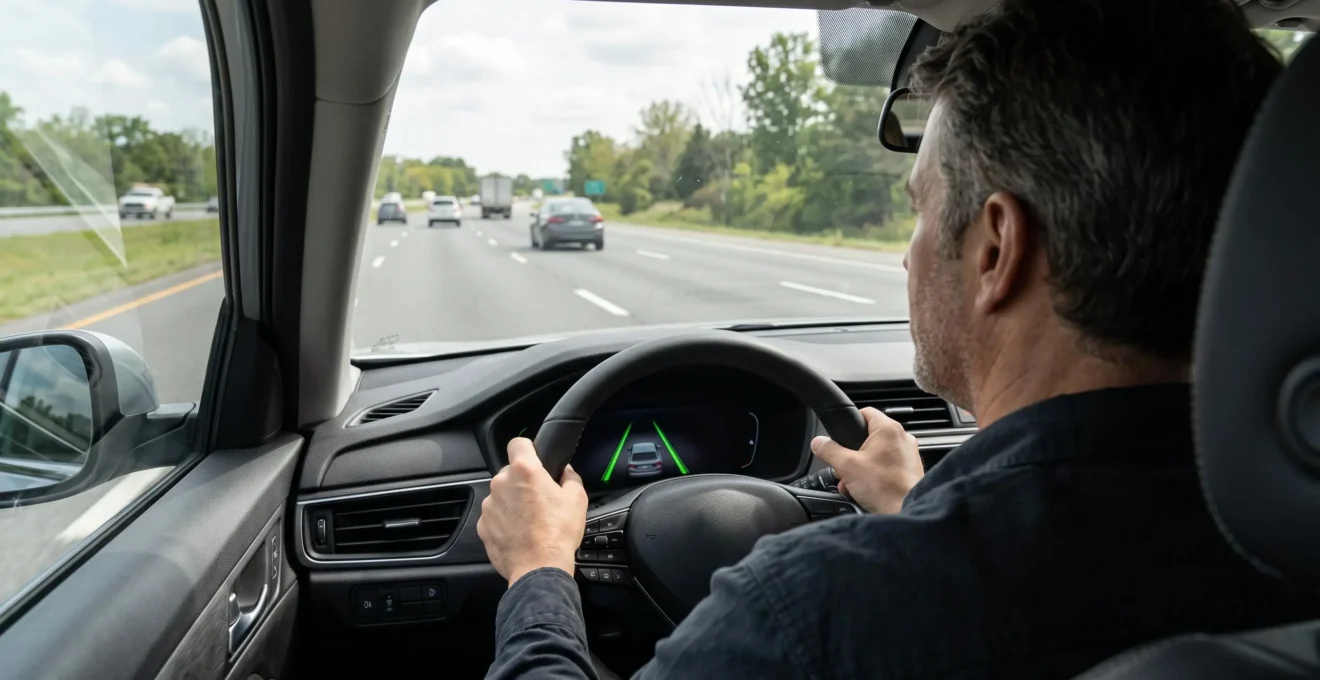
Some advanced car technologies prevent specific types of crashes. Others mainly improve convenience, introduce additional settings or create expensive components that owners may eventually need to repair. Knowing the difference matters more than counting the features advertised on a vehicle’s specification sheet.
Automatic emergency braking, blind-spot detection and lane departure warning have measurable safety benefits in real-world research. But those benefits are not interchangeable: a technology associated with 20% fewer crashes of one type cannot automatically be credited with reducing every driver’s overall crash risk by 20%.
Meanwhile, software updates delivered over the air (OTA), elaborate infotainment screens, radar sensors and camera systems introduce practical ownership questions. What happens when rain disables an assistance feature? Who pays for recalibration after replacing a windscreen? Will an expensive technology package still be useful after seven years?
The sensible approach is to evaluate each feature against three criteria: demonstrated safety performance, everyday usability and long-term ownership costs. That separates technologies worth prioritising from equipment that may be impressive on a test drive but frustrating to live with.
Advanced car technology: the essential facts
- Crash reduction depends on the feature and collision type. IIHS-HLDI findings associate automatic emergency braking with 50% fewer front-to-rear crashes, while lane departure warning is associated with an 11% reduction in specified crash categories.
- Weather-related ADAS limitations, intermittent warnings and post-repair calibration requirements are different problems. Understanding the cause helps prevent unnecessary repairs and unsafe assumptions.
- For long-term ownership, prioritise proven safety equipment, understandable controls, documented software support and realistic repair exposure over expensive convenience features.
- Why Does Lane Assist Switch Off in Heavy Rain Even on a New Car?
- How to Test ADAS in a 20-Minute Test Drive Without Taking Risks?
- High-Tech Trim or Basic Trim: Which Makes More Sense if You Keep Cars 7+ Years?
- The Cleaning Mistake That Can Trigger Repeated False ADAS Warnings
- When Should You Recalibrate Cameras After a Windscreen Replacement to Avoid Repeat Faults?
- Why Do Public Chargers Show ‘Available’ but Fail When You Plug In?
- Why Do In-Car Screens and Sensors Fail More Often After Heatwaves?
- Which Vehicle Technologies Could Add £1,000 in Repair Risk Over 5 Years?
Why Does Lane Assist Switch Off in Heavy Rain Even on a New Car?
Lane assistance can switch off during heavy rain because its cameras may no longer identify road markings reliably. Water, spray, reflections and poor contrast reduce the information available to the system. A temporary disengagement can therefore be normal even in a brand-new vehicle, although warnings that persist in clear conditions deserve investigation.
Many lane-assistance systems rely on a forward-facing camera positioned near the interior rear-view mirror. Its software analyses the road ahead, identifies lane boundaries and estimates the vehicle’s position. These calculations depend on image quality and the system’s confidence in what it sees.
Heavy rain can simultaneously obscure the windscreen, hide painted lines and create reflections from headlights or standing water. Worn road markings, temporary roadworks and spray from other vehicles can further complicate recognition.
However, lane assistance is not one universal function. Three technologies are commonly confused:
- Lane departure warning: alerts drivers when an unintended lane departure is detected, without necessarily steering.
- Lane-keeping assistance: can apply corrective steering when the vehicle approaches or crosses a detected lane boundary.
- Lane centering: provides more continuous steering support to help maintain the vehicle’s position within a recognised lane, subject to its operating conditions.
Their intervention thresholds, supported speeds and operating restrictions vary by manufacturer and model. A successful lane-departure warning test does not prove that lane centering will work equally well in poor weather.
11% fewer crashes
Lane departure warning was associated with an 11% reduction in single-vehicle, sideswipe and head-on crashes in IIHS-HLDI research. Injury crashes within those categories fell by 21%. Neither figure establishes a universal reduction in all crashes or measures the effectiveness of every lane-centering system.
IIHS-HLDI research summary on real-world crash avoidance benefits, July 2025.
A driver also needs to distinguish a temporary operating limitation from a genuine malfunction. If assistance becomes unavailable during heavy spray and returns when visibility improves, an environmental limitation is plausible. A persistent fault message on a dry, clearly marked road is more concerning.
Reduced capability should be communicated clearly. A system that announces it cannot recognise a lane is preferable to one that appears active while making unreliable steering corrections. However, abrupt disengagements and confusing warnings can erode trust, potentially encouraging drivers to disable assistance even when it could help.
If lane assistance disengages, maintain ordinary manual steering control, adapt speed to conditions and avoid abrupt reactions to the notification. Rain also affects visibility and tyre grip, so restoring an electronic feature does not restore normal road conditions.
The most useful safety technology is not necessarily the one that remains active most often. It is the one that performs reliably within documented limits and makes those limits understandable to the driver. This is worth evaluating before buying.
How to Test ADAS in a 20-Minute Test Drive Without Taking Risks?
A 20-minute test drive can reveal whether advanced driver-assistance systems are understandable, comfortable and practical during normal driving. Begin with a stationary explanation of the controls, observe routine alerts on suitable roads and finish by reviewing settings. Never deliberately create a dangerous situation to trigger automatic emergency braking or pedestrian detection.
ADAS stands for advanced driver-assistance systems, a broad category covering features that warn, assist or intervene under specific conditions. A short test drive cannot validate their full safety performance, but it can reveal whether the driver understands what the vehicle is doing.
Use the following timetable as a flexible purchasing exercise, not a validated safety-testing protocol. The route and conditions must remain suitable, and a salesperson should explain unfamiliar controls before departure.
| Time | Activity | What to observe |
|---|---|---|
| 0–4 minutes | Stationary feature briefing | Active systems, dashboard symbols, warning settings and driver responsibilities. |
| 4–10 minutes | Ordinary urban driving | Alert clarity, display readability, normal steering feel and unnecessary warnings. |
| 10–16 minutes | Suitable, clearly marked road | Lane-assistance feedback and, only where permitted and appropriate, adaptive cruise control behaviour. |
| 16–20 minutes | Parked settings review | Adjustment options, warning volume, feature availability and documented restart behaviour. |
There is an important boundary between observing assistance and provoking emergency interventions. Do not drive towards an obstacle, deliberately close dangerously on another vehicle or ask someone to stand in front of the car to test pedestrian detection. Never attempt to trigger automatic emergency braking on a public road.
Independent research and controlled safety assessments are more appropriate sources for evaluating collision-prevention performance. The IIHS-HLDI findings described earlier distinguish substantial benefits from automatic emergency braking from more modest effects in other crash categories.
For usability, record five observations on a simple scorecard: warning clarity, frequency of apparently unnecessary alerts, smoothness of permitted steering assistance, ease of adjusting settings and whether the vehicle retains preferences after restarting. The last point may require a separate stationary restart check and confirmation in the manual.
Rate each observation as clear, acceptable or frustrating, adding the actual behaviour observed. This is a personal usability comparison, not a crash-prevention rating.
Finally, request the exact model’s equipment specification, operating limitations and independent safety-test information. Daylight operation does not establish performance at night, in heavy rain or through roadworks.
A feature that behaves politely during a demonstration may still have limitations that matter during everyday ownership. That makes the purchasing decision as important as the first impression behind the wheel.
High-Tech Trim or Basic Trim: Which Makes More Sense if You Keep Cars 7+ Years?
For a driver keeping a car for seven years or longer, a basic trim with strong standard safety equipment may offer better value than an expensive technology package. Prioritise proven collision-prevention functions, reliable everyday controls and affordable maintenance. Pay extra for premium technology only when its benefits justify the purchase price, subscriptions and potential repair complexity.
Vehicle manufacturers frequently bundle different kinds of technology into the same trim upgrade. A package might contain automatic emergency braking, larger digital displays, automated parking and upgraded connected services, even though these features address very different needs.
The first task is to distinguish crash-prevention equipment from convenience equipment. IIHS-HLDI findings associate automatic emergency braking with 50 % fewer front-to-rear crashes and pedestrian-detecting automatic emergency braking with 27% fewer pedestrian crashes. These are findings for specific crash categories, not predictions of an individual owner’s total crash risk.
By contrast, a larger central display, decorative lighting or automated parking may improve the ownership experience without establishing comparable crash-reduction benefits.
Before comparing prices, check whether the basic trim already includes the safety systems you want. Some vehicles provide substantial ADAS equipment as standard, leaving the premium package primarily focused on comfort and presentation.
| Criterion | Basic trim | High-tech trim |
|---|---|---|
| Initial cost | Usually lower within the same model range | Additional purchase premium |
| Collision prevention | May already include key ADAS functions | May add capabilities, depending on specification |
| Daily usability | Potentially simpler controls | Additional features, menus and interfaces |
| Software dependence | Varies by vehicle architecture | May involve more connected functions |
| Repair complexity | Depends on installed components | May include additional costly assemblies |
| Resale value | Lower initial investment | Possible premium, not guaranteed |
Technological ageing is also different from mechanical ageing. A mechanically sound vehicle may remain usable long after a navigation service loses support or an optional connected subscription becomes unavailable.
Check whether heating, ventilation and demisting remain accessible if the central display becomes unresponsive. Determine whether phone integration can substitute for built-in navigation, and whether essential functions require continuous access to manufacturer servers.
Over-the-air updates can deliver software changes without a workshop visit, but OTA capability is not a guarantee of seven years of support. Ask which systems receive updates, whether updates are included, and what support commitments are documented.
A simple break-even calculation helps. Suppose, hypothetically, a premium trim costs £2,100 more and the vehicle is kept for seven years. The additional purchase cost is £300 per ownership year before subscriptions, financing effects, repairs or resale differences.
If a connected service also costs a hypothetical £10 per month throughout those seven years, that adds £840, bringing the combined illustrative premium to £2,940. This is a budgeting example, not a quotation or forecast for any specific vehicle.
Compare that annualised cost with the number of occasions when the additional equipment will genuinely improve your experience. Consider resale premiums and software availability as uncertain scenarios rather than guaranteed savings.
For long-term owners, the strongest choice is often the least complicated specification that delivers the required safety performance. Keeping that equipment working properly is the next challenge.
The Cleaning Mistake That Can Trigger Repeated False ADAS Warnings
Cleaning only the visible windscreen while overlooking sensor viewing areas—or leaving unsuitable residues around them—can contribute to repeated ADAS warnings. Cameras require a sufficiently clear optical view, while radar may operate through concealed covers. Dirt, films and inappropriate accessories can interfere with susceptible systems, although recurring warnings can also indicate faults unrelated to cleaning.
A modern vehicle may combine forward-facing cameras, radar modules, parking sensors and additional cameras around its bodywork. Each component has different maintenance requirements, and not every sensor is directly visible.
For example, Toyota’s Safety Sense 2.5 documentation identifies a camera behind the windscreen and radar sensing equipment behind the front grille. Its instructions tell owners to keep relevant surfaces clean, avoid attaching stickers or accessories near sensing areas and use appropriate care around sensor covers.
These are manufacturer-specific instructions, not universal rules for every ADAS installation. Some radar sensors sit behind painted body panels, where unsuitable coatings, repairs or accessories can matter even when the visible exterior looks clean.
A visibly clean windscreen does not prove that the front radar’s sensing area is unobstructed. Likewise, wiping a bumper does not resolve a damaged sensor bracket or an electrical connection problem.
Use the vehicle’s handbook to identify accessible sensing zones before applying glass treatments, polish, protective film or cleaning chemicals. Avoid touching concealed modules or attempting to remove their covers.
A sensible troubleshooting sequence begins while parked: record the exact dashboard message, inspect accessible surfaces, clean them only as prescribed and observe what happens during subsequent normal driving. Note the weather, vehicle speed and whether the warning disappears.
If the message vanishes after cleaning, contamination becomes a plausible explanation. That observation does not conclusively exclude an intermittent wiring, software or alignment problem.
Persistent faults warrant diagnostic trouble-code checks and manufacturer-specific service procedures. Repeatedly resetting alerts or polishing the same area is unlikely to solve a damaged component. Cleaning also cannot substitute for calibration when a repair has disturbed sensor positioning.
Knowing which tasks belong to routine maintenance and which require professional diagnosis prevents unnecessary replacement decisions. Windscreen repairs are an especially important example of that boundary.
When Should You Recalibrate Cameras After a Windscreen Replacement to Avoid Repeat Faults?
Determine the camera recalibration requirement before a windscreen replacement is authorised, then complete any manufacturer-prescribed procedure as part of the repair process. Depending on the vehicle, calibration may be static, dynamic, combined or automatically performed under specified conditions. Waiting for a dashboard warning is not a reliable way to decide whether calibration was required.
Forward-facing ADAS cameras operate through a particular section of the windscreen and depend on their installed position and optical environment. Replacing the glass can affect the relationship between the camera, its mounting bracket and the road scene, even when the finished installation appears correct.
Not every vehicle requires the same procedure. Requirements depend on the manufacturer, model, camera system, glass specification and repair instructions. The installer should identify these requirements when planning the job.
There are three common calibration arrangements:
- Static calibration: the vehicle is positioned in a controlled workshop environment using prescribed targets and equipment.
- Dynamic calibration: the vehicle is driven under specified conditions so the system can complete its prescribed learning or adjustment process.
- Combined calibration: both static and dynamic operations are required, in the manufacturer’s specified sequence.
Some vehicles have different automatic calibration processes. None of these methods should be substituted merely because a workshop finds another method more convenient.
Tyre condition, wheel alignment, workshop setup, equipment positioning and road conditions may affect the successful completion of particular procedures. These dependencies must be checked against the applicable vehicle instructions.
For a documented regional example, the ICBC policy on ADAS calibration for glass claims addresses how participating repair facilities in British Columbia identify manufacturer requirements and retain evidence of completed calibration. It recognises static, dynamic and combined procedures.
The policy illustrates the importance of repair documentation; it does not establish universal insurance coverage or repair requirements throughout Canada, the United Kingdom, the United States or Australia.
Five checks before accepting a replacement windscreen
- Confirm the glass specification. Obtain an invoice or work order identifying the replacement glass as appropriate for the vehicle and its camera equipment.
- Check the calibration requirement. Ask the installer to identify the manufacturer-prescribed procedure and provide written confirmation of whether calibration is required.
- Establish who performs the work. Obtain the calibration provider’s details or the repairer’s written confirmation that the required procedure is included.
- Request completion evidence. Collect the applicable calibration report, diagnostic documentation or other manufacturer-prescribed confirmation of successful completion.
- Confirm payment responsibility. Obtain an itemised quotation or invoice and written confirmation of any applicable insurance approval, excess or uncovered charge.
Clearing diagnostic trouble codes is not the same as proving that a camera has been correctly calibrated. Similarly, an unlit warning lamp does not establish that all prescribed operations were completed successfully.
If the glass installer cannot perform the required calibration, establish who will arrange it and whether the vehicle can be used safely in the meantime. Do not assume that the assistance system has been fully restored before the prescribed work is complete.
Insurance arrangements vary by policy, repairer and jurisdiction. Check coverage and payment responsibility before approving additional work rather than assuming calibration will automatically be included in a glass claim.
ADAS ownership extends beyond the vehicle’s physical sensors. Connected services and external infrastructure introduce a different set of reliability challenges, particularly for electric vehicle drivers.
Why Do Public Chargers Show ‘Available’ but Fail When You Plug In?
A public EV charger can appear available because its status system reports an unoccupied or usable connector, yet the charging session may fail at another stage. Physical connection, vehicle communication, payment authorisation and electricity delivery must all succeed. Availability information therefore does not guarantee that a particular driver can start and complete charging.
Charging relies on more than a socket and a power supply. A typical session involves several separate systems:
- The charging network reports connector availability.
- The vehicle and charging equipment establish a physical connection.
- The charger and vehicle exchange the required communication signals.
- The charging operator authorises payment or access.
- Energy delivery begins and continues under the relevant operating limits.
A problem at any stage after the availability update can produce the frustrating experience of finding a seemingly vacant charger that will not charge the vehicle.
In the United Kingdom, government guidance accompanying the Public Charge Point Regulations 2023 addresses public charging requirements, including reliability and open-data obligations for relevant charge points. These requirements do not mean that every displayed available connector guarantees successful authorisation or energy delivery.
The point of failure often provides useful diagnostic clues.
| Observed symptom | Possible explanation | Appropriate response |
|---|---|---|
| Connector will not lock | Physical obstruction, connection fault or vehicle-port issue | Stop, inspect for obvious damage without dismantling equipment, and try another suitable connector. |
| Payment rejected | Authorisation, account, terminal or connectivity issue | Check accepted payment methods and try an authorised alternative. |
| Session starts, then stops | Charger fault, communication interruption or vehicle-side restriction | Record the displayed error and contact the operator if necessary. |
| Charging power is unexpectedly low | Battery conditions, vehicle limits, charger capability or shared site power | Check vehicle charging limits and charger specifications. |
Do not manipulate damaged connectors, force locking mechanisms or attempt electrical repairs. A visibly damaged unit should be reported and avoided.
For longer journeys, connector compatibility and live status are only two checks. Verify site accessibility, accepted payment methods, recent user reports and the location of an alternative charger. Maintain sufficient battery range to reach that backup without relying on the first site working.
Charging reliability is also a purchasing variable. An owner with dependable home charging faces a different practical situation from someone relying entirely on public infrastructure. Payment interoperability, compatible software and network coverage may be more important than advertised peak charging power alone.
This inconvenience should not be confused with evidence about crash prevention. A failed charging session says little about the effectiveness of the vehicle’s automatic emergency braking or other ADAS functions.
Connected infrastructure is one source of technological dependence. Environmental exposure is another, and it can affect both the electronics drivers touch and the systems they rarely see.
Why Do In-Car Screens and Sensors Fail More Often After Heatwaves?
After prolonged exposure to high temperatures, some in-car screens and electronic systems may temporarily limit functionality or behave abnormally. Heat can affect display readability, touch responsiveness and temperature-sensitive electronics. However, a malfunction noticed after a heatwave does not prove permanent damage, and higher overall failure rates cannot be assumed without model-specific evidence.
A vehicle parked in direct sunlight may experience substantial heating of its dashboard surfaces and enclosed cabin. The driver’s display, central touchscreen and associated electronic modules operate within temperature limits defined by their design.
Depending on the vehicle, excessive temperatures may contribute to temporary reduced functionality or protective behaviour. Other symptoms can arise from aging components, power-supply issues, damaged connections or unrelated software problems.
The distinction matters because a system that returns to normal after cooling is not presenting the same evidence as one that fails repeatedly under moderate temperatures.
Also distinguish cabin-facing electronics from exterior safety sensors. Poor touchscreen responsiveness may make navigation, climate adjustment or vehicle settings harder to operate. It does not automatically mean radar-based collision warning or braking hardware has failed.
Nevertheless, an unusable screen can become a distraction problem if the driver repeatedly tries to operate controls while moving. Where important functions depend on a central display, inability to access them may have practical safety implications.
Assess recurring symptoms systematically. Record whether the problem follows prolonged parking in sunlight, whether the display or function recovers after the cabin cools and whether the same behaviour occurs under ordinary temperatures. Note warning messages and the affected features without experimenting with safety-critical systems while driving.
These observations give a technician a more useful starting point than the general statement that the electronics stopped working after hot weather.
Preventive measures should match the problem being addressed. Shaded parking and suitable sun protection can reduce direct solar exposure. Manufacturer-approved ventilation or cabin preconditioning may improve temperature management. Approved cleaning methods help avoid damaging sensitive display surfaces.
None of these measures repairs defective wiring, failed components or misaligned sensors. Persistent safety-system warnings deserve professional attention regardless of outside temperature.
When comparing vehicles, check the manufacturer’s operating guidance and examine whether important controls remain accessible if a large central screen becomes temporarily unavailable.
Heat exposure illustrates a broader ownership lesson: an electronic inconvenience and an expensive component failure are different risks. Understanding their potential costs is essential before paying extra for more technology.
What matters before choosing a technology package
- Separate evidence of crash prevention from everyday convenience: a pleasant interface is not proof of safer driving.
- Investigate component integration, calibration requirements and diagnostic access, not just the visible cost of replacement parts.
- Evaluate repair exposure against actual warranty and insurance arrangements rather than assuming an expensive component will become an out-of-pocket expense.
Which Vehicle Technologies Could Add £1,000 in Repair Risk Over 5 Years?
ADAS cameras, radar modules, sensor-equipped mirrors, parking sensors and integrated displays can increase repair exposure because damage may require specialist parts, diagnostics and calibration. An additional £1,000 over five years is a plausible hypothetical budgeting scenario for some vehicles, not an established average or inevitable bill. The actual risk depends on repair probability, costs and coverage.
Modern vehicles often integrate electronics into assemblies that were previously simpler to replace. A cracked bumper may involve parking sensors and mounting brackets. Windscreen replacement may require camera calibration. A damaged door mirror can contain detection equipment and additional electronic components.
The distinction between a potential repair bill and expected ownership expense is crucial. A component costing £1,000 to repair does not create an expected £1,000 loss unless the probability of incurring that uninsured cost is effectively certain.
AAA‘s 2023 research examined repair estimates for three US vehicles: the 2023 Ford F-150, Nissan Rogue and Toyota Camry. The analysis considered four specific repair scenarios involving front damage, rear damage, mirror replacement and windscreen replacement.
37.6%
ADAS-related parts, replacement labour, aiming and calibration represented 37.6% of averaged repair costs across the four scenarios and three vehicles examined by AAA. This is not a universal share of accident repair costs or a predicted five-year ownership expense.
The research illustrates why seemingly modest exterior damage can result in disproportionately complex repairs. In AAA’s selected side-mirror replacement scenario, ADAS component replacement averaged $1,067.42 of the $1,507.55 total estimated repair cost.
Those figures are US repair estimates for selected vehicles, not representative UK quotations. They also describe repair scenarios rather than the likelihood of an individual owner experiencing them.
To assess a particular vehicle, build a repair-risk register rather than relying on one headline cost. Include components that are costly to replace, vulnerable to damage or dependent on specialist procedures.
| Component | Potential cost drivers | What to verify |
|---|---|---|
| Windscreen-mounted ADAS camera | Glass compatibility, diagnostics and prescribed calibration | Replacement-glass quotation and calibration procedure |
| Front radar module | Sensor, mounting structure, alignment and calibration | Whether bumper or grille repairs affect sensor positioning |
| Sensor-equipped door mirror | Integrated electronics and complete assembly replacement | Parts pricing and availability of individual components |
| Parking sensors | Integrated bumper parts, wiring and sensor mounts | Repair-versus-replacement possibilities |
| Digital displays | Screen assembly, controls and software configuration | Replacement options and essential control dependence |
| Electronic control units | Module replacement, programming and diagnostic access | Workshop capabilities and manufacturer requirements |
An appropriate cost model accounts for both the chance of damage or failure and the owner’s financial responsibility.
Expected additional five-year repair exposure = Σ [probability of each relevant repair event × owner’s net cost of that event].
Net cost should include parts, labour, diagnostics, required calibration and software configuration, reduced by applicable warranty or insurance payments and adjusted for any deductible or excess. Estimate each event carefully to avoid counting the same accident-related costs more than once.
Hypothetical five-year repair exposure: a £1,000 scenario
Consider a fictional vehicle with three independently modelled, mutually exclusive additional repair scenarios over five years. Assume a 20% probability of an uncovered repair costing £2,000, a 30% probability of a separate repair costing £1,000 and a 10% probability of a third repair costing £3,000.
The illustrative expected exposure is (0.20 × £2,000) + (0.30 × £1,000) + (0.10 × £3,000) = £1,000. These probabilities and prices are invented solely to demonstrate the calculation. They are not market estimates, manufacturer reliability figures or predictions for any real vehicle.
An owner in this example might incur no repair expense, one substantial bill or a different outcome altogether. The £1,000 figure represents a probability-weighted expectation under the stated assumptions, not money automatically paid over five years.
Real-world estimates require vehicle-specific information. Request complete repair quotations, establish which components are included in the insurance policy and check whether warranty exclusions apply to accidental damage, wear or electronic failures.
Repair complexity can also depend on access to manufacturer diagnostic software, the need for specialist calibration equipment and whether several providers must participate. Two vehicles with similar visible damage can therefore generate materially different invoices.
For buyers, the final decision should combine four factors: independently demonstrated safety benefits, actual everyday usefulness, expected ownership duration and net financial exposure.
The headline’s 20% crash-reduction proposition and the £1,000 five-year repair scenario answer different questions. Neither is a universal result. The research supports meaningful reductions in particular collision categories; the financial model illustrates a possible expense under specified assumptions.
Before purchasing, compare the basic and premium equipment lists, review independent crash-test evidence, ask for manufacturer-specific software and maintenance information, and obtain representative local repair quotations. Choose proven protection first, pay for convenience features you will actually use, and budget for the technology you will be responsible for maintaining.
Does a car with more ADAS features automatically receive a better safety rating?
No. Independent safety ratings evaluate specified vehicle performance and equipment under defined assessment protocols. A longer feature list does not establish stronger crash protection. Compare the exact model and applicable independent test results, including the relevant test year and equipment specification.
Can over-the-air software updates improve a car’s safety systems?
OTA updates can change supported vehicle software without a conventional workshop installation, but the purpose and effect depend on the update. Some address faults or functionality, while others affect non-safety features. Read the manufacturer’s release information and avoid assuming that every update improves crash avoidance or guarantees continued long-term support.
Should you disable lane-keeping assistance if it repeatedly makes unwanted corrections?
Repeated inappropriate interventions deserve investigation rather than automatic acceptance. Check road conditions, settings and the manufacturer’s operating guidance, and arrange diagnosis if behaviour persists. Any temporary settings change should follow the vehicle instructions. Do not disable legally required or safety-critical functions without understanding the consequences.
Does a used car’s clean dashboard mean its ADAS sensors are correctly calibrated?
No. The absence of warning lights does not prove that all camera and radar procedures were completed correctly. When buying a used vehicle, examine relevant repair history, particularly after windscreen replacement or collision damage, and request calibration evidence where the manufacturer required it. A suitable professional inspection may provide additional reassurance.
Is an extended warranty worth buying for a technology-heavy car?
It depends on the warranty price, covered components, exclusions, claim limits and the vehicle’s likely repair exposure. Check specifically whether cameras, radar modules, digital displays, electronic control units, diagnostics and calibration are covered. Compare the contract against the original manufacturer warranty and insurance before assuming it eliminates expensive electronic repair bills.