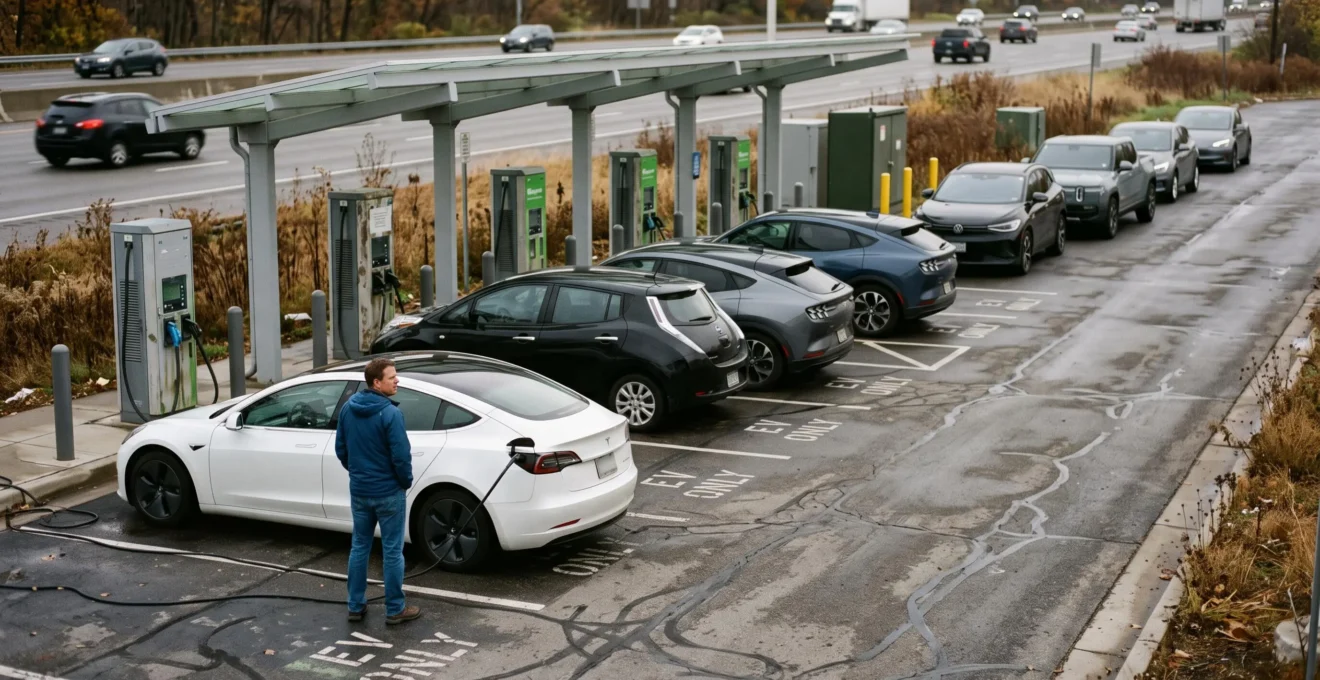
A 200-mile electric vehicle journey should not require a complicated charging strategy. Yet a single unavailable connector, an unexpected payment problem or a queue at the wrong motorway services can turn a straightforward drive into an unpredictable afternoon.
Smart charging networks promise live availability, integrated payments and better use of charging infrastructure. Those features are useful, but they do not eliminate the gap between what an app displays and what happens when a driver reaches the charger. Nor do they guarantee the fastest charging speed or the lowest price.
The most reliable approach is to treat charging information as a planning tool rather than a promise. Check compatible stations, prepare alternative networks, understand the applicable tariff and retain enough battery to change plans. These habits matter particularly when travelling unfamiliar routes, where charging options may be widely spaced and mobile coverage unreliable.
With a few decisions made before departure, public charging becomes less dependent on luck, even when the network itself is imperfect.
Smart EV charging: What matters most
- Availability is not reliability: Check recent charger activity and driver reports rather than trusting a single green status indicator.
- Keep another option within range: Prepare backup locations on different networks and decide when to use them.
- Compare total charging costs: Account for subscriptions, session fees, time-based pricing and the extra time spent waiting.
- Why Do Public Chargers Show « Available » but Fail When You Plug In?
- How to Plan a Multi-Network Charging Route With a 2-Stop Backup Plan?
- Subscription Charging or Pay-As-You-Go: Which Is Cheaper After 800 Miles a Month?
- The Peak-Time Charging Habit That Adds 25% to Your Monthly EV Spend
- When Is the Best Time to Fast-Charge to Avoid Slow Speeds and Long Queues?
- Why Do Repeat Repairs Happen After 2 Garage Visits for the Same Issue?
- Why Do Short Trips Destroy Reliability Even in « Bulletproof » Cars?
- Which Roadside Assistance Cover Actually Gets You Recovered in Under 90 Minutes?
Why Do Public Chargers Show « Available » but Fail When You Plug In?
Public chargers can appear available because their app status does not always reflect their physical condition or ability to start a session. A charger may be communicating normally while its connector, payment terminal or vehicle authentication process fails. It may also be blocked by another vehicle. A green indicator is therefore a useful signal, not confirmation that charging will work.
Charging operators collect information from equipment using communication protocols such as OCPP, while data-sharing systems such as OCPI distribute availability information to other services. That information can be delayed, incomplete or interpreted differently across applications.
The distinction between a live charging session and a last-known status matters. A recently updated session indicator provides stronger evidence of activity than an availability label with an old timestamp. Even a recent update cannot rule out damaged equipment or physical obstruction.
99%
The UK requires qualifying public rapid-charging networks rated at 50 kW and above to meet a 99% annual average reliability standard across the operator’s relevant network. This is not a guarantee for an individual charging visit.
The UK rules also distinguish statuses such as BLOCKED and UNKNOWN. They recognise that payment-terminal faults can contribute to charger downtime. However, these regulatory categories do not establish how often apparently available chargers fail during real-world plug-in attempts, and the requirements do not apply automatically outside the UK.
When charging fails, start with a brief diagnosis rather than repeatedly initiating the same session.
- Inspect the connector and cable visually for obvious damage, contamination or poor seating. Do not touch connector contacts or attempt repairs.
- Check the charger screen and app for authentication, payment or hardware error messages.
- Try an adjacent compatible stall if it is safe and available.
- Check whether the vehicle reports a charging or connection fault.
- Record the stall ID, error code and time before contacting the operator.
Report the specific failure through the charging operator’s app or support number. In the UK, operators covered by the relevant regulations must provide a free, staffed 24-hour helpline. Elsewhere, support arrangements vary by provider.
If a payment was taken without the expected energy being delivered, retain the receipt and request a transaction review. Some operators may issue refunds or goodwill credits, but compensation is not automatic. Ask the provider to confirm the resolution in writing.
Before depending on an unfamiliar station, compare its network app with recent driver comments on an independent service such as PlugShare. A recent successful session is helpful evidence, although it cannot guarantee the charger will remain operational.
Once charger-status uncertainty is understood, the next safeguard is straightforward: design a route that can tolerate one failed stop without turning a manageable journey into a range emergency.
How to Plan a Multi-Network Charging Route With a 2-Stop Backup Plan?
A multi-network charging route works best when each planned fast-charge stop has an accessible alternative, preferably on a different operator’s network. For a journey involving two charging stops, prepare a backup for each leg rather than assuming one spare charger protects the entire trip. Confirm connector compatibility, payment access and remaining range before departure, then establish clear conditions for switching plans.
Start with your vehicle’s route planner or an EV-specific planning application. Identify fast chargers that suit the car’s DC charging connector, supported adapters and charging capabilities. Then check each location against the operator’s own information.
The U.S. Department of Energy‘s Alternative Fuels Data Center information for EV consumers recommends checking compatible public charging locations and ensuring the vehicle can cover the distance between them. It also highlights the importance of allowing extra range for factors such as terrain, vehicle loads and climate-control use.
A practical backup search can begin with chargers approximately five to ten minutes off-route, but this is a planning preference, not a validated universal standard. In sparsely served areas, the closest suitable alternative may be much farther away.
Hypothetical example: A 200-mile route with two charging opportunities
Imagine a driver choosing a primary fast charger around the midpoint of a 200-mile journey and identifying a second charging location farther along the corridor. Both locations are checked for vehicle compatibility.
For each location, the driver saves an alternative on another network. If the midpoint charger becomes unavailable, the decision to continue depends on whether the car’s remaining estimated range, including a safety margin, covers the alternative. The second planned location provides another opportunity to charge, not a substitute for maintaining adequate reserve.
This is an illustrative route structure, not a measured journey or a guarantee that the selected stops will be operational.
Before departure, activate the relevant charging apps, add payment methods and verify whether an existing RFID card or roaming service actually works at the chosen stations. A roaming arrangement may cover several operators without covering every location or tariff.
Also compare stopping strategies. Many vehicles charge more quickly at moderate or lower states of charge than near full capacity. Two shorter sessions may outperform one long session if the car’s charging curve, station locations and total detour time support that choice. Additional stops can also introduce more opportunities for queues, so the optimum is vehicle- and route-specific.
A backup is most useful when the driver knows exactly when to activate it.
Five checks to complete before leaving
- Save the primary stops: Produce a route with the addresses and identifiers of each intended charging location.
- Identify an alternative for each leg: Save compatible backup stations on different networks and note their additional driving distance.
- Verify payment access: Confirm that the required apps, accounts, cards or supported contactless options are ready. Keep a list of accepted methods.
- Calculate the reserve: Record the estimated arrival charge at each primary and backup station using realistic driving conditions.
- Write down switching triggers: Set a maximum acceptable queue, define what counts as an unusable charger and record when continuing to the backup is safe.
A route with alternatives reduces the consequences of charger failure, but the cheapest charging option is not necessarily the one with the lowest advertised electricity rate. Payment arrangements deserve the same preparation as station availability.
Subscription Charging or Pay-As-You-Go: Which Is Cheaper After 800 Miles a Month?
A charging subscription is cheaper after 800 miles a month only when its actual discounts exceed the membership fee and any additional charges. Monthly mileage alone cannot establish the break-even point. The result depends on vehicle efficiency, how much electricity is purchased publicly and whether the subscription applies to the networks used on regular journeys.
The simplest comparison begins with energy consumption rather than distance. Estimate your monthly charging demand, then isolate the portion purchased from public stations. Home and workplace charging should not be priced as though every kilowatt-hour were bought from a rapid charger.
For the relevant public charging sessions, use:
Subscription cost = Monthly membership fee + discounted energy charges + applicable additional fees.
Pay-as-you-go cost = Standard energy charges + applicable additional fees.
Where the subscription applies to every relevant session and both options have the same additional fees, the break-even energy volume is the monthly fee divided by the discount per kWh.
Hypothetical comparison: 800 miles per month
Assume an EV consumes 0.30 kWh per mile and half its monthly driving energy is purchased from public chargers. Over 800 miles, that produces an illustrative 240 kWh of driving consumption, of which 120 kWh is allocated to public charging. Actual purchased energy may be higher because of charging losses.
Suppose a subscription costs £10 per month and reduces the applicable public charging rate by £0.10 per kWh. At 120 eligible kWh, the illustrative discount is £12. After the membership fee, the saving is £2 before other charges.
At 60 eligible kWh, the illustrative discount falls to £6, leaving the subscription £4 more expensive than pay-as-you-go. These are invented teaching assumptions, not current operator tariffs or market benchmarks.
Network eligibility can reverse the calculation. A driver who travels across several operators may find that only some sessions receive the member price. Additional costs such as connection fees, parking charges, idle penalties or session minimums can also change the comparison.
The U.S. Department of Energy’s information on charging infrastructure costs and pricing describes per-kWh, session-based, time-based and subscription pricing structures, including different rates for members and non-members.
The practical choice depends on how consistently a driver uses eligible networks.
| Driving situation | Subscription | Pay-as-you-go |
|---|---|---|
| Occasional long-distance travel | Membership cost may outweigh discounts. | No recurring fee may make occasional sessions cheaper. |
| Frequent travel on one network | Can offer savings if eligible charging volume exceeds break-even. | Standard rates may cost more over repeated sessions. |
| Regular multi-network journeys | Value depends heavily on partner coverage and roaming terms. | Offers flexibility but requires individual tariff comparisons. |
| Mostly home or workplace charging | May be unnecessary if public use is limited. | Often simpler for infrequent public charging. |
Review auto-renewal rules, cancellation deadlines and partner-network coverage before subscribing. These terms vary by provider and should be checked against the current contract. Compare actual invoices with the equivalent standard tariff every billing cycle, particularly when travelling patterns change.
Even a well-chosen tariff can become expensive when charging sessions repeatedly occur at inconvenient times. Understanding when prices and occupancy change is the next part of keeping journey costs predictable.
The Peak-Time Charging Habit That Adds 25% to Your Monthly EV Spend
Charging during expensive tariff periods can increase monthly EV costs, but a 25% increase is not a universal or established premium. The actual difference depends on whether an operator uses time-dependent pricing, the hours that qualify and how much energy you buy during those periods. Peak charging may also involve queues, adding a time cost even when the electricity price stays unchanged.
Electricity demand changes throughout the day, and some charging operators offer tariffs reflecting those conditions. However, the electricity rates paid by a charging-site operator are not necessarily passed directly to drivers. A network facing higher demand charges does not automatically apply an equivalent retail surcharge.
For drivers, the relevant number is the difference between the actual advertised peak and off-peak prices for the same charging service.
Calculate the premium using:
Percentage uplift = (Peak price − Off-peak price) ÷ Off-peak price × 100.
Hypothetical example: What a 25% premium means
Assume a charger costs £0.40 per kWh off-peak and £0.50 per kWh during a defined peak period. The peak rate is 25% higher.
For 100 kWh purchased at those respective rates, the illustrative energy charge changes from £40 to £50. The difference is £10, before any additional fees.
If only some monthly charging occurs at the higher rate, the uplift in the driver’s total charging bill will be smaller. These prices are hypothetical and do not describe a specific network.
Time-dependent prices are worth examining particularly at managed destination chargers where a driver can control when charging starts. Overnight hotel charging, workplace charging and scheduled AC sessions may offer opportunities to shift consumption, provided the location actually publishes a cheaper tariff and the vehicle can remain connected legitimately.
DC fast charging requires a different decision. On a long-distance trip, spending extra driving time to reach a discounted charger may cost more in inconvenience than the tariff saves. The right comparison includes energy cost, detour distance, waiting time and the additional range required.
High-demand periods can also increase competition for stalls. That creates two possible consequences of the same timing habit: higher prices where a peak tariff exists, and longer waits where charger occupancy rises.
A useful monthly review separates paid energy from waiting time. Check the timestamps and prices on recent receipts, identify recurring expensive sessions and test whether a less disruptive charging window exists.
Price is only one part of timing. On a journey, battery temperature, charging curves and the number of occupied stalls can affect the arrival-to-departure time more than a small difference in the electricity tariff.
When Is the Best Time to Fast-Charge to Avoid Slow Speeds and Long Queues?
The best time to fast-charge is when your chosen station has spare capacity and your battery is prepared to accept a useful charging rate. There is no universally quiet hour. Traffic patterns, holiday travel, station design and local demand all matter. Check recent occupancy before committing to an exit and preserve enough battery range to reach another charger if conditions deteriorate.
Busy travel corridors may experience congestion around major departure and return periods, including holiday weekends, Friday afternoons and Sunday evenings. These are sensible periods to monitor, not evidence that every station will be crowded at those times.
Compare live stall occupancy with recent user reports on the operator’s application or an independent charging map. A site with several working, compatible stalls may be more resilient to arrivals than a location with only one suitable connector, although availability can change during the drive.
Charging speed is also affected by the vehicle itself. A charger’s advertised maximum power does not mean the battery will receive that power continuously.
Some charging installations share power electronics between multiple stalls. Depending on their architecture and power-management settings, simultaneous charging can reduce the power available to individual vehicles. Other installations provide different power-sharing arrangements, so an occupied neighbouring stall does not always imply slower charging.
Battery temperature matters too. A cold battery may accept energy more slowly, while many EVs can warm the battery before reaching a selected fast charger. The U.S. Department of Energy’s advice on winter EV charging explains preconditioning and notes that most batteries reduce fast-charging power between approximately 80% and 100% charge.
That upper-range slowdown makes it worth comparing several shorter sessions with charging almost to full at one stop. However, charging curves differ between models, and arriving with an extremely low battery is not automatically slower. Battery temperature and vehicle-specific controls determine the result.
When a queue appears, estimate whether waiting or diverting is quicker. Compare the expected wait plus charging time at the current location against the travel time to a backup, its expected wait and charging time there. Only consider the diversion when the vehicle can reach the alternative with an appropriate reserve.
For a hypothetical comparison, imagine a current station where the estimated wait is 25 minutes and charging would take another 20 minutes. If a compatible alternative is 10 minutes away, has no reported queue and would require 20 minutes of charging, the alternative could save 15 minutes before accounting for uncertainty. These durations are illustrative, not measured predictions.
Do not rely on reaching a charging hub almost empty. Keeping a buffer preserves the option to bypass a queue, particularly where the next available station is distant.
When the same charging problem occurs at several otherwise unrelated stations, however, timing and network choice may not be responsible. Repeated failures deserve a more systematic vehicle-side diagnosis.
Why Do Repeat Repairs Happen After 2 Garage Visits for the Same Issue?
Repeat repairs happen when a recurring fault is treated as an isolated symptom rather than traced to its underlying cause. For an EV that repeatedly fails to charge, the problem may involve the public charger, vehicle charge port, software communication or high-voltage charging components. Two unsuccessful garage visits do not prove a particular diagnosis, but they justify requesting clearer evidence and a documented investigation.
Public charging failures can be difficult to diagnose because the vehicle, charger, communication systems and payment service must all cooperate. A failed session on one network does not necessarily mean the vehicle is defective. Equally, failures across multiple independent networks should not automatically be dismissed as infrastructure problems.
A useful diagnostic approach compares circumstances rather than repeatedly changing settings without recording the result.
- AC charging works but DC charging repeatedly fails: This narrows the investigation toward systems involved in DC charging, although it does not identify the faulty component.
- Charging fails on several independent networks: Vehicle-side issues become more important to investigate, alongside compatibility and authentication factors.
- Only one operator produces failures: The network’s equipment, payment process or vehicle interoperability may deserve closer attention.
- Problems follow a vehicle software change: Record the software version and check manufacturer notices, without assuming the update caused the problem.
Keep a charging-failure log containing dates, locations, stall IDs, charger types, error messages and vehicle state of charge. Photographs of relevant displays and connectors can be useful. If possible, document whether the same connector worked with another compatible vehicle, but do not interfere with another driver’s session.
For a dealer or service centre, this evidence is more actionable than a general statement that charging sometimes stops. Ask whether the technician can retrieve relevant diagnostic trouble codes or charging-event logs, and request a written explanation of what was tested.
When a fault recurs after repair, reopen the case with the previous repair records attached. Seek escalation through the manufacturer or operator’s formal complaint process as appropriate.
Consumer remedies depend on the country, transaction, warranty terms and fault history. UK consumers may have relevant rights under the Consumer Rights Act 2015; in the United States, state-specific warranty and lemon-law protections may apply in qualifying circumstances. Neither framework guarantees replacement, compensation or reimbursement merely because two repair attempts occurred.
Do not accept an app reset as a complete diagnosis when the underlying failure remains unexplained. A reset may restore service temporarily without addressing why the fault occurred.
A reliable charging experience depends on both sound infrastructure and a vehicle operating as intended. Everyday charging habits also affect battery performance and the number of times a driver must interact with public networks.
Why Do Short Trips Destroy Reliability Even in « Bulletproof » Cars?
Short trips do not inherently destroy EV reliability, even when a vehicle has a reputation for durability. Unlike combustion-engine cars, battery-electric vehicles do not experience the same engine cold-start wear. The more relevant concerns are repeated charging habits, battery temperature and time spent at high states of charge. Their impact depends on vehicle design, battery chemistry and operating conditions.
The distinction matters because a driver making many short journeys may charge more frequently without actually needing to. Frequent public charging sessions expose the driver to additional payment steps, charger availability problems and potentially higher energy prices.
That creates practical inconvenience rather than proof of accelerated mechanical failure.
Battery ageing is more nuanced. Keeping many lithium-ion batteries at very high states of charge for extended periods, particularly in warm conditions, can contribute to degradation. However, manufacturers use different battery chemistries and management strategies. Some recommend periodic full charges for battery calibration or particular battery types.
Follow the vehicle’s charging guidance rather than assuming that one charge limit suits every EV. A moderate everyday charging target may be appropriate for many vehicles, while a higher target can be reasonable before a long journey.
Cold-weather use adds another variable. Short drives may provide limited opportunity for the battery to warm naturally. If the driver immediately starts a DC fast-charging session, the vehicle may restrict charging power to protect the battery. Supported preconditioning features can help prepare the battery when a fast charger is selected as the destination.
To distinguish perceived battery deterioration from measured loss, check whether the manufacturer provides a battery health assessment or an authorised diagnostic procedure. Estimated driving range alone is not a definitive battery-health measurement because temperature, recent efficiency and driving conditions influence the display.
When reviewing charging habits, focus on whether the vehicle frequently remains parked at a high charge level, how often public fast charging is genuinely necessary and whether cold-weather charging conditions are being managed appropriately.
A highly regarded EV can still become inconvenient if its charging routine poorly matches the driver’s travel pattern. Conversely, a vehicle with mostly short trips may perform well when charged appropriately and maintained according to manufacturer guidance.
Better habits reduce avoidable complications, but they cannot eliminate the possibility of an unexpected failure. Long-distance drivers also need to know what happens when neither the vehicle nor a charging station can get them moving again.
Key takeaways before the unexpected happens
- Preserving range is also preserving choice: the ability to reach another working charger may prevent a roadside recovery.
- A failed charging session and a vehicle breakdown are not necessarily treated the same way by an assistance policy.
- Recovery arrangements should be checked before travelling, especially where compatible charging options are sparse.
Which Roadside Assistance Cover Actually Gets You Recovered in Under 90 Minutes?
No roadside assistance policy can be assumed to guarantee EV recovery within 90 minutes in every situation. Actual response times depend on location, provider availability, traffic, vehicle requirements and policy conditions. The most useful cover is one that explicitly addresses EV breakdowns, depleted batteries and suitable vehicle transportation, while clearly explaining where recovery will take you and when service limits apply.
Headline response-time promises need careful reading. Some providers distinguish initial attendance from completed recovery. Others specify targets rather than enforceable guarantees, with exceptions for remote areas, severe weather or unusual demand.
Before purchasing or relying on assistance, ask whether the published response time refers to a technician arriving, the vehicle being repaired or the vehicle reaching a recovery destination.
EV compatibility is particularly important. Many EV manufacturers impose restrictions on towing with driven wheels on the road. Depending on the vehicle, flatbed transport or another manufacturer-approved recovery method may be required. An operator should follow the vehicle’s recovery instructions rather than assume that conventional towing is appropriate.
Coverage for running out of charge deserves separate scrutiny. A policy may provide transport to a nearby charging station, limited assistance for an immobilised vehicle or another form of recovery. A depleted battery is not automatically handled like a mechanical breakdown.
There is also a less obvious scenario: the vehicle is functional but cannot continue because the only reachable public charger is unavailable. Standard breakdown assistance may not treat lack of usable infrastructure as a covered mechanical fault.
Compare providers using the questions that determine the outcome, not just the advertised response time.
| Policy feature | Question to ask | Why it matters |
|---|---|---|
| Response commitment | Is the time a target or a contractual guarantee, and what exclusions apply? | Attendance time may differ from total recovery time. |
| EV transportation | Can the provider arrange manufacturer-approved towing or transport? | Incorrect recovery methods can damage the vehicle. |
| Out-of-charge assistance | Does the policy explicitly cover a depleted traction battery? | Some services distinguish battery depletion from breakdown. |
| Recovery destination | Will the vehicle go to a charger, repairer, home or chosen destination? | The nearest charger may not solve the driver’s travel problem. |
| Failed charging infrastructure | What happens if no reachable working charger is available? | Infrastructure unavailability may fall outside standard cover. |
| Geographical limits | Are motorways, remote areas and cross-border journeys included? | Coverage and dispatch options may change by location. |
Before travelling, check whether assistance is already included with the vehicle manufacturer’s warranty or service package. Compare that entitlement with any third-party membership to identify genuine gaps rather than paying twice for overlapping benefits.
Save the direct dispatch number, policy identification details and emergency contact instructions somewhere accessible without an internet connection. Do not assume an assistance app will function offline; verify its capabilities in advance. In a hazardous roadside situation, follow local emergency guidance rather than delaying safety measures to contact a membership provider.
Finally, ask what happens after dispatch. A prompt technician arrival is of limited value if suitable transport is unavailable or the policy only moves the vehicle to a charging location that cannot provide a compatible, working connection.
Before your next 200-mile journey, save two compatible charging alternatives, confirm payment access, check your battery reserve and review the EV-specific terms of your roadside assistance. That short pre-departure routine gives you practical options when a supposedly smart charging network does not behave as expected.
Can I trust a charging app that says four stalls are available?
The display indicates reported availability, not guaranteed usability. Check when the information was updated, look for recent successful charging sessions and confirm that the available connectors suit your vehicle. If the station is essential to your journey, keep another compatible location within your remaining driving range.
Do I need a separate app for every public charging network?
Not necessarily. Some charging networks accept contactless bank cards or support third-party roaming services, allowing drivers to use one application or RFID card across participating operators. Availability depends on the network, charger and country. Check accepted payment methods before travelling, because roaming coverage does not automatically include every station.
Should I charge my EV to 100% before every long journey?
Not automatically. The appropriate departure charge depends on vehicle guidance, battery chemistry, expected driving conditions and the distance to suitable chargers. Many EVs charge more slowly toward the upper end of their battery capacity, so charging to 100% during an intermediate fast-charging stop may add unnecessary time. A higher departure charge can still be sensible when the next reliable charger is distant.
What should I do if a charger takes payment but delivers no electricity?
Record the stall ID, transaction reference, time and displayed error. Contact the charging operator to establish whether the transaction was completed, cancelled or temporarily authorised. Request an appropriate refund review when payment was captured without the expected charging service. Keep the operator’s response and your payment records; reimbursement procedures and consumer rights vary by jurisdiction.
Can a route planner guarantee I will never wait for an EV charger?
No. Even a route planner using live occupancy information cannot guarantee that a stall will remain free or operational when you arrive. The best defence is to combine current station information with compatible backup locations, reliable payment access and enough driving range to change stops. This reduces exposure to queues without eliminating uncertainty.