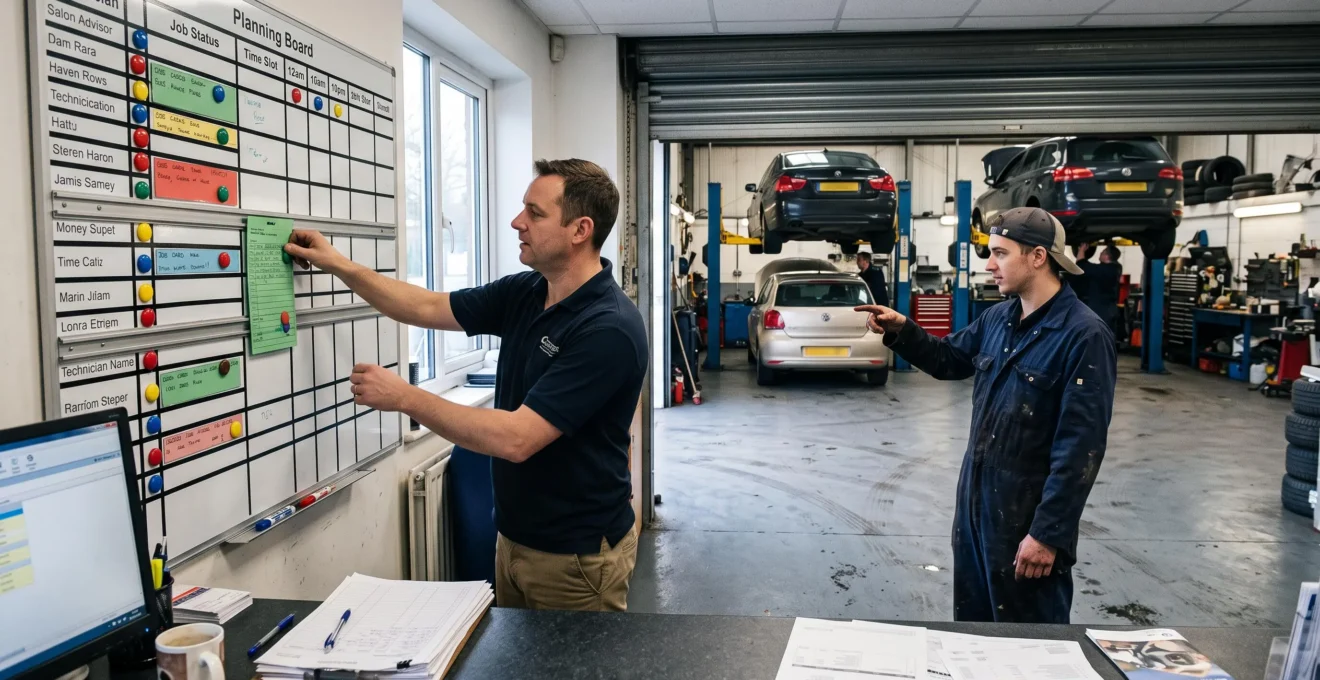
A garage can confirm your appointment weeks in advance and still miss the promised collection time. The reason is often straightforward: reserving a date does not necessarily reserve the technician, service bay, parts and diagnostic time required to finish the job.
Advanced workshop scheduling addresses that mismatch. Instead of filling an appointment calendar alone, a capacity-based system matches each job to available resources, accounts for uncertainty and updates the schedule when conditions change. Confirmation reminders and clearer booking information can also help workshops manage missed appointments and unexpected work.
For drivers, the benefit is a more dependable handover and collection process. For small fleet operators, it means scheduling maintenance around actual vehicle availability rather than discovering too late that several vehicles will be off the road together.
A 40% reduction in waiting time is a possible improvement target, not an established industry-wide result. The supplied evidence does not substantiate that specific percentage. Whether a workshop achieves it depends on its starting performance, job mix and scheduling discipline. The practical goal is to eliminate avoidable waiting without assuming that more staff are required.
Workshop scheduling: the essentials
- A confirmed appointment is more dependable when technician time, bay availability, parts and diagnostic requirements are considered together.
- Accurate booking descriptions, parts confirmation and agreed collection expectations reduce preventable scheduling surprises.
- Fleet maintenance tracking and staggered servicing make vehicle downtime easier to anticipate and manage.
- Why Do Garages Miss Your Collection Time Even When You Booked Weeks Ahead?
- How to Book a Service Slot So the Garage Can’t ‘Guess’ the Time Needed?
- Dealer Scheduling or Independent Garage: Which Gives Faster Turnaround for Simple Jobs?
- The Booking Description Mistake That Gets Your Car Turned Away on Arrival
- When Is the Best Time to Book Car Maintenance to Avoid 2-Week Delays?
- When Should You Schedule Servicing to Avoid Losing Capacity During Peak Weeks?
- How to Set Up Maintenance Tracking in 20 Minutes Without Buying Any Software?
- How Maintenance Tracking Prevents the « I Forgot » Repair That Costs £900
Why Do Garages Miss Your Collection Time Even When You Booked Weeks Ahead?
Garages miss collection times because an appointment date does not always guarantee sufficient workshop capacity. A confirmed booking can still be delayed by extended diagnostics, unavailable parts or urgent work entering the queue. Booking weeks ahead secures a place in the calendar, but it does not automatically protect the estimated completion time.
The essential distinction is between calendar booking and capacity-based booking. Calendar booking records when a vehicle arrives. Capacity-based booking considers when the required technician, equipment, parts and service bay can realistically complete the job.
Consider a hypothetical workshop with one technician qualified to investigate a particular electrical problem. Two vehicles may have confirmed appointments on the same morning, but if the first diagnosis takes longer than allocated, the second cannot progress on schedule. The calendar contains both reservations, yet the specialist’s capacity has been exceeded.
Three operational disruptions explain many potential collection-time overruns:
- Extended diagnosis: An intermittent or complex fault requires more investigation than the initial allowance.
- Parts availability: An additional component becomes necessary after the vehicle is inspected or dismantled, and the part cannot be obtained immediately.
- Unplanned urgent work: A safety-critical repair or urgent customer request competes with previously allocated resources.
These disruptions can combine. A delayed diagnosis leaves less time for the repair; a late part arrival can then push the job into another technician’s allocation. Workshops that lack contingency capacity may transfer the delay to subsequent appointments.
Before confirming a booking, ask three questions: Is technician capacity reserved for this job? Are the expected parts available or being ordered? What happens if the diagnosis exceeds the allotted time?
For a fleet, the consequences extend beyond one collection. A delayed vehicle may miss its planned route, require a replacement driver or disrupt the allocation of other vehicles later that day. The resulting operational delay may be larger than the initial workshop overrun.
A useful measure is the difference between the promised collection time and actual collection time, recorded alongside the reason for each variance. Workshop operators can review this information by job type to identify where scheduling estimates need improvement.
A reliable collection promise therefore starts with the resources behind the booking. The next step is ensuring the garage understands the work well enough to estimate those resources.
How to Book a Service Slot So the Garage Can’t ‘Guess’ the Time Needed?
Describe the vehicle’s symptoms, operating conditions, previous repair attempts and intended outcome when booking. This helps the garage distinguish routine servicing from a defined repair or an open-ended diagnosis. The more accurately the work is described, the better the workshop can estimate technician time and allocate an appropriate appointment.
Workshop labour estimates are commonly based on standard repair times or actual hours worked. The Federal Trade Commission’s Auto Repair Basics guidance explains these pricing methods and notes that diagnostic work may attract separate charges.
Standard labour times provide a useful starting point for bounded jobs such as an oil change or brake-pad replacement. However, they cannot establish precisely how long an unknown intermittent fault will take to diagnose.
Use four elements when requesting an appointment:
- Symptom: Explain what happens, when it first appeared and how often it occurs.
- Triggering conditions: Identify relevant speed, temperature, weather, engine state or driving conditions.
- Previous work: Mention recent inspections, replaced components and unsuccessful repair attempts.
- Expected outcome: Specify whether the booking is for scheduled maintenance, a known repair or fault investigation.
For a simple service, an effective description might be: « Scheduled oil and filter service due according to the maintenance schedule. No known warning lights or additional faults. Please confirm the required parts and estimated collection time. »
For an intermittent fault, a better description is: « Engine hesitation occurs occasionally after warm-up, particularly during acceleration. The issue began recently. No components have been replaced. The booking is for diagnosis rather than a guaranteed same-day repair. »
These descriptions enable different scheduling decisions. The first job may qualify for a relatively predictable service allocation. The second may require specialist diagnostic equipment, additional testing time and a collection estimate conditional on the investigation.
For a fault that cannot reliably be reproduced, request a suitable extended diagnostic allocation where available. Agree on the initial diagnostic budget and how the garage will communicate its findings before authorising further work.
An extended slot does not guarantee that a fault will be found. It does, however, give the workshop a better opportunity to investigate the reported conditions without presenting the appointment as a routine repair.
Accurate job classification makes scheduling more predictable, but the choice of workshop also matters when availability, specialist capability and parts supply differ.
Dealer Scheduling or Independent Garage: Which Gives Faster Turnaround for Simple Jobs?
Neither dealerships nor independent garages are consistently faster for routine maintenance. The quickest option is generally the provider that can confirm the required parts, allocate sufficient technician capacity and offer the earliest realistic collection time. Warranty conditions and specialist equipment may influence which provider is suitable for a particular vehicle.
Comparing appointment dates alone can be misleading. A garage offering a booking tomorrow may still need to wait for parts, while another offering a later appointment may be ready to complete the work as soon as the vehicle arrives.
Evaluate both options using three measurable criteria: appointment availability, confirmed parts availability and any warranty or contractual restrictions.
| Decision criterion | Dealership | Independent garage |
|---|---|---|
| Routine service availability | Depends on the dealer’s booked workload and resource allocation. | Depends on the garage’s workload, staffing and flexibility. |
| Manufacturer-specific parts | May have access to manufacturer supply channels, but stock still requires confirmation. | May source appropriate parts through independent or manufacturer supply channels. |
| Warranty and contractual conditions | May be appropriate or necessary for certain covered repairs. | May perform routine maintenance without affecting manufacturer warranty rights, subject to applicable law and conditions. |
| Collection commitment | Request a job-specific completion estimate. | Request the same estimate for an equivalent job. |
Dealerships may need to accommodate warranty repairs, recalls and routine customer-paid work within the same operating capacity. Independents may have greater flexibility for some straightforward tasks, but they can also encounter technician shortages or parts delays. Neither pattern establishes a universal speed advantage.
Parts readiness often matters more than workshop type for a defined job. Before comparing the offered appointment dates, provide the vehicle identification details and ask each garage to confirm that the appropriate parts can be available when work begins.
Warranty rules require particular care. In the United States, the FTC guidance on auto warranties and service contracts explains that routine maintenance at an independent provider does not automatically invalidate a manufacturer’s warranty. Certain warranty-covered repairs and optional service contracts can have different requirements.
That US guidance should not be treated as a statement of law for the UK, Canada, Australia or other jurisdictions. Check local rules, the manufacturer’s warranty and any separately purchased service contract.
The operational comparison should therefore use two timestamps: the earliest available booking and the promised return of a driveable vehicle after the defined work is completed.
Once a suitable garage is selected, the remaining risk is a mismatch between the work requested and the actual job discovered when the vehicle arrives.
The Booking Description Mistake That Gets Your Car Turned Away on Arrival
Understating the work required is a major preventable booking mistake. If a driver reserves time for one simple task but arrives needing several additional repairs, the garage may lack sufficient technician capacity, equipment or parts. It may then limit the work, offer a revised collection time or request another appointment.
Consider a hypothetical booking for one replacement tyre. On arrival, the vehicle actually requires two tyres, wheel alignment assessment and investigation of abnormal wear. The original appointment may not provide enough time or resources to address everything safely.
A service slot represents a commitment of workshop capacity. Extending one job into another customer’s allocated time can affect subsequent handovers, technician utilisation and the number of jobs completed that day.
This explains why a workshop may prefer to reschedule additional work rather than accept a job it cannot realistically finish. Such decisions are not evidence that every garage will refuse an incorrectly described booking; they reflect the operational constraints involved.
The most effective prevention is a day-before reconfirmation. Contact the garage to confirm the exact work requested and disclose any change since the original appointment.
For example, if a warning light appeared after booking a routine service, explain the new symptom before arrival. The garage can then advise whether to extend the appointment, arrange a separate diagnostic booking or inspect the vehicle to determine whether it is safe to drive.
Five checks before handing over your vehicle
- Confirm the vehicle registration, mileage and appointment time. Deliverable: a booking confirmation matching the correct vehicle.
- Restate the complete work requested, including any new symptoms. Deliverable: an updated job description acknowledged by the garage.
- Check whether the necessary parts and equipment are expected to be available. Deliverable: confirmation of parts readiness or a clearly stated dependency.
- Agree on the estimate, diagnostic allowance and approval process for additional work. Deliverable: a documented cost or time authorisation arrangement.
- Ask when the vehicle is expected to be ready and how delays will be communicated. Deliverable: a collection estimate and agreed contact method.
Additional work discovered during a repair needs separate consideration. A minor consumable replacement may fit within the existing schedule, provided the customer approves applicable charges. A larger repair may require additional authorisation, technician time or parts that are not immediately available.
The correct response depends on safety, cost, parts supply and the garage’s actual capacity. Customers should understand what has been approved and what remains outstanding before collecting the vehicle.
Correctly describing the job reduces avoidable surprises on the day. Booking far enough ahead of predictable demand peaks addresses another source of delay: finding an appointment in the first place.
When Is the Best Time to Book Car Maintenance to Avoid 2-Week Delays?
The best time to book maintenance is before the vehicle reaches its service deadline and before the garage enters a predictable busy period. There is no universal booking lead time that prevents a two-week delay. Track your preferred garage’s availability, monitor maintenance triggers and arrange appointments while there is scheduling flexibility.
The relevant measure is booking lead time: the elapsed time between requesting an appointment and the earliest suitable slot offered.
Lead time varies with the type of job, garage size, technician availability, local demand and parts requirements. An oil service and a complex electrical diagnosis may have entirely different scheduling constraints, even at the same garage.
Predictable demand pressures can include:
- Periods preceding mandatory vehicle inspections, where applicable.
- Holiday travel periods when drivers want vehicles serviced before departure.
- Seasonal tyre changes and weather-related maintenance demand.
- Long weekends and periods when workshop opening days are reduced.
Rather than assuming a universal two-week queue, record the lead time offered for several appointment requests over the year. Even a small personal history can help identify when your preferred provider becomes harder to book.
Early-week or early-morning appointments may be worth testing, but they are not inherently quieter. Some workshops experience a backlog of weekend breakdowns on Monday mornings, while others prioritise quick-service work at particular times. Ask the garage which slots it normally reserves for predictable maintenance.
Maintenance triggers provide a more dependable basis for planning than arbitrary calendar dates. Use the manufacturer’s mileage and time requirements, adjusted for the specified operating conditions, to identify when a service is due.
Where the service interval and workshop availability allow it, consider beginning the booking process three to six weeks before a known busy period. This is a planning example, not a manufacturer-approved service tolerance or a proven optimal lead time.
The distinction matters: arranging an appointment early is generally different from performing maintenance late. Required servicing should still occur within the applicable vehicle-specific limits.
For one vehicle, the challenge is obtaining a reliable appointment. For a fleet, it becomes coordinating multiple appointments without sacrificing the capacity needed to operate the business.
When Should You Schedule Servicing to Avoid Losing Capacity During Peak Weeks?
Fleet operators should schedule servicing during periods of lower operational demand while limiting the number of vehicles unavailable at any one time. The objective is not simply to find a convenient garage appointment. It is to maintain enough roadworthy vehicles for scheduled work without missing mandatory inspections or manufacturer maintenance requirements.
A single driver manages one appointment. A fleet operator manages a portfolio of maintenance obligations competing with delivery routes, customer bookings and driver availability.
The useful scheduling unit is therefore an operational capacity window: a period when a vehicle can be removed from service without undermining required activity.
Start by identifying the minimum number of vehicles needed during each working week. Then determine how much simultaneous maintenance downtime the fleet can absorb while maintaining an appropriate operational reserve.
For illustration, consider a hypothetical fleet of 20 vans. If the operator’s approved coverage plan requires 18 available vans, scheduling three vans for maintenance at the same time would exceed that illustrative availability allowance unless replacement capacity were arranged.
Staggering maintenance across separate weeks can reduce such conflicts. Vehicles with different service deadlines need not automatically be booked together simply because they were purchased or registered around the same time.
However, safety and compliance take priority over utilisation. Any flexibility must be established from the manufacturer’s requirements, vehicle condition and applicable inspection rules. Safety-critical repairs should not be postponed merely to protect operating capacity.
The UK’s DVSA guide to maintaining roadworthiness recommends planning commercial-vehicle safety inspections at least six months in advance. It recognises manual and electronic planning systems and emphasises ongoing record management.
That guidance applies to the relevant commercial-vehicle operator framework in England, Scotland and Wales. It is not a universal six-month advance-booking requirement for private cars or every light-vehicle fleet.
A practical fleet maintenance plan should distinguish among scheduled preventive work, legally required inspections and immediate safety repairs. Some discretionary service work may be brought forward when permitted. Required inspections and safety-critical repairs cannot simply be deferred to quieter weeks.
Peak-week downtime has two potential consequences: the direct maintenance expense and the commercial activity lost while the vehicle is unavailable. The second cost is especially important when customers cannot be served by another vehicle.
Reviewing the fleet’s own workload calendar against the maintenance calendar makes this trade-off visible. Operators can then allocate appropriate maintenance windows without depending exclusively on a garage’s preferred appointment dates.
Staggering maintenance becomes substantially easier when every vehicle’s next service date and mileage trigger are recorded in one accessible tracking system.
How to Set Up Maintenance Tracking in 20 Minutes Without Buying Any Software?
You can establish a basic maintenance tracking system in approximately 20 minutes using a spreadsheet or phone calendar, provided your existing service records are accessible. Record each vehicle, its latest maintenance, mileage and next service deadline. Then create reminders before those deadlines so appointments can be arranged proactively.
The important part is not the software. It is recording the next action trigger rather than storing completed work without a follow-up date.
Start with the vehicle service booklet, previous invoices, available manufacturer records and any reliable information supplied by a previous owner. These documents help establish what work has already been completed and which intervals may be approaching.
For each vehicle, create the following columns:
| Field | What to record | Purpose |
|---|---|---|
| Vehicle | Registration or internal fleet identifier | Links the record to the correct vehicle. |
| Maintenance performed | Service or repair description | Establishes completed work. |
| Service mileage | Odometer reading at the intervention | Supports mileage-based tracking. |
| Next deadline | Manufacturer-specified mileage or date | Identifies when action is required. |
| Reminder | Advance review date or mileage threshold | Creates time to arrange the appointment. |
As an optional workflow, set a reminder at 80% of a defined maintenance interval. For a hypothetical 10,000-mile interval, that would mean reviewing the next booking after 8,000 miles have elapsed since the previous service. This is an administrative reminder, not a replacement for the manufacturer’s required service interval.
Mileage-based reminders require updated odometer readings. Calendar notifications alone cannot accurately determine mileage if the vehicle’s usage varies, so review the actual mileage regularly.
For several vehicles, excessive individual notifications may become difficult to manage. A practical alternative is a single monthly fleet review, supported by urgent deadline alerts where necessary. During that review, update mileage, check approaching deadlines and identify vehicles that need bookings.
A monthly review must not override an earlier inspection or service requirement. Vehicles with heavy usage or short inspection intervals may need more frequent monitoring.
The system should also distinguish an appointment being booked from the work being completed. After each intervention, update the record using the actual invoice, date and odometer reading, then establish the next due date.
This closes the tracking loop. Without that final update, even a carefully maintained calendar will eventually become unreliable.
A maintenance log is most valuable when it changes decisions before a problem develops. The final connection is between those timely decisions and the repair costs they may help avoid.
Key takeaways before the next service is due
- Review overdue maintenance against vehicle condition and manufacturer requirements rather than assuming that every missed interval causes the same damage.
- Use recorded service history to distinguish preventable scheduling failures from unexpected mechanical faults.
- Track whether maintenance is increasingly planned or reactive, and investigate the causes of recurring emergency work.
How Maintenance Tracking Prevents the « I Forgot » Repair That Costs £900
Maintenance tracking helps prevent costly forgotten repairs by identifying service deadlines before neglected components deteriorate or minor problems develop into larger failures. A missed service does not automatically cause a £900 repair, and no single repair cost applies across vehicles. The financial benefit comes from detecting maintenance needs early enough to act.
The underlying mechanism is a potential maintenance failure cascade. A small task is missed, deterioration continues unnoticed, and a more expensive component may eventually require attention.
For example, repeatedly extending engine-oil replacement beyond the applicable interval can increase the risk of accelerated wear. Inadequate tyre pressure can contribute to irregular wear and higher fuel consumption. Missing a specified timing-belt replacement can expose certain engines to particularly expensive failure risks.
These outcomes are vehicle-dependent rather than inevitable. Engine design, maintenance history, driving conditions, the severity of neglect and the specific fault all affect the consequences.
The £900 figure should therefore be treated as an illustrative repair-cost scenario, not a verified average saving or a universal consequence of forgetting maintenance.
UK government guidance on vehicle roadworthiness directs drivers to consult the vehicle handbook for servicing and routine checks. It also makes clear that a vehicle can be unsafe even when it has a current MOT certificate.
For cars and light vans within the stated UK rules, the minimum tyre-tread depth is 1.6 mm across the specified central portion of the tyre and around its circumference. Different requirements may apply to other vehicle categories and jurisdictions. Meeting a minimum tread requirement does not establish that a tyre is otherwise safe.
These distinctions reinforce the need to separate routine maintenance reminders from safety-critical decisions. Tracking supports compliance and early action; it does not justify continuing to operate an unsafe vehicle until a convenient appointment becomes available.
A useful operational indicator is the proportion of maintenance interventions that were planned rather than reactive over the previous 24 months.
Classify each historical visit as planned maintenance or unplanned repair. Then review the pattern and its causes. A high share of emergency interventions may indicate missed servicing, but it may also reflect ageing vehicles, unexpected defects or demanding operating conditions. The ratio is a diagnostic tool, not proof of negligence.
Planned maintenance creates scheduling choice. An advance reminder allows drivers and fleet operators to compare garages, confirm parts, reserve suitable technician time and select a collection arrangement that fits their commitments.
Emergency work sharply reduces that flexibility. When a vehicle is unsafe or unusable, the priority becomes obtaining a suitable repair rather than selecting the most convenient appointment.
For operators evaluating advanced scheduling, compare waiting times and vehicle downtime before and after adopting a more structured process. Define waiting time consistently, record missed appointments and collection overruns, and distinguish maintenance-related downtime from unrelated breakdowns.
If the operational goal is a 40% reduction in waiting time, results should be calculated against an established baseline using comparable jobs. A scheduling system should be judged by documented performance rather than the percentage in a headline.
Start with the next vehicle due for maintenance: verify its service deadline, update its history, describe the required work accurately and request an appointment with confirmed parts and a realistic collection estimate. Repeat that process consistently, and the workshop schedule becomes a practical tool for reducing avoidable disruption rather than another source of uncertainty.
Can workshop scheduling really reduce waiting time by 40% without hiring more staff?
A 40% reduction is a target that would need to be demonstrated using actual workshop performance data. Capacity-based scheduling can reduce avoidable waiting by improving resource allocation, booking accuracy, parts readiness and communication. The achievable improvement depends on the workshop’s initial inefficiencies and cannot be assumed for every garage.
How can appointment reminders help reduce garage no-shows?
Appointment reminders give customers an opportunity to confirm attendance, update their requirements or cancel in advance. A workshop can then attempt to reallocate released capacity. Measure the effect by comparing missed appointments before and after introducing reminders, using consistent definitions and comparable booking periods.
What should a garage booking confirmation include?
A useful confirmation identifies the vehicle, appointment date, requested work, expected handover arrangement and any preparation required. It should also clarify whether the stated collection time is a firm commitment or an estimate subject to diagnosis, additional approval or parts availability.
Is specialist workshop scheduling software necessary for a small fleet?
No. A small fleet can begin with a spreadsheet, calendar reminders and a consistent maintenance review procedure. Specialist software may become useful when coordinating numerous vehicles, technicians, suppliers and live workshop updates. The necessary features depend on operational complexity, not simply the number of vehicles.
Which metrics show whether a workshop scheduling process is improving?
Track booking lead time, average customer waiting time, on-time vehicle collection, missed appointment rate, parts-related delays and vehicle downtime. Measure technician and bay utilisation where reliable data is available. Compare results across equivalent job categories and account for changes in demand, staffing and repair complexity before attributing improvements to scheduling.