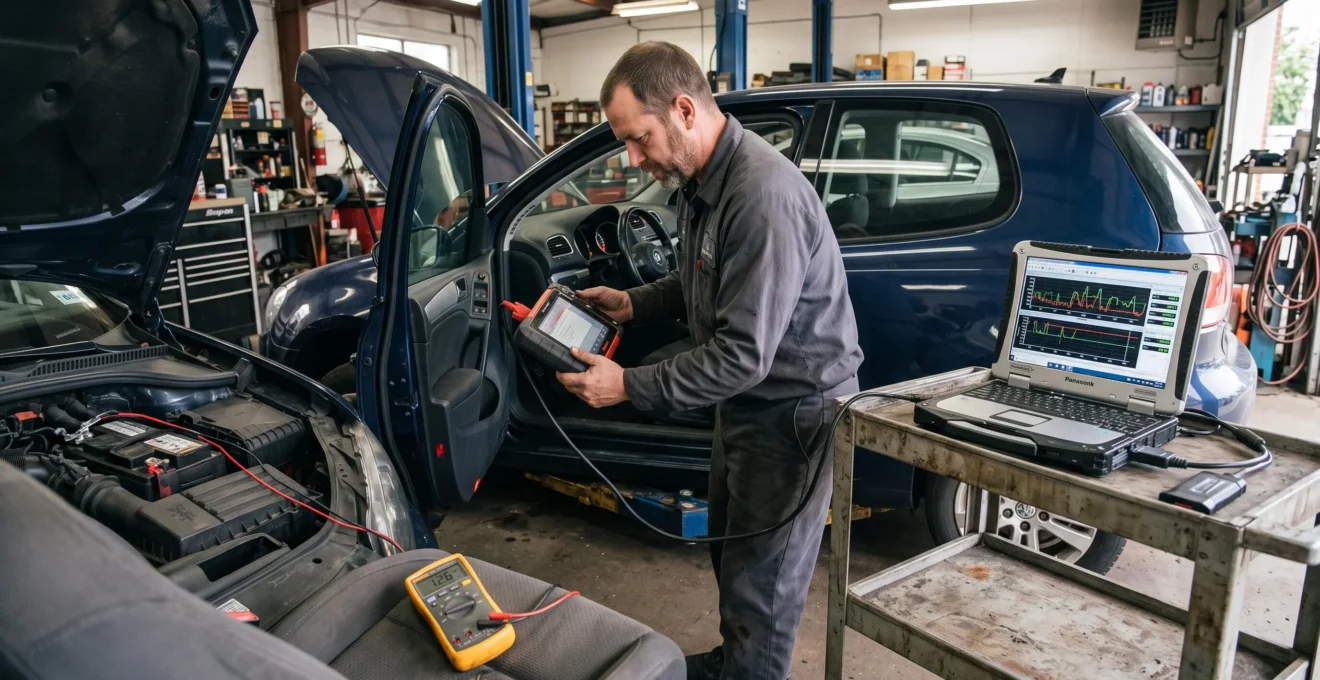
A car jerks between gears, hesitates when accelerating, or develops a worrying vibration. The obvious suspect seems mechanical: a worn gearbox, damaged clutch, or failing engine component. Yet the actual cause could be an electrical connection, an unreliable sensor signal, or a power-supply problem.
Modern vehicles operate through constant cooperation between mechanical components and electronic control systems. Sensors report what is happening, control modules interpret those signals, and actuators adjust physical operations. When one electrical message becomes unreliable, a perfectly functional mechanical component may behave as though it is failing.
Misreading that relationship can become expensive. A driver may pay for a replacement component that was never defective, then face another diagnostic bill when the original problem returns.
The solution is not to assume every unusual symptom is electrical. It is to describe the symptoms precisely, investigate shared causes, and demand measurable evidence before authorizing major repairs.
Mechanical symptoms, electrical causes: the essentials
- What you feel is not necessarily what failed. Incorrect sensor information or unstable electrical power can cause genuine mechanical reactions.
- Describe behavior instead of naming a defective part. Record the conditions, warning lights, timing, and recent repairs associated with each incident.
- Test before replacing. Power supply, grounding, fault-code patterns, and live diagnostic data can help distinguish electrical problems from mechanical damage.
- Why Does an Electrical Fault Feel Like a Gearbox Problem?
- How to Describe Car Symptoms So a Technician Can Diagnose Faster?
- Auto Electrician or Mechanic: Who Should You Book First for Intermittent Faults?
- The Misdiagnosis That Leads to Replacing Good Parts and Still Having the Fault
- When Should You Test Grounds and Charging to Stop Random Electrical Gremlins?
- Why Do Interior DIY Upgrades Create New Rattles Within 2 Weeks?
- Electrical or Mechanical: Which Is More Likely When Fault Codes Multiply?
- How to Read Live Diagnostic Data Without Misdiagnosing the Fault
Why Does an Electrical Fault Feel Like a Gearbox Problem?
An electrical fault can feel like a gearbox failure because modern automatic transmissions depend on electronic signals to control gear selection, shifting pressure, and timing. If a sensor sends incorrect information or an electrical circuit becomes unreliable, the transmission may shift harshly, hesitate, or enter a protective operating mode even when its mechanical components are functional.
Think of the transmission controller as a conductor directing an orchestra. The gears, clutches, and hydraulic components perform the physical work, but the controller decides when and how they operate. If the conductor receives incorrect information, the performance suffers even though the instruments themselves are working.
According to HELLA‘s transmission sensor troubleshooting documentation, transmission speed information is used to regulate shifting pressure and determine appropriate gear operation. The documentation identifies wiring defects, short circuits, sensor problems, and mechanical damage among potential fault causes.
Different symptoms can justify different electrical checks, although none proves an electrical failure on its own:
| What the driver notices | Electrical possibility worth investigating |
|---|---|
| Erratic or unexpectedly harsh shifting | Incorrect transmission speed signals or intermittent wiring connections. |
| Juddering or hesitation at low speed | Unstable sensor inputs or electronic control of a transmission actuator. |
| Intermittent refusal to engage a gear | Gear-position signal problems, power-supply faults, or controller-related faults. |
| Warning lights accompanying shifting problems | Control-system faults, missing signals, or communication problems. |
A crucial distinction is between the component experiencing the problem and the circuit causing it. A transmission solenoid might operate incorrectly because its electrical supply is compromised. Replacing the solenoid without identifying that supply problem may achieve nothing.
Intermittent symptoms, particularly those affected by moisture, heat, or vibration, can justify investigating electrical connections. Consistent symptoms under the same load or operating conditions may strengthen a mechanical hypothesis. Neither pattern is conclusive: mechanical faults can also change with temperature, and electrical failures can become permanent.
If shifting is severely abnormal or the vehicle enters limp mode, avoid forcing continued operation and arrange professional assessment. The first useful step is describing exactly what happened rather than declaring the transmission defective.
How to Describe Car Symptoms So a Technician Can Diagnose Faster?
Describe a car fault by recording what happens, when it happens, how long it lasts, and which conditions make it repeat. Include the vehicle’s speed, engine temperature, weather, warning lights, and recent repair history. This gives the technician observable evidence instead of a suspected diagnosis, making intermittent faults easier to investigate systematically.
Consider two descriptions of the same hypothetical issue:
- Unhelpful: « My gearbox is broken. Sometimes the car drives strangely. »
- Useful: « After about 20 minutes of driving, the car occasionally hesitates for two seconds when changing gears at low speed. An amber warning light appeared during the last two incidents. »
The second description identifies a specific behavior and the conditions surrounding it. A technician can use those details to plan a repeatable test rather than beginning with an assumed defective assembly.
Intermittent faults are particularly difficult because the vehicle may behave normally throughout a workshop visit. A written symptom timeline, dashboard photographs, and a safe recording made by a passenger can provide evidence of events the technician cannot reproduce immediately.
Previous repairs also belong in the description. A fault appearing after a battery replacement, aftermarket accessory installation, or dashboard removal may involve disturbed connections. This does not prove the recent work caused the problem, but the sequence gives the workshop a useful starting point.
Prepare a five-point diagnostic handover
- Record the operating conditions. Write down the approximate speed, engine temperature, weather, and driving situation for each incident. Deliverable: a dated symptom log.
- Describe the exact behavior. Note hesitation, noise, vibration, loss of power, or an unexpected gear change without naming a presumed defective part. Deliverable: one clear symptom description.
- Document dashboard warnings. Safely photograph visible warning lights while parked and note when they appeared. Deliverable: a labelled photograph or written warning-light record.
- List recent vehicle work. Include battery changes, jump starts, servicing, accessory installations, and interior modifications. Deliverable: a short chronological repair history.
- Identify repeatable patterns. Compare incidents and note whether the fault happens under similar circumstances or disappears unexpectedly. Deliverable: a concise list of triggers and exceptions.
This information does not replace professional testing. It improves the quality of the first conversation and may reduce wasted investigation when the fault cannot be reproduced on demand.
Once the symptoms are documented, the next decision is finding a workshop equipped to investigate both electrical and mechanical explanations.
Auto Electrician or Mechanic: Who Should You Book First for Intermittent Faults?
For intermittent faults affecting several systems, an auto electrician or workshop specializing in vehicle diagnostics may be a sensible first choice. For persistent mechanical noises, visible damage, or symptoms consistently linked to load and movement, a qualified general mechanic may be more appropriate. The deciding factor is the workshop’s diagnostic capability, not simply its job title.
An automotive electrician typically concentrates on circuit integrity, control modules, wiring, grounds, and electrical measurements. A general mechanic may have broader experience with physical assemblies such as transmissions, suspension, brakes, and engine mechanisms.
However, modern vehicle diagnosis crosses those boundaries. A skilled general technician may perform advanced electrical tests, while an auto electrician may understand the mechanical operation of electronically controlled assemblies.
The following comparison offers a practical starting point rather than a fixed rule.
| Fault pattern | Reasonable first option | Diagnostic priority |
|---|---|---|
| Intermittent symptoms across unrelated systems | Auto electrician or cross-system diagnostic specialist | Power supply, wiring, communication, and shared electrical faults. |
| Symptoms begin after a battery change or jump start | Electrical diagnostic specialist | Battery connections, grounds, charging behavior, and disturbed wiring. |
| Persistent grinding, knocking, or mechanical vibration | General mechanic or relevant mechanical specialist | Physical inspection and tests of the affected assembly. |
| Gearbox symptoms combined with electronic warnings | Transmission specialist with electrical diagnostic capability | Controller signals, actuator operation, and mechanical transmission condition. |
The expensive mistake is booking the apparently obvious specialist without establishing whether the workshop can test the boundary between systems. Wiring inside a transmission, for example, may require both electronic knowledge and assembly-specific experience.
Before booking, ask: « How would you distinguish an electrical control problem from a mechanical failure before recommending replacement parts? »
A convincing response should discuss fault reproduction, scan-tool findings, electrical measurements where appropriate, and physical inspection. Immediate certainty based solely on a brief symptom description deserves caution.
Depending on the country and local availability, mobile auto electricians and independent diagnostic specialists may offer an alternative to a main dealership. Compare their equipment, vehicle-specific experience, diagnostic charges, and ability to document findings. They are not automatically cheaper or better.
The right first appointment is the one most likely to isolate the cause before expensive components are ordered. That becomes especially important when the vehicle has already undergone an unsuccessful repair.
The Misdiagnosis That Leads to Replacing Good Parts and Still Having the Fault
Replacing parts without proving they caused a fault creates a cycle sometimes called the « parts cannon. » A workshop replaces the most suspicious component, the symptoms return, and another component becomes the next suspect. Electrical faults are particularly capable of surviving this process because the actual problem may lie in shared wiring, power supply, grounding, or control signals.
Imagine a hypothetical automatic-transmission complaint. The driver experiences harsh shifts and occasional hesitation. A solenoid is replaced, but the problem continues. The workshop then suspects the valve body. Later testing reveals excessive resistance in an electrical connection supplying the affected circuit.
In this illustration, neither replacement addressed the actual cause. The problem was not necessarily the component performing the action; it was the electrical support that allowed the component to function.
The distinction matters because a component can pass a bench test and still malfunction inside the vehicle. A bench test may provide stable power and suitable connections, whereas the installed component operates through wiring exposed to vibration, heat, moisture, and electrical load.
A good component connected to a bad circuit can behave like a bad component. Conversely, correct voltage and wiring do not establish that the component itself is mechanically sound.
HELLA’s broader technical explanation of automotive sensors and actuators describes how incorrect or missing sensor information can prevent a functional actuator from operating correctly. Its diagnostic approach combines electronic and mechanical checks rather than treating a stored fault code as proof that a component must be replaced.
The financial consequences involve two separate categories of expenditure:
- Unnecessary replacement costs: parts, installation materials, and labor paid for components that did not resolve the fault.
- Repeated diagnostic and repair costs: additional appointments, testing, labor, transport disruption, and time spent without a reliable vehicle.
Parts already fitted may also be subject to return restrictions, although refund rights depend on local consumer law, workshop terms, and whether the repair was performed correctly. A failed repair does not automatically mean the customer has no remedy.
Before approving another replacement, ask the workshop three questions:
- Has the suspected fault been reproduced or otherwise verified?
- Which measurement or inspection result identifies this particular component as defective?
- Have its electrical supply, grounding, connections, and relevant control signals been tested?
Not every fault can be reproduced during a short appointment. When evidence remains inconclusive, a staged diagnostic plan with an agreed spending limit may be more reasonable than speculative replacement.
Before another expensive assembly is condemned, one of the most useful investigations is whether its electrical foundation is stable.
When Should You Test Grounds and Charging to Stop Random Electrical Gremlins?
Ground connections and the charging system deserve early attention when several electrical systems behave unpredictably, particularly after battery work, jump starting, or changes in electrical load. A weak battery, poor connection, or charging problem can affect multiple control systems. Testing these shared electrical paths helps establish whether individual component readings can be trusted.
A vehicle’s electrical system is like a building’s water supply. Different rooms have separate taps, but they depend on shared pipes and pressure. If the common supply becomes unreliable, several rooms may develop problems even though their individual fittings are sound.
Similarly, automotive control modules depend on suitable power and ground connections. A corroded terminal or damaged ground strap can increase electrical resistance, causing an excessive voltage drop when current flows.
AA1Car‘s voltage-drop testing article explains why loose or corroded connections can restrict current and why an energized circuit may fail under load even after passing a simple continuity check.
The distinction is important: checking that a wire has continuity does not prove it can reliably carry the required current during operation.
Particular circumstances justify investigating the battery, grounds, and charging system:
- Problems appearing shortly after a battery replacement, jump start, or related electrical work.
- Multiple warning lights or unrelated electronics malfunctioning around the same time.
- Symptoms changing when the headlights, cabin blower, or rear-window demister are switched on.
- Faults becoming more noticeable at idle or changing as engine speed increases.
- Intermittent starting or electronic-control problems occurring alongside other unusual symptoms.
Drivers can safely observe whether symptoms change between idle and normal driving or under different electrical loads, provided the vehicle remains safe to operate. The measurements themselves are better left to a suitably qualified technician.
Ask the workshop to assess battery condition, charging-system operation, and voltage drop across relevant power and ground connections under appropriate operating conditions. Modern charging strategies differ between vehicles, so interpreting a voltage reading requires the manufacturer’s specifications and an understanding of the system design.
These checks may be relatively straightforward in an accessible conventional circuit, but complexity and cost vary. Hybrid and electric vehicles also contain high-voltage systems that require specialized training and must not be tested using ordinary owner-level procedures.
A stable electrical baseline does not eliminate every sensor or communication problem. It does, however, make subsequent measurements more meaningful by reducing uncertainty about the supply supporting the components being tested.
Electrical and mechanical interactions are not limited to the engine bay. Even a seemingly harmless interior modification can disturb both physical components and wiring.
Why Do Interior DIY Upgrades Create New Rattles Within 2 Weeks?
Interior modifications can introduce rattles when trim clips, insulation pads, wiring harnesses, or mounting points are disturbed during removal and refitting. The noise may only become noticeable after repeated vibration and temperature changes. Two weeks is a possible observation window, not a fixed period or proven failure threshold; some rattles appear immediately, while others take longer.
Consider a driver installing a replacement infotainment unit or routing a dashboard accessory cable. Removing the surrounding trim may temporarily free clips, foam separators, and electrical connectors that normally remain securely positioned.
If the panel is not fully seated, it can vibrate against adjacent plastic surfaces. A loose connector may tap against the inside of the dashboard, while an unsecured wiring harness can move against a trim panel on rough roads.
What sounds like a purely mechanical rattle may therefore have a wiring-related origin.
The complication becomes more significant when a new electrical symptom appears after the same modification. A partially seated connector or pinched harness could potentially explain both the interior noise and an intermittent electronic malfunction.
That connection should be investigated rather than assumed. A poorly installed trim clip and an unrelated electrical fault can also occur together.
After interior DIY work, useful verification steps include:
- Checking that removed trim panels and clips are fully seated and securely fitted.
- Confirming that accessible wiring is routed as intended, without pinching or unnecessary contact with moving parts.
- Ensuring electrical connectors disturbed during installation have been properly reconnected.
- Taking an appropriate test drive over ordinary uneven surfaces to identify new noises while the work remains fresh in memory.
Any inspection around airbags, steering components, or safety-related electrical systems requires particular caution and should follow vehicle-specific service instructions. Untrained owners should not disconnect or probe supplemental restraint system wiring.
The useful diagnostic lesson is that a cosmetic change can influence both mechanical fitment and electrical reliability. A fault timeline that includes recent interior work may reveal a shared starting point that would otherwise be overlooked.
When several electronic warnings accompany a new noise or malfunction, the next task is identifying whether those warnings share a cause or represent genuinely separate failures.
Electrical or Mechanical: Which Is More Likely When Fault Codes Multiply?
Multiple fault codes across unrelated vehicle systems should prompt an investigation into shared electrical supplies, grounds, communication networks, and control signals. One fault can affect several modules, producing warnings that appear unrelated. However, multiple codes do not prove a single electrical cause; genuine mechanical problems, water damage, and separate component failures can also create complex fault patterns.
A diagnostic trouble code records a condition detected by a control system. It does not necessarily identify the component that originally caused that condition.
For example, one module may receive implausible information from another and record a communication or data-validity fault. Meanwhile, the originating module may have logged a different code associated with a defective sensor.
Documented diagnostic case: Mazda CX-5
In HELLA’s Mazda CX-5 diagnostic case, certain 2013–2017 Mazda CX-5 vehicles equipped with the specified 2.2-litre diesel engine and automatic transmission are described as experiencing starting and acceleration problems, warning indicators, and emergency operating behavior.
HELLA identifies a defective pressure sensor as one possible cause. Its faulty signal can produce entries in several control units, including P0471 in the engine controller and U0401 in the ABS controller. Harsh shifting may also occur. This is a vehicle-specific diagnostic example, not proof that the same sensor explains similar symptoms in other models.
The case demonstrates why several warning lights do not automatically mean several expensive assemblies have failed.
A useful first interpretation is to examine the relationship between codes rather than treating each code as an independent repair instruction.
Ask the technician to examine the following information:
- Sequence: Which codes were recorded first, and which appeared after another system reported a problem?
- Distribution: Are the codes confined to one assembly or spread across unrelated modules?
- Type: Do any codes concern low voltage, missing communication, or implausible data?
- Timing: Were the codes recorded during the same event, and did the driver experience symptoms then?
- Recurrence: Which conditions return after appropriate diagnostic checks, rather than appearing only in historical fault memory?
There is a practical plausibility argument for investigating shared causes first: one unreliable power connection or input signal can affect multiple systems. However, the number of codes alone cannot establish statistical probabilities or determine the correct repair.
Serious water ingress, accident damage, or extensive harness deterioration may create several real faults simultaneously. Likewise, a mechanical defect can generate secondary electronic warnings when a controller detects unexpected behavior.
Diagnostic history should be saved before codes are cleared, because erasing stored information may remove valuable evidence of an intermittent event.
Once the code pattern suggests where to investigate, live diagnostic data can help determine whether the suspected problem is actually occurring under operating conditions.
Key takeaways before interpreting live data
- Confirm that the vehicle’s electrical supply and relevant ground connections are suitable before drawing conclusions from unusual sensor readings.
- Preserve the timing and distribution of fault codes so that primary faults can be investigated separately from possible secondary effects.
- Compare measurements under normal and faulty conditions; a reading captured when the vehicle behaves correctly may not explain an intermittent malfunction.
How to Read Live Diagnostic Data Without Misdiagnosing the Fault
Live diagnostic data displays information reported by vehicle sensors and control modules while the system operates. To avoid misdiagnosis, compare relevant readings during normal operation and when the symptom occurs, check the reliability of the electrical supply, and interpret each value against vehicle-specific expectations. One unusual reading is a clue, not proof of a defective sensor.
A fault code and live data answer different questions. A code identifies a condition that the control system detected. Live data helps show what the system is reporting at a particular moment.
Think of a fault code as a smoke alarm and live data as the instruments used to locate the source of the smoke. The alarm indicates that something needs attention, but it does not establish exactly what caused the condition.
For a non-specialist, the goal is not to interpret every parameter on a scan tool. It is to understand what measurements would support or challenge the proposed diagnosis.
Start with two or three relevant parameters selected according to the symptoms. For an electronically controlled transmission problem, these might include:
- Module-reported supply voltage, interpreted alongside an appropriate direct electrical measurement.
- Relevant transmission speed or gear-position sensor information.
- Communication status or data-validity information from the involved control modules.
The selected parameters must match the vehicle and fault. Not every scan tool exposes the same measurements, and displayed update rates may be too slow to capture brief electrical interruptions.
The key comparison is between normal operation and the moment the fault occurs. A signal that freezes, disappears, or fluctuates unexpectedly during the symptom may help identify the next circuit or component to test.
But unusual data requires interpretation. A sensor may report an unexpected value because its supply voltage is unstable, its ground reference is incorrect, or another system is providing misleading information. Some apparently strange values are also normal during particular operating conditions.
Similarly, a snapshot collected while the fault is absent cannot reliably exclude an intermittent wiring defect. A workshop may need recording functions, appropriate signal measurements, or controlled reproduction of the operating conditions to capture the event.
The strongest diagnosis combines several evidence layers: the driver’s timeline, stored codes and their context, electrical supply measurements, live values, and physical inspection. The aim is to establish a causal chain rather than simply find a parameter that looks abnormal.
A replacement recommendation becomes more credible when the technician can explain which observation identifies the faulty component, how competing explanations were checked, and how the repair will be verified.
Before authorizing the next repair, ask the workshop for the recorded findings, the evidence supporting its proposed cause, and the planned verification test. That discussion can turn a costly sequence of guesses into a targeted repair decision supported by measurements.
Can a car have an electrical fault without a dashboard warning light?
Yes. Some electrical faults do not meet the conditions required to trigger a dashboard warning, and others occur too briefly to produce an obvious indicator. A vehicle may also store diagnostic information without illuminating a warning lamp. The absence of a warning does not rule out an electrical problem, just as the presence of a warning does not prove one.
Can a weak battery cause driving problems even when the engine starts?
It can contribute to electrical instability under certain conditions, but starting successfully does not establish the battery’s complete condition or prove the charging system is operating correctly. Depending on vehicle design and operating circumstances, a battery, charging, or connection problem may affect electronic systems. Proper testing is required before attributing driving symptoms to the battery.
Should fault codes be cleared before visiting a repair shop?
Generally, preserve the codes and associated information until a technician has reviewed them. Clearing codes can erase stored diagnostic context, including information useful for identifying intermittent faults. A technician may clear codes later as part of a controlled testing or repair-verification procedure.
Is it safe to keep driving when a gearbox fault appears intermittently?
Not necessarily. Intermittent operation does not mean a fault is harmless. Sudden loss of power, unexpected gear engagement, severe slipping, overheating warnings, or abnormal vehicle control can create safety risks or further damage. Stop safely and arrange professional assistance when drivability is compromised, following the vehicle manufacturer’s warning instructions.
What should you request after paying for a diagnostic inspection?
Ask for a written summary of the reported symptoms, relevant fault codes, tests completed, measurements obtained, conclusions, and recommended next steps. Where applicable, request an explanation of any uncertainty and how the proposed repair will be verified. A useful diagnostic report should distinguish observed evidence from suspected causes, even when the underlying fault has not yet been identified conclusively.