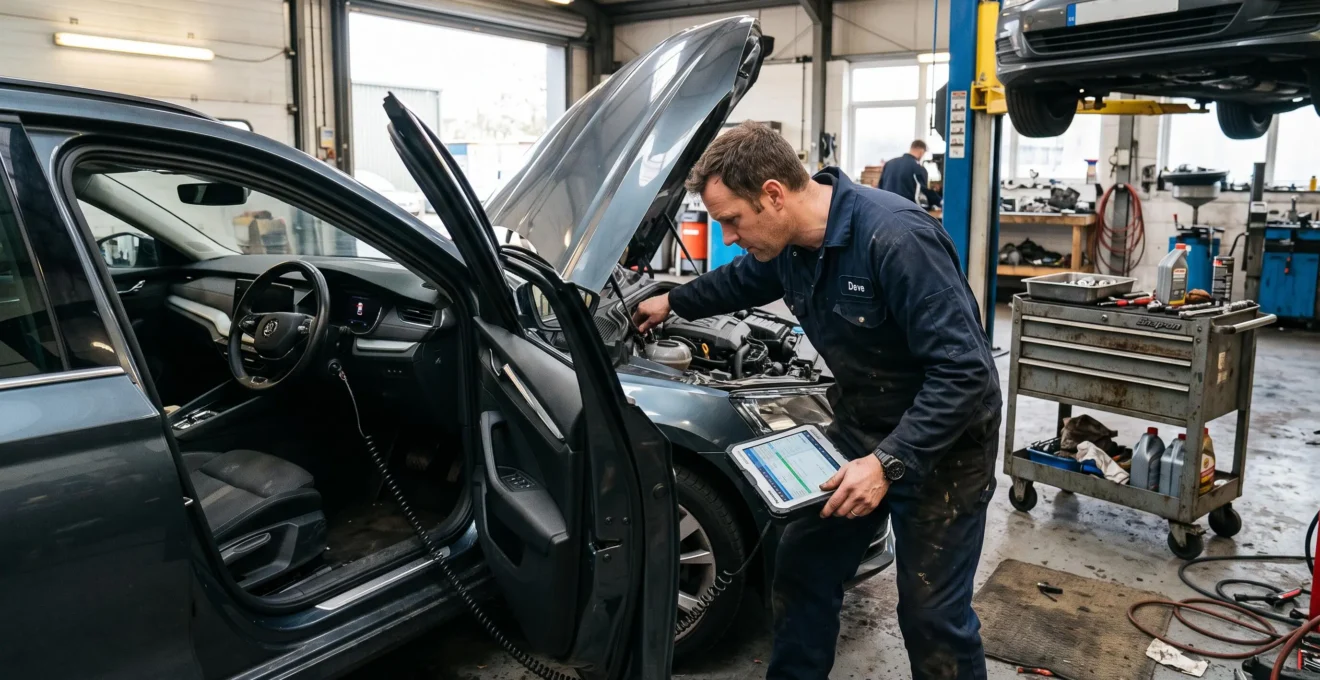
A garage replaces a faulty component, hands back the keys and presents an invoice. Days later, the same warning light appears. The replacement part is new, but the problem has not gone away.
Modern vehicles combine mechanical components with electronic control units, stored settings, sensors and manufacturer-specific software. Some repairs therefore require more than fitting the correct part. They also need programming, adaptation, calibration or diagnostic testing that confirms the entire system works correctly.
The specialised workshop equipment that matters depends on the repair. A basic fault-code reader may be sufficient for an initial investigation, but it cannot necessarily register a replacement battery, configure a control module, calibrate a driver-assistance camera or access protected vehicle functions.
For owners facing repeated unsuccessful repairs, the important question is not whether a garage owns expensive tools. It is whether the workshop has the specific equipment, software access and technical competence required for the vehicle and the job.
Why workshop equipment changes repair outcomes
- A new part is not always a completed repair. Certain components require electronic setup, relearning or calibration, while others were never the underlying cause.
- Diagnostic capability varies. Generic code readers, professional multi-brand equipment and manufacturer-level systems offer different functions and access permissions.
- Check capability before booking. Ask who will perform programming or calibration, what evidence will confirm success and how unresolved faults will be handled.
- Why Can a Garage Replace the Part but Still Not Fix the Problem?
- How to Ask a Garage About Their Equipment Without Sounding Difficult?
- Main Dealer or Independent: Which Has the Equipment You Actually Need for This Repair?
- The “We’ll Have a Go” Repair That Can Leave Safety Systems Miscalibrated
- When Should You Stop Returning to the Same Garage and Escalate to a Specialist?
- How to Vet a “Full-Service” Garage in 15 Minutes Without Knowing Cars?
- Why Does One Garage Find the Fault in 1 Hour and Another Can’t Find It at All?
- Which Diagnostic Equipment a Garage Uses—and Why It Changes Your Repair Outcome
Why Can a Garage Replace the Part but Still Not Fix the Problem?
A garage can replace the correct component without completing the repair because certain vehicle systems require electronic configuration, calibration or relearning after installation. Alternatively, the original diagnosis may have identified a symptom rather than its cause. A new component cannot resolve damaged wiring, unstable voltage, communication faults or incorrect stored settings elsewhere in the system.
A modern component may be mechanically fitted and electrically connected while the vehicle’s control unit continues operating with values learned from the previous component. Depending on the manufacturer’s procedure, these stored values may need resetting or recalibrating.
For example, a replacement throttle body may change airflow characteristics compared with the previously installed unit. If the engine management system continues using outdated learned values, idle problems can remain even though the new component functions correctly.
Manufacturer example: throttle-body servicing and persistent fault codes
An American Honda Motor Co., Inc. technical publication from June 2013 identifies selected Acura vehicles that may develop fluctuating idle or diagnostic trouble codes P2279 and P0507 following throttle-body servicing.
The manufacturer describes a procedure involving the Honda Diagnostic System, clearing learned throttle-position values, resetting the engine control module and completing idle learning. If the codes return, further diagnosis is required.
This documented example illustrates why electronic relearning can matter, but the procedure applies to the specified vehicles and must not be assumed necessary for every throttle body or sensor replacement. See the Acura technical bulletin on throttle-body relearning.
Other electronically managed components can require vehicle-specific procedures. A replacement steering-angle sensor may need calibration, some control modules require coding, and certain cameras need alignment. By contrast, a conventional camshaft-position sensor may need no special programming at all. The correct requirement comes from the manufacturer’s instructions for the precise vehicle and component.
The distinction between hardware failure and configuration failure is particularly important. A component can be physically defective, correctly installed but incorrectly configured, or fully functional while another fault produces the same symptoms.
The following decision grid helps distinguish likely diagnostic directions without treating symptoms as proof.
| Observed result | Possible explanation | Next diagnostic step |
|---|---|---|
| Symptom disappears and testing confirms normal operation | The replaced component may have caused the fault | Document successful functional verification |
| Symptom remains unchanged | Incorrect root-cause diagnosis, missing setup or another system fault | Check manufacturer procedures, wiring, power supply and live data |
| Symptom improves but returns | Intermittent fault, incomplete adaptation or unresolved contributing cause | Record operating conditions and investigate recurrence |
Repeated replacements become expensive because each unsuccessful attempt can add parts, labour and further diagnostic charges. Rather than authorising another component immediately, request the test results explaining why it is considered faulty.
A persistent problem does not automatically mean the garage is incompetent or the new component is defective. It does mean the diagnosis and any required post-installation procedures deserve further examination before more work is approved.
How to Ask a Garage About Their Equipment Without Sounding Difficult?
Ask the garage which diagnostic, programming or calibration procedures your particular repair requires, and whether it can complete them in-house. Present the questions as an attempt to understand the job, not to challenge the technician. A competent workshop should be able to explain its process, limitations and any subcontracted work without disclosing commercially sensitive details.
A useful opening question is: “Will the car need calibration or programming after this job, and do you carry that out here or arrange it with someone else?”
That wording is specific enough to identify a capability gap while allowing the garage to explain why a particular procedure is unnecessary.
Match additional questions to the system involved:
- Electronic modules: “Can your diagnostic equipment perform the coding or initialisation required for this vehicle?”
- ADAS cameras or radar: “What calibration method does the manufacturer specify, and do you have access to it?”
- Tyre-pressure monitoring: “Does this vehicle need sensor identification or registration after fitting, and can you perform it?”
- Battery replacement: “Does the battery management system require registration or configuration for the replacement battery?”
Not every vehicle requires each procedure. Some tyre-pressure systems relearn automatically, for example, while others need a programming or registration tool. The workshop should identify the applicable process rather than automatically selling an additional service.
Responses such as “We’ll see when it arrives” are not necessarily evasive. A technician may reasonably need to inspect the car before confirming the required operations. The concern arises when the garage cannot explain how it will establish the requirements, who will perform essential operations or how additional charges will be approved.
Ask whether an outside specialist is involved and who remains responsible for coordinating the repair, validating the completed work and handling a return visit. Subcontracting can be entirely legitimate; undisclosed dependencies are what create avoidable cost and scheduling uncertainty.
Clear questions also protect the workshop. Identifying a missing capability before booking allows it to decline, refer or coordinate the job properly instead of discovering the limitation halfway through.
Main Dealer or Independent: Which Has the Equipment You Actually Need for This Repair?
Neither a main dealer nor an independent garage is automatically the right choice for every repair. Dealerships generally have established access to their manufacturer’s diagnostic systems and procedures. Well-equipped independent specialists can perform many of the same operations, provided they have compatible equipment, authorised software access and appropriate training for the vehicle involved.
The most useful comparison concerns the repair operation, not the sign above the garage entrance.
| Repair type | Main dealer | Competent independent |
|---|---|---|
| Routine mechanical wear | Normally equipped | Normally suitable with the right tools and procedures |
| Engine or electrical diagnosis | Manufacturer-specific diagnostic access | Often capable with professional software and relevant expertise |
| Control-module replacement | Established manufacturer programming route | Possible where coding, software and authorisation are available |
| Security-protected functions | Often has an established authorised route | Depends on manufacturer, credentials and approved access |
| ADAS calibration | Depends on dealership facilities and service arrangements | Possible in-house or through a qualified calibration partner |
Recent vehicles may contain security gateways that limit access to protected electronic functions. The restrictions vary by manufacturer, vehicle, operation and software authorisation.
Owning a professional scan tool does not automatically mean a technician can perform every protected reset, coding operation or adjustment.
Bosch’s explanation of Secure Diagnostic Access describes how participating manufacturers protect certain diagnostic functions and how authorised access can be integrated into Bosch ESI[tronic] software. Availability depends on supported vehicles, subscriptions, registration requirements and markets.
This is not evidence that independent garages are universally locked out. Some independent businesses obtain manufacturer credentials directly, while others use approved multi-brand solutions.
For example, an independent specialist may have manufacturer-level subscriptions for the vehicles it regularly services. Another garage may perform the mechanical work and contract a mobile programming or calibration technician for the electronic completion stage.
Both arrangements can produce a properly completed repair when responsibilities and verification requirements are clear.
Before choosing, ask: “Which diagnostic platform and software access will you use for this vehicle’s required operation?” A meaningful answer identifies the method and capability, even if the workshop does not disclose every licence detail.
Where restricted programming or specialist calibration is involved, request confirmation that the full process can be completed before booking. For ordinary mechanical repairs, paying dealership rates solely because the vehicle contains complex electronics may offer no technical advantage.
The “We’ll Have a Go” Repair That Can Leave Safety Systems Miscalibrated
A repair can be mechanically correct yet leave a safety-related system incorrectly calibrated. Windscreen replacement, suspension changes, wheel alignment, bumper work and steering repairs may affect cameras, radar or other sensors used by driver-assistance functions. Whether recalibration is required depends on the vehicle and manufacturer’s instructions, not simply on whether a warning light appears.
Advanced Driver Assistance Systems (ADAS) depend on sensor alignment, vehicle geometry and electronic reference values. Lane-keeping assistance, automatic emergency braking and adaptive cruise control may use cameras or radar to interpret the surrounding environment.
Consider a windscreen fitted with a forward-facing camera. Removing or replacing the glass may affect camera positioning. On vehicles where the manufacturer specifies calibration after replacement, merely reconnecting the camera does not demonstrate that it is correctly aligned.
Similar concerns may arise after:
- Suspension repairs that change ride height or vehicle geometry.
- Wheel alignment on vehicles with manufacturer-defined ADAS setup requirements.
- Front bumper removal, replacement or repair near radar sensors.
- Steering-system work affecting steering-angle or torque-sensor references.
- Repairs to components used for automatic headlamp levelling.
The risk is not limited to a dashboard warning. A system may appear to operate during ordinary driving while its performance is compromised under particular conditions. The absence of a diagnostic trouble code is therefore not proof that a camera or radar operates within manufacturer tolerances.
In its May 2019 technical position, Thatcham Research’s position on ADAS repairs advises repairers to assess calibration requirements when work affects sensors, associated components or vehicle geometry. Where calibration is required, the organisation calls for competent technicians and auditable evidence that the affected systems meet manufacturer specifications.
Some vehicles require static calibration with workshop targets. Others use dynamic calibration under specified driving conditions, while certain procedures combine both methods. A target frame is not universally required for every vehicle.
An incomplete calibration can also complicate subsequent fault investigations. A different garage may need to establish whether unexpected system behaviour originated in an earlier repair, and insurance or warranty questions may depend on the circumstances, policy terms and applicable local rules.
Before approving the job, ask for the manufacturer-required calibration to be identified and included in the estimate. After completion, request available calibration records or equivalent documented evidence of the procedure and its result.
A controlled functional check may help identify obvious problems, but an ordinary road test cannot replace formal calibration or establish compliance with manufacturer tolerances. If assistance systems behave unexpectedly, arrange professional inspection rather than attempting to test their limits on public roads.
Safety-related work should be considered complete when the applicable manufacturer procedures have been followed and verified, not merely when the vehicle looks repaired or the warning lights are absent.
When Should You Stop Returning to the Same Garage and Escalate to a Specialist?
Consider escalating when two repair attempts have failed to resolve the same symptom, when successive diagnoses lack supporting evidence, or when the garage cannot perform the tests required to investigate the problem. These are practical decision triggers, not proof of negligence. The priority is to prevent further speculative expenditure and obtain a diagnosis supported by measurable findings.
After an unsuccessful repair, a garage should have an opportunity to review the original diagnosis and confirm whether the agreed work was completed correctly. An immediate return may be appropriate if the symptom remains and the business has a credible investigation plan.
However, repeated replacement recommendations without new evidence should prompt closer scrutiny.
- Two unsuccessful attempts: Ask what the workshop has learned and which different test will be performed next.
- Changing diagnoses: Request the evidence supporting each proposed cause, including relevant diagnostic measurements.
- Missing equipment: Seek a referral if the necessary software, calibration or programming cannot be accessed.
- Unresolved safety faults: Request prompt specialist assessment rather than continuing normal use when safety may be compromised.
A specialist may bring manufacturer-specific diagnostics, access to technical service information and familiarity with recurring fault patterns. These advantages can make diagnosis more focused, although specialisation is not a guarantee of success.
Before changing workshops, request copies of invoices, diagnostic reports, fault codes, recorded measurements and relevant repair notes. Ask for replaced parts to be retained where feasible, agreed in advance and permitted by the circumstances. Some parts are exchange units or subject to return conditions.
The new specialist should review the existing evidence but independently verify the cause. Otherwise, the same unconfirmed diagnosis can simply follow the vehicle to another workshop.
Consider a hypothetical situation in which an owner pays for two sensor replacements, but neither resolves an intermittent engine fault. A specialist who tests wiring continuity and records live data could identify a different cause without fitting a third sensor. This illustrates a possible diagnostic approach, not a documented repair outcome or guaranteed saving.
The sensible comparison is between the full cost of resolving the fault and the cost of further uncertain attempts. A higher initial diagnostic fee may be worthwhile when it buys structured testing and a documented explanation.
If a dispute develops, preserve documentation and use the applicable consumer complaint process. The relevant rights and remedies depend on the country, contract and circumstances; a specialist referral does not automatically resolve responsibility for earlier work.
How to Vet a “Full-Service” Garage in 15 Minutes Without Knowing Cars?
Vet a full-service garage by checking whether it can describe the equipment, procedures and accountability required for your specific repair. A short website review followed by a focused telephone conversation can reveal more than broad advertising claims. You do not need to understand automotive electronics; you need clear answers about capability, subcontracting, verification and what happens if the fault persists.
Start with the garage’s website. Look for services such as vehicle programming, manufacturer-level diagnostics, ADAS calibration or battery registration, rather than treating a general “all makes and models” statement as proof of specialist capability.
Named diagnostic platforms and authentic equipment photographs are useful clues, but neither proves that subscriptions are current or technicians are qualified for your particular vehicle.
Recent customer reviews mentioning similar repairs may provide additional context. A review describing successful engine diagnosis is more relevant to an intermittent electronic fault than one praising a routine oil change.
Trade-scheme membership can also offer a checkable consumer-protection signal. In the UK, The Motor Ombudsman’s Service and Repair Code, updated on 1 June 2025, covers accredited independent and franchised repairers and includes commitments relating to fair service, pricing, agreed work and complaints handling.
Accreditation does not establish that a garage owns specialist diagnostic equipment. Outside the UK, check the relevant local trade accreditation and dispute-resolution arrangements rather than assuming the same scheme applies.
The following five actions form a practical screening process that can often be completed in approximately 15 minutes, although complex repairs may require longer technical confirmation.
Five checks to complete before booking a specialist repair
- Identify the repair and vehicle. Record the registration or vehicle identification details, symptoms and proposed work. Deliverable: a brief repair description you can read to the garage.
- Confirm diagnostic capability. Ask which equipment or manufacturer software supports the required operation. Deliverable: a named tool, access method or an explicit statement that confirmation is pending.
- Establish calibration responsibility. Ask whether programming or calibration is required and who performs it. Deliverable: written confirmation of the provider or the basis for saying the procedure is unnecessary.
- Clarify charges and warranties. Request the diagnostic fee, approval rules for additional work and applicable parts-and-labour warranty terms. Deliverable: a written estimate or booking confirmation.
- Agree the unresolved-fault process. Ask what evidence will be provided and how a return visit will be handled if symptoms remain. Deliverable: a documented follow-up arrangement, including any applicable charges.
A garage may reasonably be unable to guarantee that a fault will disappear before diagnosis. Distinguish that uncertainty from an unwillingness to explain the testing process or the terms of the work.
Also watch for inconsistencies. A website may advertise comprehensive diagnostics while the telephone discussion reveals that essential programming must be arranged elsewhere. Outsourcing is not inherently problematic, provided the workshop coordinates it transparently.
The strongest workshop choice is not necessarily the business that advertises the widest service range. It is the one that can explain how your particular repair will be diagnosed, completed and verified.
Why Does One Garage Find the Fault in 1 Hour and Another Can’t Find It at All?
Diagnostic speed depends on access to suitable equipment and technical information, technician familiarity with the system, and the ability to reproduce or measure the fault. One workshop may recognise a familiar failure pattern and confirm it quickly, while another lacks the data or access needed to investigate. The difference is not necessarily general mechanical skill.
A fault code identifies a condition detected by a vehicle’s electronic system. It does not always identify which physical component caused that condition.
For example, a sensor-related code may result from the sensor itself, its power supply, wiring, connector or another system affecting the sensor’s output. Replacing the named sensor without checking the surrounding circuit risks treating the code as a parts recommendation.
Professional diagnosis combines stored trouble codes with live sensor data, freeze-frame information and targeted tests. Freeze-frame records, when available, preserve selected operating conditions associated with a detected fault.
Intermittent symptoms are particularly demanding. A car may behave normally in the workshop but fail after warming up, during acceleration or under particular electrical loads.
A suitable diagnostic platform may allow technicians to record parameters during a controlled road test or monitor the vehicle over time. The technician must still select the relevant measurements and interpret them correctly.
Clearing codes and waiting for the warning light to return does not, by itself, establish the cause. On some vehicles, clearing codes can also remove useful stored information, making the original conditions harder to reconstruct.
Owners can improve the investigation by supplying a precise symptom history. Note whether the problem occurs with a cold or warm engine, at a particular speed, during braking, after rainfall or when specific electrical systems are operating.
Rather than asking whether the garage has a diagnostic computer, ask: “Can you record the relevant live data when the symptom occurs, and explain what the measurements show?”
Not every intermittent fault can be reproduced in one visit. Some require repeated observations, specialised test equipment or a longer monitoring strategy. An evidence-based workshop should explain those limits and the next planned test instead of promising an immediate answer.
The aim is not the shortest appointment at any cost. It is a diagnosis that identifies the cause with enough confidence to justify the proposed repair and reduce the likelihood of another unsuccessful visit.
Key takeaways before choosing diagnostic equipment
- Match the diagnostic tool to the vehicle system and required operation, rather than assuming every scan tool performs the same functions.
- Verify that the workshop has any necessary software authorisation, manufacturer procedures and calibration capability.
- Ask what diagnostic evidence and post-repair verification will be supplied before approving further component replacements.
Which Diagnostic Equipment a Garage Uses—and Why It Changes Your Repair Outcome
The equipment a garage uses determines which vehicle systems it can examine, what tests it can perform and whether it can complete operations such as coding, adaptation and calibration. Generic code readers provide limited diagnostic access, professional multi-brand platforms support more extensive functions, and manufacturer-level systems offer vehicle-specific capabilities. However, actual access depends on software coverage, licensing and authorisation.
For consumers, the key distinction is between reading evidence, performing system-specific operations and verifying a completed repair. These functions may require different hardware, software and specialist equipment.
The following comparison describes typical capabilities rather than guaranteeing that every product within a category supports the same functions.
| Equipment level | Typical capabilities | Important limitations |
|---|---|---|
| Generic OBD code reader | Read common emissions-related fault codes and basic diagnostic information | Limited manufacturer-specific system access, coding and calibration |
| Professional multi-brand diagnostic platform | Broader module access, live data, active tests, service functions and selected coding operations | Coverage differs by vehicle, software package, subscription and security permissions |
| Manufacturer-level diagnostic system | Vehicle-specific guided tests, configuration, programming and supported software operations | May require paid subscriptions, credentials, approved hardware or additional specialist tools |
| Dedicated calibration and measurement equipment | Manufacturer-specified ADAS setup, sensor positioning, alignment or other specialised measurements | Must match the vehicle procedure and be operated under the specified conditions |
Manufacturer-level access is particularly important for some electronic repairs. A garage may successfully identify a failed control module using a multi-brand platform but still need different access to configure its replacement.
Similarly, a technician may read an ADAS-related fault code without possessing the equipment or approved workflow needed to recalibrate the affected camera or radar.
Equipment capability is not a simple ranking in which the most expensive device always wins. A specialist using a suitable oscilloscope, accurate wiring information and sound diagnostic reasoning may identify an electrical fault that another workshop overlooks despite owning an advanced scan tool.
Subscriptions also influence workshop capability. Manufacturer software, diagnostic information and protected functions can involve recurring costs or separate authorisations. A garage may deliberately maintain comprehensive access for a limited range of manufacturers rather than partial access across every brand.
Ask whether the diagnostic platform supports the exact vehicle and operation, whether its software and permissions are appropriate, and what additional equipment will be used if calibration is required.
A workshop that openly explains its brand specialisation may be a more reliable choice for a complex repair than one claiming unrestricted capabilities without identifying how the work will be completed.
Finally, remember that diagnosis and repair are separate purchases of value. A diagnostic fee should fund an agreed investigation and documented findings, not automatically guarantee that every fault can be resolved within the first appointment.
For the next booking, identify the affected system, ask the garage to confirm its diagnostic and programming capabilities, obtain any required calibration and verification arrangements in writing, and agree on the evidence expected from the diagnostic work. The objective is a repair decision supported by testing rather than another hopeful replacement.
Can a garage charge for diagnosis even when it cannot find the fault?
Yes, diagnostic work may be chargeable even if the cause remains unidentified, depending on the agreed service and applicable consumer rules. Before authorising it, confirm the fee, intended tests and expected report. An inconclusive investigation should still be explained, including which possibilities were checked and what further work is recommended.
Does every replacement electronic sensor need programming?
No. Many sensors can be replaced without electronic programming, while others require calibration, registration, adaptation or configuration. Requirements differ between manufacturers, vehicle models, component types and software configurations. The correct procedure should be checked against vehicle-specific repair information instead of assuming every electronic part requires coding.
Can a mobile specialist complete programming or ADAS calibration at a garage?
Some mobile specialists can perform programming and certain calibration operations at another workshop. Suitability depends on the vehicle, required authorisations, calibration method and working conditions. Static ADAS procedures may require controlled space, lighting, floor conditions or accurately positioned targets. The garage should confirm that the location meets the manufacturer’s requirements and that results will be documented.
Is a successful diagnostic scan enough to prove a repair is complete?
No. The absence of fault codes does not necessarily establish that every system is correctly configured or calibrated. Depending on the repair, completion may require functional checks, adaptation confirmation, manufacturer-specified calibration or other documented tests. The relevant verification procedure should match the affected system.
What documents should an owner request after a complex electronic repair?
Request an itemised invoice, the relevant diagnostic findings, details of the components replaced and confirmation of any required coding, adaptation or calibration. Where applicable, ask for calibration records or other evidence of successful verification. Also retain the written estimate, warranty terms and any agreed follow-up arrangements in case the symptoms return.