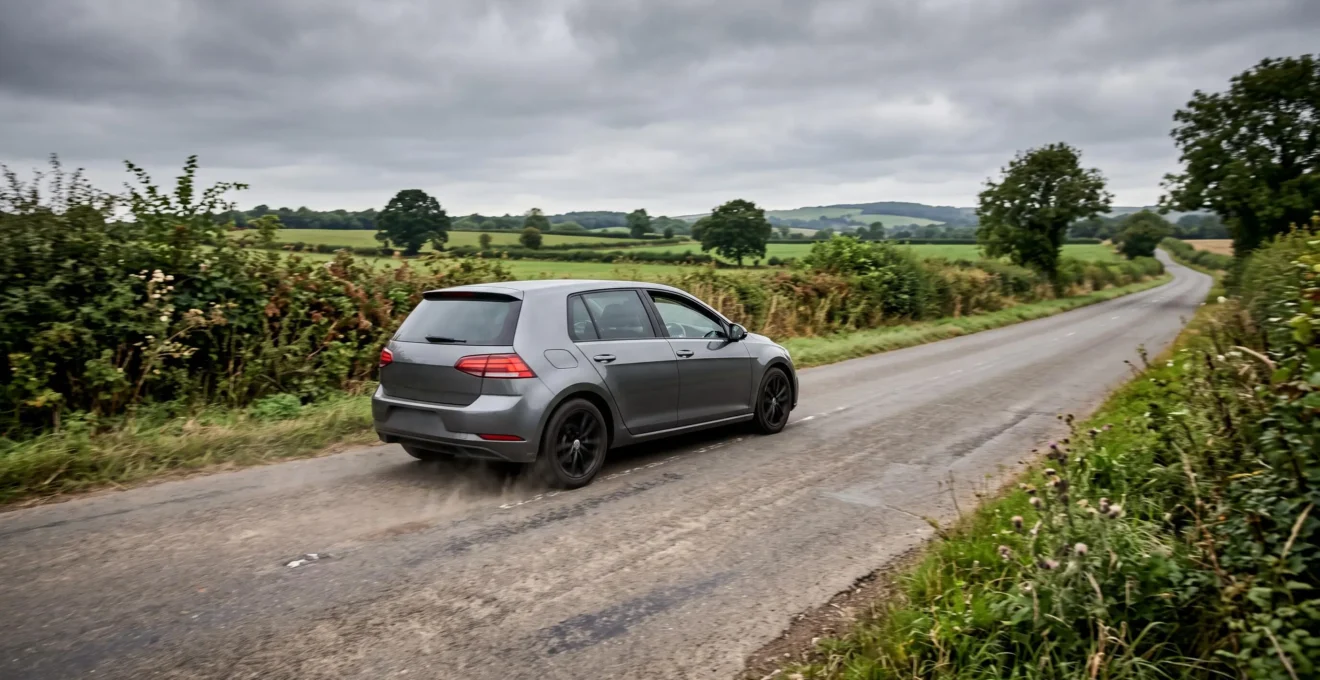
A car advertised with 200 bhp and an impressive 0–60 mph time can still feel disappointingly slow when accelerating from 40 to 70 mph. The reason is straightforward: maximum engine power and acceleration available at motorway speeds are different measurements.
During an overtake, the engine must deliver enough power at its current rpm to overcome vehicle weight, aerodynamic drag and rolling resistance. The selected gear determines engine speed, while throttle calibration, turbocharger response and automatic transmission behaviour influence how quickly that power arrives.
This distinction matters whether a vehicle has always felt unresponsive or has recently lost performance. One situation may call for a downshift; the other may require mechanical diagnosis.
The useful starting point is not another manufacturer’s specification. It is a controlled comparison of 40–70 mph acceleration, throttle response and repeatability, conducted only where the test is lawful, safe and permitted. Those observations can separate an actual performance problem from normal vehicle characteristics and provide evidence that a repair has worked.
What matters most when your car feels slow
- Peak bhp and 0–60 mph figures do not reliably predict overtaking response. Engine speed, gearing, weight and available power matter more.
- A properly controlled 40–70 mph test can distinguish genuinely weak acceleration from delayed response, provided the entire test is legal and safe.
- Check symptoms, diagnostic codes and mechanical evidence before replacing parts. Repeat the same test after repairs to establish whether performance improved.
- 27: Why Your Car Feels “Sluggish” Even When It Has Plenty of Power on Paper
- 28.1: Why Does a “200 bhp” Car Still Feel Slow When You Overtake at 60 mph?
- 20.1: Why Does More Power Sometimes Feel Slower in Real Traffic?
- 27.1: Why Does a Turbo Car Feel Lazy Below 2,000 RPM Even After a Service?
- 28.2: How to Do a Safe 40–70 mph Roll-On Test Without Breaking Any Laws?
- 28.3: Engine Issue or Gearbox Issue: Which Is More Likely When Acceleration Feels Flat?
- 28.4: The Parts Swap Mistake That Wastes £600 and Still Leaves the Car Slow
- 28.5: When Should You Re-Test Performance So You Can Prove the Fix Actually Worked?
27: Why Your Car Feels “Sluggish” Even When It Has Plenty of Power on Paper
A car feels sluggish when the acceleration available during everyday driving falls short of the driver’s expectations. This does not necessarily mean the engine is producing less power than specified. Peak horsepower, the power available at normal cruising rpm and the delay between pressing the accelerator and receiving a response are different characteristics.
A manufacturer’s horsepower figure describes the engine’s maximum rated output at a particular engine speed, not the power continuously available throughout the rev range. A petrol engine rated at 200 bhp may reach that output only near the upper part of its operating range.
At 2,000–3,000 rpm, the same engine may deliver considerably less power. Whether the driver can access stronger acceleration depends on the torque curve and the gearbox’s ability to select a more suitable ratio.
Usable power matters more than peak power when evaluating motorway overtaking. Engine torque, multiplied through the gearbox and final drive, determines the driving force available at the wheels. Vehicle mass and resistance determine how much acceleration that force produces.
Driver perception introduces another variable. An automatic gearbox that pauses before downshifting can make an otherwise capable car feel reluctant. A quiet engine with progressive power delivery may feel slower than a noisier engine delivering less actual acceleration.
Brochure 0–60 mph figures add to the confusion. Depending on the vehicle and testing method, they may reflect carefully managed standing starts, favourable traction or launch-control operation. They do not directly establish how quickly the same vehicle accelerates in sixth gear at motorway speeds.
Separate a sluggishness complaint into three possibilities:
- Genuinely weak acceleration: the car takes longer than a credible comparable reference, or longer than its own established baseline, to gain speed.
- Poor response: acceleration is adequate once underway, but throttle, turbocharger or gearbox delays make the initial response frustrating.
- Unrealistic expectations: performance matches the vehicle’s normal characteristics, but the driver expected its advertised power to feel stronger.
This distinction prevents a common diagnostic mistake: treating an unpleasant driving sensation as proof of a defective engine.
The next question is why a seemingly powerful car can struggle most noticeably when the driver needs acceleration at 60 mph.
28.1: Why Does a “200 bhp” Car Still Feel Slow When You Overtake at 60 mph?
A 200 bhp car can feel slow at 60 mph because its advertised power may be available only at much higher engine speeds. In a tall cruising gear, the engine may operate far below its maximum-power range. Vehicle weight, aerodynamic resistance and the time needed for an automatic downshift can further reduce the acceleration the driver experiences.
At motorway speeds, the engine must overcome forces that are less significant at low speed. Aerodynamic drag increases with speed, and the power required to overcome that drag rises approximately with the cube of vehicle speed under otherwise comparable conditions.
This means that increasing speed from 60 to 70 mph is not simply a continuation of accelerating away from a junction. The vehicle is working against progressively greater air resistance.
There is also a useful distinction between acceleration time and acceleration energy. A vehicle moving from 40 to 70 mph gains substantial kinetic energy, even though it is not starting from rest. That energy must come from the powertrain while it also overcomes road loads.
The selected gear can transform the result. Consider a hypothetical 200 bhp family car travelling at 60 mph in sixth gear:
- In sixth, the engine may be operating at relatively low rpm, where less power is available.
- In fourth, the engine may move into a stronger part of its power band, producing greater wheel force at the same road speed.
- If an automatic gearbox takes time to downshift, the driver experiences a delay before the stronger acceleration begins.
A downshift does not create more engine power. It allows the engine to operate at a speed where it can deliver more of its existing capability, subject to the engine’s operating limits.
Vehicle mass is equally important. Two cars with identical rated power may accelerate differently because one is heavier, carries more passengers or uses different gearing.
The most useful comparison is therefore a measured 40–70 mph time obtained under controlled conditions. Where published figures are available, compare vehicles using the same test definition, transmission behaviour and operating conditions. There is no universally applicable 40–70 mph benchmark for every passenger car.
Peak horsepower becomes more informative when combined with vehicle weight, the engine’s power curve and measured acceleration. Those same factors also explain why adding horsepower does not always make a vehicle feel quicker in traffic.
20.1: Why Does More Power Sometimes Feel Slower in Real Traffic?
More power can feel slower in everyday traffic because the extra output may be available only at engine speeds the driver rarely uses. Longer gearing, additional weight, delayed turbocharger response and conservative throttle calibration can offset the subjective benefit. A less powerful vehicle with immediate low-speed response may therefore feel more eager.
Consider two hypothetical cars. Car A has a relatively modest peak-power rating but develops useful torque early in its rev range. Car B produces substantially more peak power, but its engine needs higher rpm to deliver its strongest performance.
During gentle acceleration, Car A may respond more promptly. During a sustained full-throttle acceleration test in the appropriate gear, Car B may ultimately be faster.
Both observations can be correct.
Power-to-weight ratio helps explain the difference between vehicles with similar engine output. A heavier vehicle needs more driving force to achieve the same acceleration, all else being equal. Longer gear ratios may also reduce wheel force at a particular road speed, although they can reduce cruising rpm and noise.
Throttle calibration adds another layer. In some modern vehicles, an economy or comfort mode changes how accelerator-pedal movement translates into requested engine torque. A driver may need to press the pedal further to obtain the response available in a sportier mode.
Throttle sensitivity is not the same as maximum power. A sharper pedal map can make a car feel stronger without increasing its full-throttle output.
Automatic transmission modes may change shift timing, gear selection and the willingness to downshift. These changes can produce a substantial difference in perceived responsiveness even when the engine itself is mechanically unchanged.
Sound also influences judgment. Artificially enhanced engine noise and changing exhaust sound can make acceleration feel more dramatic without establishing that the vehicle is moving faster.
To distinguish actual improvement from altered sensation, record both the initial response delay and the subsequent acceleration time. Compare like-for-like runs in the same mode, then investigate how changing modes affects the result.
If the car has a turbocharged engine, its low-rpm response deserves separate consideration because some delay may be inherent in the hardware rather than evidence of a maintenance problem.
27.1: Why Does a Turbo Car Feel Lazy Below 2,000 RPM Even After a Service?
A turbocharged car can feel lazy below 2,000 rpm because the turbocharger may not yet receive enough exhaust-gas energy to deliver strong boost. Servicing cannot eliminate delay built into the turbocharger and engine calibration. However, 2,000 rpm is not a universal threshold, and unusual or worsening hesitation may indicate a fault requiring diagnosis.
A turbocharger uses exhaust-gas energy to drive a turbine connected to an intake-air compressor. When the driver requests more torque, the system may need time to increase turbine speed and intake pressure.
As explained in Garrett Motion‘s explanation of turbo lag, the response depends on turbocharger design, exhaust flow and engine operating conditions.
Two related effects are worth separating. The boost threshold describes the operating region where significant boost becomes available. Transient turbo lag describes the delay in building boost after a change in accelerator demand.
Neither behaves identically across all engines. Turbocharger sizing, engine load, calibration and the initial turbo speed all influence the response.
A correctly functioning vehicle may therefore feel soft at very low rpm yet accelerate strongly after a downshift. If the engine’s useful boost range begins higher in the rev range, choosing a lower gear before requesting acceleration may improve response.
That technique should remain within the manufacturer’s permitted engine-speed range and should never substitute for choosing a safe overtaking opportunity.
Consistent low-rpm softness is less suspicious than a clear change from the vehicle’s previous behaviour.
Warning signs worth investigating include:
- Hesitation that has recently become more pronounced or appears unpredictably under comparable loads.
- New or unusual whistling, hissing or other noises during boost demand.
- Unexpected exhaust smoke, particularly when accompanied by reduced performance.
- Acceleration that varies noticeably between otherwise comparable runs.
- Fault codes, abnormal boost readings or symptoms that persist after an appropriate downshift.
These signs do not identify a specific failed component. A boost leak, control-system problem, intake restriction or another engine fault may produce overlapping symptoms.
A routine service can correct problems related to items actually serviced or replaced. It cannot be expected to change an engine’s original turbocharger sizing or calibration. Equally, a service does not establish that every performance-related fault has been repaired.
When subjective impressions remain inconclusive, a controlled acceleration measurement provides better evidence than repeatedly judging how quickly the turbo seems to wake up.
28.2: How to Do a Safe 40–70 mph Roll-On Test Without Breaking Any Laws?
A 40–70 mph roll-on test should be performed only where the entire speed range is lawful and the activity is safe and expressly permitted. A properly authorised closed test facility is preferable. Use a consistent gear, load and measurement device, record several runs under comparable conditions, and never attempt the test on a public road where it could breach speed limits or endanger others.
The essential principle is repeatability. An acceleration figure taken on one road, in one direction, with an unknown gradient cannot establish whether a vehicle is performing normally or has improved after a repair.
Legal limits come first. The UK Highway Code rules on speed and safe driving make clear that the speed limit is an absolute maximum, not a guarantee that travelling at that speed is safe.
For a 40–70 mph test, a normal public road with a lower limit is unsuitable, even if it is straight, dry and apparently empty. Public-road rules also differ between the UK, US, Canada, Australia and other English-speaking jurisdictions. Private ownership alone does not establish that a location is authorised for high-speed testing.
Where a suitable facility and permission are available, use the following controlled procedure.
- Establish the test environment. Use an authorised, sufficiently long, straight and dry testing area with appropriate visibility, run-off space and no conflicting traffic.
- Prepare the vehicle. Check tyres, brakes and general roadworthiness. Record vehicle load, approximate fuel level, driving mode and relevant environmental conditions.
- Choose a consistent test configuration. Select a suitable fixed gear that keeps the engine within its safe operating range. For an automatic, use a supported manual-selection mode if available and appropriate. If the transmission changes gear, record that behaviour.
- Measure the acceleration. Use a securely mounted GPS-based timing device capable of resolving the required speed interval. A suitable logged data-acquisition system may also be used. Do not interact with devices while driving.
- Repeat and review. Where the facility permits, obtain multiple runs in each direction under comparable conditions. Identify unusual results and investigate their cause before deciding whether to exclude them.
GPS measurement quality matters. A phone application with an insufficient or irregular sampling rate may produce unstable timings, especially when the measured acceleration interval is short. A basic OBD adapter is not automatically an accurate replacement for a validated GPS timer; vehicle-reported speed, polling frequency and software behaviour can differ.
Environmental conditions can change the result even when the car is mechanically identical. The SAE technical paper on road-load testing repeatability identifies wind, atmospheric pressure, temperature and track conditions as influences on coastdown measurements.
That research concerns coastdown testing, not a validated consumer 40–70 mph protocol. Nevertheless, it establishes why environmental variation should not be ignored when interpreting road-load measurements. Opposite-direction runs may reveal gradient or wind-related bias, but do not perfectly eliminate those influences.
Retain individual results rather than recording only the fastest run. A collection of consistent measurements is more useful for diagnosis than one unusually favourable figure.
Five actions to create a usable acceleration baseline
- Confirm testing permission and safety: produce a record of the authorised facility, applicable operating rules and permitted speed range.
- Document the vehicle setup: create a log showing gear, driving mode, passengers, fuel level and tyre condition.
- Record the test conditions: note the route or track section, direction, temperature, wind conditions and surface condition.
- Capture repeated measurements: save the individual 40–70 mph times and measurement-device details without relying on a single best run.
- Build the baseline summary: calculate a representative result from valid runs, document the observed spread and retain the original data for comparison after repairs.
If a full-speed test cannot be performed legally and safely, do not attempt it. A workshop can investigate the problem using appropriate diagnostic equipment, and permitted lower-speed observations may still provide useful information. The next step is to determine whether the engine or the transmission is responsible.
28.3: Engine Issue or Gearbox Issue: Which Is More Likely When Acceleration Feels Flat?
Flat acceleration may originate in the engine, gearbox, clutch or another source of vehicle resistance. If engine rpm rises sharply without a matching increase in road speed, clutch or transmission slip becomes a concern. If the engine struggles to produce torque under load, investigate fuel delivery, ignition, airflow, boost control and related sensors before blaming the gearbox.
A frequently suggested diagnostic shortcut is to rev the engine in neutral or park. That observation has limited value because an engine operating without road load can respond normally despite a fault that appears during acceleration.
For example, insufficient fuel delivery or a boost leak may become apparent only when the engine is asked to produce substantial torque. A stationary revving test cannot reliably exclude those faults, and unnecessary high-rpm free-revving should be avoided.
A more useful distinction is the relationship between engine speed, vehicle speed and the driver’s accelerator demand.
| Observed symptom | Possible explanation | Useful next check |
|---|---|---|
| Engine rpm rises without proportional vehicle acceleration | Clutch slip or transmission-related slip | Inspect clutch or transmission operation under appropriate controlled conditions |
| Automatic gearbox delays or avoids downshifting | Shift calibration, operating mode, control issue or transmission fault | Review commanded versus actual gear and relevant transmission data |
| Engine hesitates under load | Ignition, fuel-delivery, airflow or engine-management problem | Examine fault codes and relevant live sensor readings |
| Turbo response is weak or inconsistent | Normal boost behaviour, intake leakage or boost-control fault | Compare requested and measured boost under appropriate conditions |
| Vehicle feels unusually resistant to movement | Possible brake drag or another mechanical resistance | Have brake operation and wheel resistance inspected safely |
Manual and automatic transmissions present different diagnostic clues. In a manual car, a worn clutch can allow engine speed to increase without transferring the expected torque to the wheels. Selecting an excessively tall gear can also make a healthy engine feel weak, without any clutch fault.
In an automatic, delayed downshifting, unexpected gear selection or torque-converter behaviour may affect response. However, an automatic that hesitates is not automatically defective: some delay is consistent with its intended programming.
An OBD scan is a useful early step. Some faults produce pending diagnostic trouble codes before the malfunction indicator lamp illuminates. Stored information may also include operating conditions associated with a detected fault.
Importantly, a fault code is evidence to investigate, not an instruction to replace a named component. A low-cost generic reader may also miss manufacturer-specific and transmission-system information.
Similarly, no stored code does not prove that the vehicle is mechanically healthy. Clutch wear, brake drag and certain intermittent problems may require direct inspection or dedicated testing.
Once the likely system has been identified, the repair decision should depend on a confirmed fault. Replacing components because they appear on a list of common causes is an expensive alternative to diagnosis.
28.4: The Parts Swap Mistake That Wastes £600 and Still Leaves the Car Slow
The expensive mistake is replacing several plausible components without testing whether any is defective. Spark plugs, ignition coils, filters and airflow sensors can all become suspects when acceleration feels weak. Yet replacing them will not correct an unrelated boost leak, dragging brake or slipping clutch. The solution is to establish a fault with measurements before authorising parts.
Consider a hypothetical owner whose car has become noticeably slower on hills. Online discussions suggest an airflow sensor, ignition components and routine service items. The owner gradually spends 600 £ replacing parts but never checks whether the engine achieves its requested boost pressure.
If the actual fault is a leaking boost hose, those purchases may leave the original complaint unchanged. The £600 figure is an illustrative spending scenario, not a documented average repair cost or a quotation for any specific vehicle.
The same pattern occurs when an owner attributes every loss of acceleration to the engine. A dragging brake caliper may create resistance even when the engine is delivering normal power. A worn clutch can prevent effective torque transfer. Neither problem is corrected by replacing intake or ignition components.
To avoid paying for guesses, use a disciplined diagnostic sequence:
- Verify the complaint. Establish whether acceleration is genuinely reduced, response is delayed or the expected performance was unrealistic.
- Collect diagnostic evidence. Read available stored and pending codes, preserve relevant freeze-frame information and examine appropriate live data.
- Test the suspected system. Depending on symptoms, this may involve boost-pressure checks, fuel-system testing, transmission diagnostics or a mechanical inspection.
- Confirm the cause. Establish that the proposed repair addresses an observed defect, not merely a possible failure described online.
- Repair and verify. Document the work, then assess whether the original symptom and measured performance have improved.
Brake testing requires particular caution. Brake components can become extremely hot, and comparing temperatures without controlling for recent braking and driving conditions can produce misleading results. Such checks are better handled by a suitably equipped technician.
Another trap involves aftermarket performance products. A tuning box, intake filter or ECU modification should not be treated as a remedy for an unidentified mechanical fault. Increasing requested performance may also introduce additional reliability, emissions, insurance or legal considerations depending on the jurisdiction.
Even genuine maintenance parts should not be confused with diagnostic proof. A component can be due for scheduled replacement without being responsible for the acceleration complaint.
When discussing repairs with a garage, request the relevant observations, test findings and explanation connecting the identified fault to the proposed repair. A clear diagnostic record is more useful than an assurance that a replacement part is commonly responsible for similar symptoms.
A credible diagnosis explains why the car was slow. The final step is to establish whether the repair restored performance, rather than assuming success because the defective component has been replaced.
Key takeaways before the final performance check
- A repair should address a verified fault and a documented symptom, not merely a suspected component.
- The original acceleration data must remain available; without it, a before-and-after comparison is largely subjective.
- Environmental variation and transmission behaviour can conceal or exaggerate small changes, so judge repeated results rather than one run.
28.5: When Should You Re-Test Performance So You Can Prove the Fix Actually Worked?
Re-test performance after the repair has been completed, the vehicle has been confirmed roadworthy and any required manufacturer-specific relearning procedure has been addressed. Use the original measurement method and comparable conditions. A genuine improvement should appear consistently across repeated runs rather than depend on a single unusually quick result.
The ideal comparison uses the same authorised testing location, speed interval, gear, vehicle load, driving mode and measurement device as the baseline. Fuel load, tyre condition and environmental conditions should also be as similar as reasonably possible.
This matters because acceleration testing contains natural variation. A slight wind change, different road gradient, warmer intake air or changed transmission behaviour can affect the result even when no mechanical change has occurred.
As a practical example, suppose a hypothetical car originally records several 40–70 mph times clustered around 10 seconds. After a repair, one run appears noticeably quicker, but the remaining results overlap the original measurements.
That single faster result is insufficient to establish a clear improvement. The appropriate response is to investigate the variation and compare representative results, not to select whichever run best supports the repair.
By contrast, if repeated post-repair measurements are consistently quicker than the original runs under comparable conditions, the evidence of improvement is stronger.
There is no universal percentage improvement that proves a repair successful. The acceptable margin depends on the measurement system’s accuracy, the observed run-to-run variation and the size of the claimed change.
Where data quality permits, compare the median before and after repair alongside the individual results and their spread. This helps identify whether the change exceeds the ordinary variation observed during testing.
Some repairs introduce another consideration: engine and transmission control systems may require prescribed adaptation or relearning processes. These are vehicle- and repair-specific. It would be misleading to prescribe a universal number of miles or drive cycles before every re-test.
Consult the applicable service information if a repaired system requires calibration, readiness monitoring or a particular drive procedure. Otherwise, begin evaluating performance once the repair is complete and the vehicle is confirmed safe to operate.
For a useful record, retain the following information:
| Measurement | Before repair | After repair |
|---|---|---|
| 40–70 mph time | Individual valid runs and representative result | Repeated runs using the same method |
| Test conditions | Gear, load, mode, environment and direction | Matched conditions or documented differences |
| Diagnostic evidence | Relevant codes, symptoms and measured abnormalities | Post-repair observations and relevant system readings |
| Driver response | Original hesitation, delay or abnormal behaviour | Whether the same symptom remains or has changed |
If the car remains sluggish and the measured acceleration has not improved, return to the garage with the original complaint, the repair record and the comparable results. That evidence provides a clearer basis for further investigation than saying the vehicle still feels slow.
If acceleration improves but the response remains delayed, the remaining issue may involve transmission strategy, turbocharger characteristics or throttle calibration rather than insufficient maximum power.
Start with a simple performance log, establish a safe and lawful baseline if one is not already available, and compare the evidence after any repair. If the fault cannot be reproduced safely or the results remain inconclusive, ask a qualified technician to investigate the specific symptoms and measurements. The objective is not to make the car feel fast at any cost, but to establish whether it performs as intended and whether a repair has delivered a verifiable improvement.
Does a faster 0–60 mph time guarantee better 40–70 mph acceleration?
No. Standing-start acceleration depends on launch traction, gearing, transmission behaviour and available power across the acceleration range. A 40–70 mph test starts with the vehicle already moving, so the selected gear, engine speed and power available at that speed become especially important. Compare results from the same test method rather than assuming one figure predicts the other.
Can a car lose performance without showing an engine warning light?
Yes. Some electronically monitored faults may generate pending diagnostic codes before a warning light appears. Other problems, including clutch wear or certain mechanical restrictions, may not generate a generic OBD fault code at all. Reading codes is useful, but a normal dashboard and an empty code list do not exclude a mechanical problem.
Should an automatic car be tested in manual mode or drive mode?
It depends on the question. A supported fixed-gear mode can help assess acceleration without changes caused by automatic gear selection. Normal drive mode is more useful when investigating delayed kickdown or everyday transmission response. Record which mode was used, because results from different modes may not be directly comparable. Follow the manufacturer’s operating guidance.
Can a hill make a healthy car feel unusually underpowered?
Yes. Climbing requires additional power to overcome the component of vehicle weight acting down the slope. The demand increases with gradient, vehicle mass and speed. A tall gear can make that extra load particularly noticeable. Consistent behaviour on a hill does not establish a fault, although a substantial deterioration from the vehicle’s normal performance deserves investigation.
What if there is nowhere legal to perform a full 40–70 mph test?
Do not perform the test. A qualified workshop may be able to assess the complaint through diagnostic logging, mechanical checks or an appropriately controlled testing facility. Lower-speed observations can sometimes help identify hesitation, gear-selection problems or inconsistent response, but they should not be presented as equivalent to a completed 40–70 mph measurement.