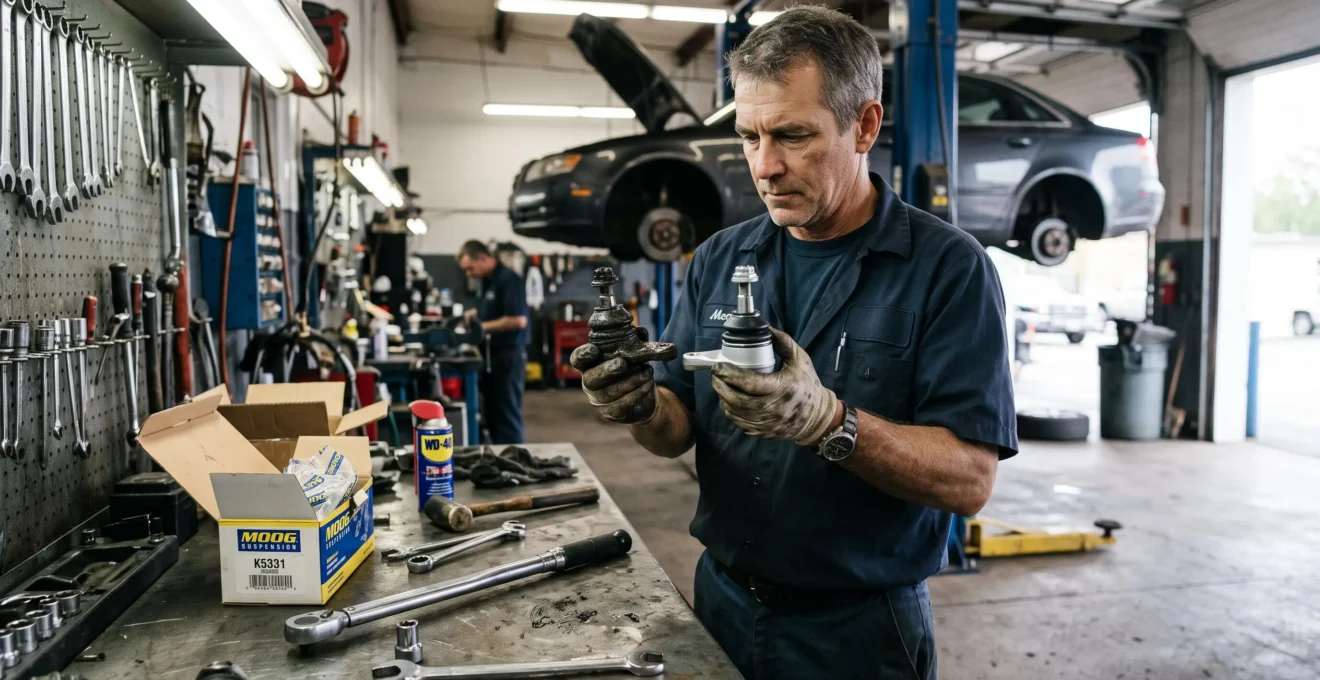
A replacement part can look identical to the original, fit into the available space, and still become a problem within the first 90 days. The usual suspects are incorrect vehicle specifications, installation errors, worn surrounding components, and inconsistent manufacturing quality. Paying more does not automatically eliminate any of them.
The aftermarket parts most worth scrutinising are those where a small dimensional difference, incorrect material specification, or installation mistake can affect the entire system. Brake components, suspension joints, steering parts, electronic sensors, and timing-system components deserve particular attention. Their risks differ, however: some failures are primarily safety-related, while others create repeat labour bills or misleading fault codes.
The practical goal is not to buy original equipment for everything. It is to establish the correct specification, identify the consequence of failure, and decide whether a more expensive replacement offers a measurable advantage over the vehicle’s remaining ownership period.
A disciplined 90-day approach begins before ordering, continues through installation, and ends with checking whether the repair actually solved the original problem.
Aftermarket Parts: The 90-Day Essentials
- Fitment beats price: verify the VIN, original-equipment part number, and relevant vehicle options before ordering.
- Inspect the surrounding system: a defective-looking new part may be reacting to worn hardware, incorrect mounting, or another unresolved fault.
- Spend according to failure consequences: prioritise safety, repeat labour, and potential secondary damage rather than premium branding alone.
- Why Do Some Aftermarket Parts Fail Within 1,000 Miles Even When They’re « New »?
- How to Check Aftermarket Part Fitment Using Your VIN Without Ordering Twice
- OEM or Aftermarket: Which Makes Sense for a Car You’ll Keep 3 More Years?
- The Brand-Mixing Mistake That Causes Brake Noise After 2 Days
- When Should You Stop Upgrading Parts and Return to Stock to Fix Recurring Problems?
- Why Do Some « Premium » Parts Still Fail Early Despite the Price?
- Premium Parts or Standard Parts: Which Makes Sense if Your Car Is Worth £3,000?
- Which « Premium Aftermarket » Parts Actually Last 2x Longer—And Which Don’t
Why Do Some Aftermarket Parts Fail Within 1,000 Miles Even When They’re « New »?
Aftermarket parts can fail within 1,000 miles because they were manufactured incorrectly, selected for the wrong vehicle specification, or installed into a system with unresolved mechanical problems. Early failure does not automatically prove poor product quality. The first investigation should establish whether the part itself failed, the installation was incorrect, or an adjoining component imposed abnormal loads.
These causes require different remedies. A manufacturing defect may involve inconsistent material properties, incorrect dimensions, or inadequate assembly control. A fitment problem may involve a part advertised for the correct model but incompatible with its particular suspension, braking, or engine configuration. A system-related failure begins elsewhere, even when the newest component is the one displaying symptoms.
Consider a hypothetical suspension repair. A replacement ball joint is installed while a damaged control-arm bushing remains in service. The joint may experience abnormal movement or loading because the original suspension geometry is no longer properly controlled. If the new joint develops play, replacing it again without inspecting the bushing risks repeating the repair.
This is a possible cascade failure, not evidence that every worn neighbouring component will destroy a new part. The direction and severity of the additional load depend on the vehicle’s design and the condition of the assembly.
Before installing a replacement, compare the following features with the removed original:
- Manufacturer markings, reference numbers, and part revision.
- Mounting-hole positions, brackets, thread dimensions, and locating features.
- Electrical connectors, pin arrangements, and cable routing where applicable.
- Seals, protective boots, visible machining, and surface finish.
- Supplied hardware and any installation instructions.
Visual similarity cannot prove that the material specification or internal construction is correct. It can, however, reveal obvious mismatches before a part becomes used and potentially harder to return.
Warranty evidence matters just as much. Retain the purchase invoice, installation date, odometer reading, relevant photographs, and the workshop’s diagnosis. Check whether the parts warranty requires an approved installer, proof of installation, or prior authorisation. Some warranties cover only the component, leaving removal and refitting labour to the owner.
These conditions are product- and contract-specific; professional installation must not be presented as a universal legal requirement.
Once the failure mechanism is understood, the next priority is eliminating the most preventable purchasing error: ordering a part that was never the correct specification.
How to Check Aftermarket Part Fitment Using Your VIN Without Ordering Twice
To verify aftermarket part fitment, use the vehicle identification number to establish the manufacturer’s recorded vehicle specification, cross-check a vehicle-specific parts catalogue, and confirm the original-equipment reference number. A VIN is an essential starting point, not a guarantee of compatibility. Factory options, production changes, and previous modifications may still require physical inspection or manufacturer confirmation.
Model year and engine size alone can be misleading. Two cars sharing the same model designation may have different brake calipers, suspension designs, electrical connectors, or emissions equipment. Production changes can also alter a part without changing the vehicle’s marketing name.
The NHTSA’s official VIN decoder explains the standard 17-character vehicle identification number and provides manufacturer-reported vehicle information. It is particularly useful for identifying US-market vehicles, but it is not a complete replacement-parts catalogue and does not necessarily identify every factory option.
For vehicles registered elsewhere, use the manufacturer’s relevant identification system or a reputable vehicle-specific parts catalogue. Depending on the market, registration details, chassis numbers, engine codes, and factory option codes may also be needed.
A reliable process separates vehicle identification from part-number confirmation.
- Establish the vehicle specification. Record the VIN and relevant engine, transmission, production-date, and equipment information.
- Cross-check the parts catalogue. Look for VIN-specific applicability, production breaks, component dimensions, and relevant option codes rather than relying solely on a model-year filter.
- Verify the OE reference. Compare the original part number, including any valid supersession, with the aftermarket manufacturer’s cross-reference.
Be particularly cautious with automatically generated marketplace compatibility claims. A listing marked as compatible may omit equipment-specific exclusions, and a generic photograph may not accurately represent the component shipped.
Electrical components deserve additional care because some sellers apply specific return conditions once packaging has been opened or a component installed. A sensor with the correct connector may still have an incompatible calibration or operating specification.
For an expensive or non-returnable part, obtain written confirmation from the seller or consult an official vehicle-specific parts diagram before committing.
Five Checks to Complete Before Ordering
- Record the VIN and relevant vehicle option codes. Deliverable: a saved vehicle specification record.
- Identify the original component’s reference and any confirmed supersession. Deliverable: a documented OE part-number match.
- Compare the replacement’s mounting points, dimensions, and connectors against the application data. Deliverable: a completed fitment comparison.
- Confirm the seller’s return conditions, including restrictions on electrical or special-order parts. Deliverable: a saved copy of the applicable policy.
- Request written fitment confirmation for any unresolved discrepancy. Deliverable: a seller or manufacturer response tied to the exact part number.
Correct fitment removes one major risk, but it does not settle whether the original manufacturer’s part or a reputable aftermarket alternative offers better value over the next three years.
OEM or Aftermarket: Which Makes Sense for a Car You’ll Keep 3 More Years?
For a car you expect to keep another three years, choose OEM or verified original-equipment-supplier parts when incorrect performance could create expensive secondary damage or significant safety risks. Reputable aftermarket alternatives can be sensible for routine wear items when specifications are confirmed. The deciding factor is total ownership cost, including replacement labour and potential repeat repairs, rather than purchase price alone.
Three terms need separating. OEM commonly describes parts supplied under the vehicle manufacturer’s branding. OES refers to an original-equipment supplier, which may also sell components under its own name. Aftermarket parts can be produced by these suppliers or by independent manufacturers.
An OES-branded component may offer similar specifications to the manufacturer-branded version at a lower price. However, sharing a supplier or factory does not prove that two products have identical materials, calibration, quality control, or construction. Confirm the actual reference and specification.
The following comparison provides a purchasing framework, not a universal ranking of product quality.
| Component category | Recommended purchasing approach | Main risk to evaluate |
|---|---|---|
| Brake discs and pads | Verified OEM-equivalent or reputable approved aftermarket parts | Friction compatibility, installation, and braking performance |
| Steering joints and critical suspension components | OEM, verified OES, or established manufacturer with documented fitment | Mechanical integrity, geometry, and safety |
| Engine sensors | Prefer exact-specification OEM or verified equivalent | Incorrect readings, calibration, and electrical compatibility |
| Filters and routine service consumables | Specification-compliant aftermarket products are often reasonable | Filtration requirements, sealing, and service intervals |
| Common replacement dampers | Quality aftermarket products matched to the vehicle’s intended setup | Ride control, load rating, and surrounding suspension condition |
The three-year horizon changes the calculation. A part that is cheaper today but requires another replacement during your remaining ownership can erase the initial saving. Workshop labour, alignment, vehicle downtime, and diagnostic costs may exceed the difference between two component prices.
Warranty law also requires geographical precision. In the United States, the FTC guidance on auto warranties and service contracts explains that aftermarket or recycled parts do not automatically invalidate a manufacturer’s warranty. However, damage caused by an aftermarket part or improper installation may be excluded, with the manufacturer or dealer required to establish the causal connection when denying the relevant coverage.
UK, Canadian, Australian, and other markets have their own consumer-protection and warranty frameworks. A manufacturer’s warranty, a replacement part’s warranty, and an optional vehicle service contract are separate arrangements with potentially different conditions.
Keep maintenance records and verify the applicable terms before assuming that either OEM or aftermarket installation guarantees coverage.
Brakes illustrate why that distinction matters: selecting two individually reputable components does not eliminate installation problems or guarantee that the complete assembly will operate quietly.
The Brand-Mixing Mistake That Causes Brake Noise After 2 Days
Brake noise appearing two days after a replacement does not automatically mean that pads and discs from different brands are incompatible. Incorrect bedding-in, deteriorated caliper hardware, contaminated mounting surfaces, and disc runout are plausible explanations. Mixed brands are not inherently defective; the relevant question is whether the selected pad and disc meet the vehicle’s specifications and the manufacturers’ compatibility requirements.
Brake pads use friction materials with different operating characteristics, while discs vary in metallurgy, surface finish, and design. These differences influence friction behaviour, heat transfer, wear, and noise. A combination intended for compatible road use can function correctly even when the brand names differ.
The mistake is assuming that any two parts listed for the same vehicle will necessarily be a suitable pair. A specialised performance pad, for example, may have operating requirements that do not suit a particular road disc or driving pattern. The manufacturer’s application guidance matters more than matching logos.
The surrounding hardware is equally important. Caliper slide pins, pistons, retaining clips, shims, hub surfaces, and wheel-fastener torque can all affect the final result.
Brembo‘s technical guidance identifies several installation and maintenance checks relevant to brake noise and vibration. These include inspecting caliper components, cleaning disc-to-hub contact surfaces, fitting anti-noise shims correctly, and using appropriate grease only at specified contact points.
The manufacturer also describes approximately 300 km of gentle bedding-in, avoiding abrupt or intensive braking during that period. This is Brembo’s guidance for relevant applications, not a universal procedure for every brake-pad formulation.
A 48-hour inspection can help classify the symptoms without pretending that the timing identifies their cause.
| Observed symptom | Possible explanation | Appropriate action |
|---|---|---|
| Light, intermittent squeal with otherwise normal operation | Bedding-in behaviour, friction characteristics, or hardware vibration | Check the manufacturer’s instructions and arrange inspection if the noise persists |
| Continuous metallic scraping or squealing | Incorrect contact, damaged hardware, wear indicator contact, or another brake fault | Stop using the vehicle until the braking system has been assessed if the sound suggests metal-to-metal contact or damage |
| Pedal pulsation or steering-wheel vibration during braking | Disc or hub runout, mounting irregularities, or other mechanical faults | Have the assembly measured against vehicle-specific tolerances |
| Pulling, poor stopping performance, overheating, or a burning smell | Potential caliper, hydraulic, friction, or installation problem | Do not continue driving; arrange professional inspection and recovery where necessary |
In its general technical guidance, Brembo gives mounted-disc oscillation of 0.10 mm and wheel-hub oscillation of 0.050 mm as normal maximum reference values. These figures must not replace the vehicle manufacturer’s applicable tolerances.
Applying anti-noise grease to a friction surface is unsafe. Lubrication belongs only on the locations specified by the component manufacturer.
If the same complaint survives multiple otherwise competent repairs, the investigation should move beyond the replacement part and consider whether the entire modified or worn system is responsible.
When Should You Stop Upgrading Parts and Return to Stock to Fix Recurring Problems?
Returning a modified car to its original specification becomes worth considering when repeated repairs fail to resolve the same symptom, particularly after an upgrade has changed component loading, geometry, calibration, or operating conditions. A second intervention is a useful trigger for a broader diagnosis, not proof that the upgrade caused the fault. Reverting to stock is most useful when performed as a controlled comparison.
An upgrade changes more than the component being replaced. Lowered suspension can alter operating angles and available travel. More aggressive engine hardware can change operating loads and calibration requirements. Modified emissions-related equipment may introduce both technical and regulatory complications.
The failure mechanism depends on the modification. It is not accurate to assume that every performance upgrade inevitably damages the next original component in the system.
Consider a hypothetical vehicle fitted with lowered springs while retaining worn suspension bushings. If tyre wear and suspension noise continue after replacing dampers, fitting another premium damper is unlikely to diagnose the cause. Measuring alignment, suspension travel, bushing condition, and installation geometry provides more useful evidence.
When the modified component is a credible cause, restoring the original specification can isolate its contribution. The comparison should ideally control other variables instead of changing several parts simultaneously.
Returning to stock has costs:
- Labour to remove upgraded components and reinstall suitable original-specification parts.
- Replacement of original hardware that was discarded, damaged, or no longer serviceable.
- Depreciation when selling used performance components.
- Additional alignment, calibration, inspection, or diagnostic work.
- Possible implications for roadworthiness approval, emissions compliance, or insurance declarations.
In Great Britain, the DVSA’s MOT inspection manual on unsafe modifications requires modifications to be assessed according to their effects on safety, roadworthiness, and the environment. Braking, steering, and suspension changes warrant particular attention. A modification is not automatically unacceptable simply because it differs from the manufacturer’s original specification.
Other countries apply different inspection and modification requirements. Insurance obligations must likewise be checked against the relevant policy and local rules.
A sensible ownership practice is to retain original components that remain safe, serviceable, and suitable for reuse. Store them cleanly, identify their original location, and preserve the associated hardware where appropriate.
Restoring factory specification is a diagnostic option, not an automatic cure. The same discipline applies when investigating why an expensive replacement failed: assess the product and the system separately.
Why Do Some « Premium » Parts Still Fail Early Despite the Price?
Premium aftermarket parts can fail early because price and branding do not guarantee correct manufacturing specifications, installation quality, or compatibility with surrounding components. Some premium ranges offer demonstrable design or material differences; others rely more heavily on warranty terms, distribution, or positioning. A higher price is therefore evidence of what a seller charges, not independent proof of superior durability.
The term premium is not a universal technical classification. Its meaning varies between manufacturers and product categories. One brand may use it for an upgraded material specification, while another may use it to distinguish a product line with different packaging or service support.
Products sold at different prices can share manufacturing facilities or suppliers. That fact alone does not establish whether their specifications are identical. Different production tolerances, materials, inspections, and contractual requirements can exist within the same factory.
The more revealing question is whether the supposedly superior component has a documented feature relevant to the failure mode you are trying to prevent.
A premium shock absorber installed alongside deteriorated mounts and suspension bushings may still suffer from poor operating conditions. Similarly, an expensive brake pad fitted to an unsuitable or damaged disc can produce disappointing results. In neither example does the observed behaviour independently establish that the expensive component was defective.
Quality indicators worth investigating include:
- Applicable approval or certification for the part and market, such as ECE R90 where relevant to replacement brake friction components.
- Traceable manufacturer identification, batch markings, and consistent part references.
- Documented design, material, performance, or testing differences.
- Warranty exclusions, claim procedures, and whether reasonable removal and installation labour is covered.
- A credible supply chain connecting the seller to the component manufacturer.
Approval is also not a promise of extraordinary service life. A component meeting an applicable performance requirement does not automatically last longer than every non-premium alternative.
Counterfeit products introduce a separate purchasing risk. Inconsistent packaging, poor marking quality, unexpected dimensional differences, or suspiciously altered labels should prompt verification with the manufacturer or authorised distributor. Weight differences alone cannot establish authenticity without a reliable reference.
Buying through an authorised supply channel can make provenance verification and warranty claims easier, although it does not eliminate the possibility of defects.
Before paying a premium, request the exact product reference and identify what measurable specification makes that product preferable to the standard alternative.
Even a genuinely superior component may be poor value on a vehicle with limited remaining economic life. The next decision is how much performance and durability that particular car can realistically use.
Premium Parts or Standard Parts: Which Makes Sense if Your Car Is Worth £3,000?
For a car worth £3,000, standard-quality, specification-compliant aftermarket parts can be the economical choice for routine maintenance. Premium components remain worthwhile where failure threatens safety, causes expensive secondary damage, or involves substantial repeat labour. Vehicle value is useful context, but it should never override the need for safe, correctly specified repairs.
A low vehicle value does not mean that the owner should accept poor braking, unreliable steering, or unsuitable engine components. It means expenditure should be assessed against the vehicle’s likely remaining service life and the consequences of another failure.
There is no universal percentage of vehicle value above which a premium part becomes irrational. A fixed threshold would ignore labour costs, vehicle condition, accident risk, and how essential the car is to its owner.
The comparison should start with total expected repair cost:
Total expected cost = initial part price + initial installation labour + expected future replacement parts and labour + other reasonably anticipated repair costs.
Expected future costs should be based on credible failure or replacement information where available. Unknown failure probabilities should remain uncertain rather than being presented as precise predictions.
Hypothetical comparison: a £3,000 car with three years remaining
Suppose a standard replacement costs £60 and a premium alternative costs £110, with £90 installation labour for either option. The initial bills would be £150 and £200 respectively. These are illustrative prices, not observed market quotations.
If the standard part requires a second identical replacement during the ownership period, its combined parts-and-labour bill would reach £300, assuming unchanged prices and no warranty reimbursement. If both parts last the full period, the standard choice remains £50 cheaper.
The premium option only becomes economically preferable under this simplified comparison if its avoided future costs exceed the initial £50 difference. The example does not establish that either product is more likely to fail.
For low-cost, easily accessible consumables, a specification-compliant standard product may be entirely adequate. Paying extra for unproven extended life is particularly questionable if the vehicle will be retired before the supposed benefit appears.
For timing-belt systems, critical bearings, and braking or steering components, the risk assessment is different. The cost of a failure may substantially exceed the original parts bill. Such components should be selected for verified suitability and reliability, not merely for the cheapest available quotation.
A timing-belt replacement may also require associated components according to the vehicle manufacturer’s service procedure. Paying for one expensive belt while overlooking a deteriorated tensioner or another specified replacement item can undermine the repair.
When corrosion, engine condition, or another major defect is likely to end the car’s economic life, extended-life upgrades deserve additional scrutiny. A component promising service beyond the vehicle’s plausible remaining use may deliver no financial return.
The remaining question is which premium products genuinely offer longer service life—and how to distinguish evidence from attractive but poorly defined longevity claims.
Key Takeaways Before Paying for Premium Durability
- Prioritise the cost and consequences of failure, especially when replacement labour is expensive or safety is involved.
- Demand a measurable comparison under relevant operating conditions before treating a longevity claim as credible.
- Match the expected service life of the component to the vehicle’s realistic remaining ownership period.
Which « Premium Aftermarket » Parts Actually Last 2x Longer—And Which Don’t
No aftermarket parts category can reliably be declared twice as durable simply because it carries a premium label. Some upgraded friction materials, filters, and suspension components may offer useful advantages in particular applications, but the size of those benefits depends on the product, test conditions, maintenance, and driving environment. A genuine 2x longevity claim requires comparable, documented service-life evidence—not a longer warranty or higher price.
Durability is difficult to compare across vehicle components because the relevant measurement changes. Brake pads are assessed through wear and usable friction material, filters through service suitability and contaminant handling, and dampers through their ability to maintain performance over time.
Even within one category, operating conditions can dominate differences between products. A vehicle used predominantly for short urban trips experiences different braking and engine conditions from one driven mainly on motorways or highways.
The table below separates plausible premium advantages from unsupported guarantees.
| Component category | Potential premium advantage | What is not established without comparative evidence |
|---|---|---|
| Ceramic or performance brake pads | Different friction, dust, noise, or temperature characteristics for suitable applications | Twice the wear life, universally shorter stopping distances, or compatibility with every disc |
| Higher-specification oil filters | Documented differences in filtration media, capacity, or construction | A longer safe oil-change interval or double service life without vehicle-specific support |
| Upgraded dampers | Different damping behaviour, construction, or application-specific performance | Double durability on worn suspension mounts or under all operating conditions |
| Premium spark plugs | Potential differences in electrode material and specified service interval | Additional lifespan over the correct original specification without a valid comparison |
| Premium engine air filters | Different filtration media or maintenance characteristics | Twice the replacement interval or superior engine protection based on price alone |
| Premium ignition cables | Potential differences in insulation, construction, and resistance specifications | Meaningfully longer service life in every engine or improved performance when standard cables are functioning correctly |
The distinction between a longer-lasting component and a longer service interval is particularly important. A filter capable of handling demanding conditions does not independently authorise changing the engine manufacturer’s maintenance schedule. Similarly, more durable spark-plug materials do not justify exceeding an applicable replacement interval.
For braking components, the previously discussed technical guidance supports appropriate installation, surrounding-system inspection, and bedding-in. It does not provide independent evidence that premium or ceramic pads last twice as long as standard alternatives.
A credible comparison should identify the product references, test conditions, mileage or operating cycles, failure definition, and measurement method. Results from comparable commercial fleets or well-documented high-mileage applications may provide useful supporting evidence, provided the vehicles and service conditions are relevant.
Customer reviews can highlight recurring fitment or service problems, but isolated mileage reports are weak evidence of relative longevity. Driving conditions, maintenance history, and the condition of surrounding components are usually uncontrolled.
Before paying for a claimed durability improvement, evaluate four factors together:
- Vehicle value and remaining life: will the car remain in service long enough to benefit?
- Failure consequences: could the component affect safety or cause major secondary damage?
- Warranty substance: what is covered, what evidence is required, and who pays labour?
- Ownership horizon: will the extra service life prevent a realistic future replacement?
These questions lead to a practical 90-day buying discipline. Before purchase, verify the exact specification, credible supplier, warranty terms, and surrounding-system condition. At installation, document the part and follow the vehicle-specific procedure. During the first days and weeks, monitor the original symptom, new noises, warning lights, leaks, or abnormal wear without assuming that every change is normal bedding-in.
By the end of 90 days, review whether the repair has remained satisfactory, retain the paperwork, and investigate unresolved symptoms before ordering another replacement. This period is a practical follow-up window, not a proven failure-rate threshold or a substitute for a manufacturer’s warranty.
For the next purchase, identify the exact part, establish the consequence of failure, obtain a comparable specification-compliant quotation, and keep the evidence needed to support a return or warranty claim. Spend more only when the additional cost addresses a demonstrable risk or provides a benefit the vehicle is likely to use.
Can a garage refuse to install aftermarket parts that I supplied?
A garage may decline a customer-supplied part, subject to applicable contracts and local law. Workshops can have policies concerning sourcing, fitment responsibility, and warranties. Before purchasing parts independently, ask the garage whether it accepts supplied components, how it handles defective parts, and whether additional labour will be charged if a replacement proves unsuitable.
Should I keep the original part after an aftermarket replacement?
Keeping a removed component temporarily can help with part-number verification, warranty evidence, and comparison if the repair fails. Ask the workshop before disposal, since some parts may be required for exchange or core-return programmes. Damaged or safety-critical components should not be reused merely because they have been retained.
Does a longer aftermarket parts warranty mean the component will last longer?
No. A warranty is a contractual promise about specified remedies under specified conditions, not a measured prediction of service life. Compare the coverage period, exclusions, proof requirements, labour reimbursement, and replacement procedures. A product with a longer warranty may still have no demonstrated durability advantage over a correctly specified alternative.
What should I do if a newly installed part fails before 90 days?
If the failure affects braking, steering, suspension integrity, or other safety-critical operation, stop driving and arrange appropriate professional assistance. Otherwise, document the symptoms, installation date, mileage, and any diagnostic findings. Contact the seller or installer before authorising a replacement, and check the applicable warranty and consumer rights. A 90-day period does not establish a universal statutory return deadline.
Are aftermarket parts from the same factory always identical to OEM parts?
No. A common manufacturer or production facility does not guarantee identical specifications, materials, calibration, or quality checks. Some OES parts may closely match original equipment, but equivalence should be confirmed through the applicable part reference, manufacturer’s documentation, and vehicle-specific requirements rather than factory origin alone.