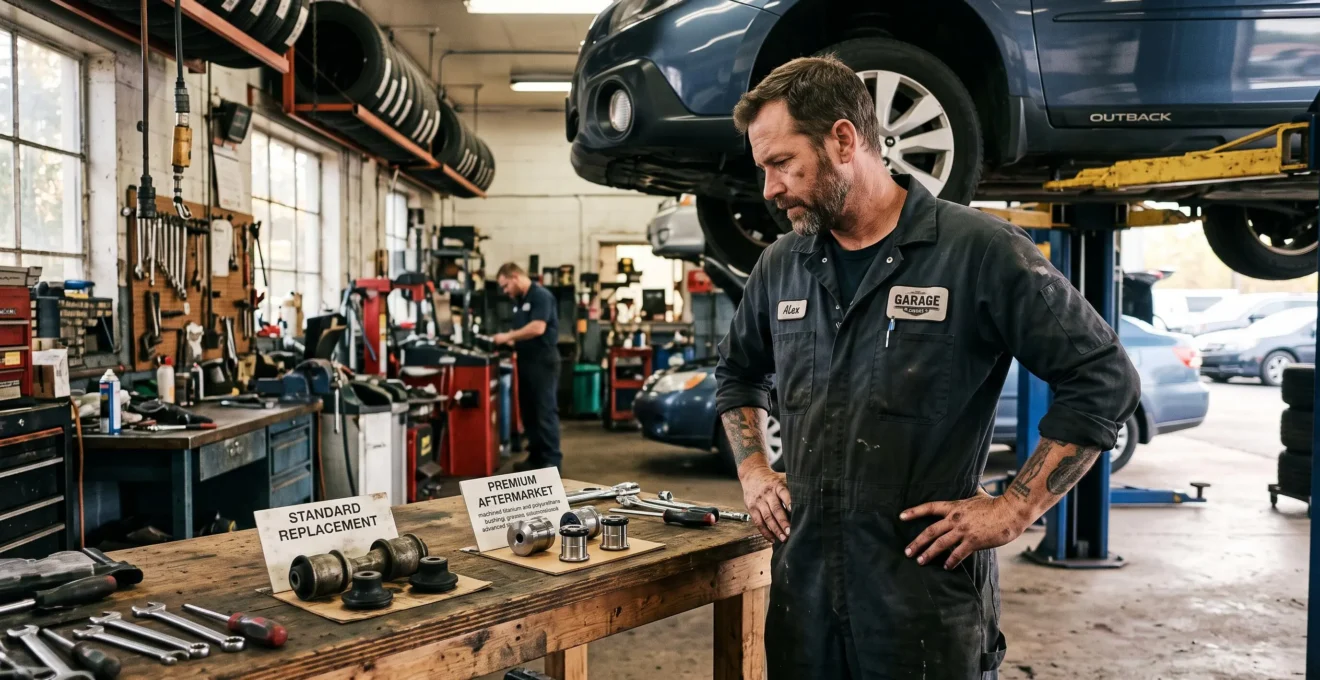
A premium aftermarket part should earn its higher price through measurable improvements in materials, manufacturing consistency, fit or resistance to demanding conditions. A sophisticated label, an impressive warranty or a higher retail price cannot establish those improvements. Nor does a premium designation demonstrate that a component will last twice as long as a standard alternative.
Some upgrades are worth considering: corrosion-resistant suspension components in harsh environments, better-specified bearings for demanding applications, and carefully matched braking or drivetrain components. Others deliver little practical benefit because the original specification is already adequate, the vehicle’s remaining life is limited, or installation conditions undermine the upgrade.
The distinction matters particularly when labour exceeds the cost of the replacement part. Repeating a difficult repair can make an apparently inexpensive component the more expensive decision.
For buyers comparing premium aftermarket, original equipment manufacturer (OEM) and standard replacement parts, the useful question is not which label sounds superior. It is whether the specific component offers a documented advantage for the vehicle, driving conditions and ownership period.
Premium aftermarket parts: the essentials
- Twice the lifespan is not a general rule. Demand component-specific evidence before accepting any durability multiplier.
- Fitment and installation come first. Even a well-engineered part can fail prematurely when incorrectly fitted or exposed to unresolved mechanical faults.
- Buy for the cost of failure. Prioritise dependable parts where repeat labour, safety consequences or secondary damage make failure expensive.
- Why Do Some « Premium » Parts Still Fail Early Despite the Price?
- How to Check if a Premium Part Is Genuine Before It Goes on Your Car?
- Premium Parts or Standard Parts: Which Makes Sense if Your Car Is Worth £3,000?
- The Premium-Part Pairing Mistake That Creates New Vibrations
- When Should You Upgrade to Premium Parts After the Second Failure?
- Why Do Some Aftermarket Parts Fail Within 1,000 Miles Even When « New »?
- OEM or Aftermarket: Which Makes Sense for a Car You’ll Keep 3 More Years?
- Which Aftermarket Parts Fail First—and How to Avoid Wasting Money in 90 Days
Why Do Some « Premium » Parts Still Fail Early Despite the Price?
Premium aftermarket parts can fail early because their price does not guarantee superior engineering, correct fitment or proper installation. Some genuinely incorporate stronger materials or improved protection against wear, while others are conventional components sold under more expensive branding. Even a demonstrably upgraded part cannot compensate for incorrect assembly, damaged mounting surfaces or unresolved faults elsewhere in the vehicle.
The first distinction is between documented engineering improvements and premium positioning. An upgraded bearing might use a different sealing arrangement or improved corrosion protection. A suspension component might incorporate a reinforced design intended for a particular duty cycle. These are potentially meaningful differences, but only if their specifications and intended applications are verifiable.
Descriptions such as « heavy duty », « OE quality » and « premium » should not be treated as proof of a common, independently tested performance grade. Suppliers can use these expressions differently. A useful comparison checks the exact component’s construction, dimensional requirements, materials, applicable technical specifications and any available testing documentation.
Three failure mechanisms can erase the advantage of a better component:
- Incorrect application: A part designed for a different engine, axle, suspension arrangement or production revision may fit superficially without operating correctly.
- Installation damage: Incorrect tightening, contaminated assembly surfaces or improper pressing can compromise a component before the vehicle leaves the workshop.
- Unresolved adjacent wear: A new joint installed alongside a damaged mating surface or severely worn suspension hardware may continue to experience abnormal loads.
A premium ball joint, for example, does not repair a damaged mounting bore or incorrect suspension geometry. The quality improvement addresses the component itself, not every condition affecting it.
Warranty wording deserves equal scrutiny. Compare exclusions, mileage restrictions, proof-of-installation requirements, reimbursement limits and whether removal and refitting labour is covered. A long warranty may be valuable, but duration alone does not establish reliability. Similarly, pro-rata compensation describes how a claim is calculated; it is not evidence that a manufacturer anticipates early failure.
There is also an important distinction between lasting longer and performing better. A component optimised for higher grip, stiffness or demanding operation may trade comfort or wear characteristics for that performance. The ideal specification depends on how the vehicle is used.
A credible premium purchase starts with a demonstrable technical advantage. The next question is whether the product being supplied is genuinely the one the manufacturer designed.
How to Check if a Premium Part Is Genuine Before It Goes on Your Car?
Check a premium part’s authenticity by verifying the seller’s authorised status, matching its part number to the manufacturer’s catalogue and inspecting the product before installation. Packaging, casting marks and authentication codes can reveal inconsistencies, but none provides universal proof. When uncertainty remains, obtain confirmation directly from the manufacturer before the part is fitted.
Counterfeits are not confined to expensive or obscure components. The UK Intellectual Property Office guidance on counterfeit vehicle parts identifies items such as brake pads, brake discs, spark plugs and filters as counterfeit risks. It also warns that convincing packaging can make imitation products difficult to identify visually.
Start with supply-chain verification. An authorised distributor provides a stronger basis for traceability than an unknown marketplace seller. A marketplace listing, even when it displays a familiar brand, does not necessarily establish who supplied or manufactured the component.
Cross-check the supplier against the manufacturer’s own distributor directory where one exists. Keep the invoice, seller identity and original packaging. If the brand provides a verification service, use its official channel rather than an unfamiliar link printed on suspicious packaging.
SKF provides a manufacturer-specific example. Its official product-authentication guidance directs buyers towards authorised distributors and describes the SKF Authenticate process for submitting photographs and purchase documentation when a product is suspicious. SKF also cautions that expert assessment may be necessary.
That procedure applies to SKF products; it is not a universal certification system for every aftermarket brand.
Five checks to complete before installation
- Confirm seller authorisation. Check the manufacturer’s official distributor information and save a screenshot or written confirmation identifying the supplier.
- Match the exact application. Compare the vehicle identification number (VIN), relevant build specifications and manufacturer part listing; retain the confirmed part number.
- Inspect the physical product. Photograph packaging, markings, casting finish and any manufacturer-provided authentication features; record unexplained differences.
- Verify the technical specification. Compare available manufacturer dimensions, materials, ratings and fitting requirements against the supplied product; save the relevant datasheet or catalogue entry.
- Resolve authenticity concerns. Send suspicious product photographs and purchase evidence to the manufacturer’s official verification contact where available; retain its response before authorising fitting.
Country-of-origin markings, QR codes and holograms can support an investigation, but should not be interpreted without manufacturer-specific information. Some legitimate brands manufacture in several countries, and counterfeiters can reproduce security-looking features.
The financial consequences extend beyond the part price. A counterfeit product may fall outside the genuine manufacturer’s warranty, while an installer may dispute responsibility for an unverified customer-supplied component. The applicable seller remedies and consumer rights depend on the jurisdiction and circumstances.
Once authenticity and fitment are established, the remaining issue is economic: whether the extra durability or protection justifies spending more on the particular vehicle.
Premium Parts or Standard Parts: Which Makes Sense if Your Car Is Worth £3,000?
On a car worth £3,000, premium parts make sense when their additional cost is small relative to repeat labour, the consequences of failure and the vehicle’s expected remaining mileage. Standard reputable components are usually more economical where replacement is straightforward and the original specification is adequate. Vehicle value matters, but it should not override safety or necessary repairs.
A £3,000 car expected to remain in service for another three years should not automatically receive the cheapest available components. Nor should every repair be upgraded. The sensible approach is to compare the total cost of keeping the vehicle operational, including labour and potential repeat repairs.
Consider two explicitly hypothetical decisions. A £40 upgrade on a repair already requiring substantial dismantling could be worthwhile if evidence indicates better reliability. A £200 upgrade with no documented benefit and little remaining vehicle life is harder to justify.
Neither example establishes an industry pricing benchmark or guarantees additional lifespan.
The following decision grid uses general repair characteristics rather than unverified durability rankings.
| Repair situation | Premium or higher-specification part | Reputable standard replacement |
|---|---|---|
| Timing-drive components | Worth prioritising when verified quality reduces a consequential failure risk. | Acceptable only where specifications, quality and installation requirements are fully satisfied. |
| Brake hydraulics and critical suspension joints | Consider documented quality and application suitability, not performance branding alone. | Can be appropriate when compliant, correctly specified and sourced from a dependable manufacturer. |
| In-tank fuel pump or labour-intensive hub assembly | Additional part cost may be justified by potentially expensive repeat labour. | Reasonable when reliability evidence is comparable and the supplier is credible. |
| Interior trim and cosmetic components | Usually limited practical benefit unless appearance or material quality matters to the owner. | Generally the economical choice when fit and function are satisfactory. |
| Routine service filters | Useful only where a specific filtration or application requirement warrants it. | Often sufficient when the correct recognised specification is met. |
The key distinction is failure consequence. A failed cosmetic component creates inconvenience. A defective steering or braking component can create a safety risk. A timing-drive failure on certain engine designs may cause extensive secondary damage.
Labour further changes the calculation. When accessing a component requires several hours of work, saving a small amount on the part may expose the owner to paying for the same labour twice.
However, premium spending does not necessarily increase resale value. If the vehicle is likely to be sold soon or is approaching the end of economical service, expensive upgrades may not be recovered in the sale price. That does not justify postponing essential safety work; it means the owner may need to reassess whether keeping the car is economical.
The calculation assumes the replacement will work correctly with the surrounding system. A higher-grade component can become a poor investment if it creates a mechanical mismatch.
The Premium-Part Pairing Mistake That Creates New Vibrations
A premium replacement can introduce vibration when its stiffness, geometry, balance or operating characteristics are incompatible with adjacent components. Common problems involve suspension bushings, driveshafts, wheel assemblies and braking systems. Mixing premium and standard parts is not automatically wrong: the risk depends on compatibility, wear differences and whether the components were designed to operate together.
Consider an uprated suspension bushing. A harder compound may resist deformation more effectively but transmit greater noise, vibration and harshness into the cabin. Pairing it with the original damper does not necessarily create a defect, but the overall suspension behaviour can change.
Likewise, replacing one driveshaft with a supposedly upgraded version may not resolve a vibration caused by worn engine mounts, damaged joints or an incorrect shaft specification. The upgrade must be assessed within the complete driveline.
Wheel balance, tyre uniformity and mounting accuracy can also explain vibration after an upgrade. A heavier alloy wheel is not automatically unbalanced; the relevant concerns are the assembled wheel-and-tyre balance, fitment and vehicle compatibility.
There are several pairing situations worth checking before installation:
- Driveshafts and wheel bearings: Verify shaft dimensions, joint design, axle-nut requirements, hub condition and any applicable bearing preload procedure.
- Bushings and dampers: Match suspension geometry and intended stiffness characteristics, especially when modifying the vehicle rather than restoring its factory specification.
- Brake pads and discs: Confirm approved friction-material compatibility, disc condition and correct bedding procedures. A premium pad cannot compensate for an unsuitable or defective disc.
- Belts and tensioners: Follow the specified belt system design, component compatibility and replacement procedure. An upgraded belt does not correct a seized pulley or defective tensioner.
The MOOG technical bulletin on diagnosing worn wheel bearings identifies incorrect torque, improper press-fitting, installation damage and demanding operating conditions as factors that can shorten bearing life. It also describes vibration and noise symptoms that require diagnosis rather than assumptions about part quality.
During the first journeys after installation, note when the vibration occurs. Road-speed-dependent vibration may suggest wheel, tyre or rotating-component issues. Vibration predominantly under braking can point towards the braking or suspension system. Vibration that changes with acceleration may indicate a driveline or mounting problem. These are diagnostic clues, not definitive identifications.
If vibration is severe, steering feels unstable, or braking behaviour changes, stop using the vehicle and arrange professional inspection.
Replacing components in pairs or matched sets is appropriate where required by the manufacturer, wear condition or operating symmetry. It is not a universal rule. A single compatible replacement can be reasonable when the opposite component is serviceable and no matched-set requirement applies.
Correct pairing removes one potential cause of repeated failure. When the same repair fails twice, the next step is to establish whether the replacement part is actually responsible.
When Should You Upgrade to Premium Parts After the Second Failure?
Upgrade after a second failure only when the evidence indicates that the standard component’s quality or specification is inadequate for the application. Two failures can instead reveal incorrect fitting, contamination, abnormal loads or an unresolved vehicle fault. A premium replacement is worthwhile when it addresses the diagnosed mechanism and its additional cost is lower than the expected cost of further failures.
Repeated replacement without diagnosis is an expensive habit. A battery that repeatedly fails may be affected by charging-system faults or parasitic electrical loads. Tie rods that wear unusually quickly may warrant investigation of suspension damage, driving conditions or alignment-related symptoms. Installing a more expensive component without correcting the actual cause may achieve nothing.
The diagnostic sequence begins with the failed part itself. An experienced technician should document the failure mode, examine mating components, confirm correct installation and compare the application against the manufacturer’s specifications.
Two identical defects in parts from the same production batch can suggest a supply or manufacturing issue. Failures involving different brands may strengthen the case for investigating environmental conditions, system faults or installation methods. Neither pattern proves a cause by itself.
A simple cost comparison helps establish whether upgrading is justified.
Hypothetical example: repeated replacement costs
Suppose a standard replacement costs £60 and fitting costs £150. Two completed repairs would total £420. A compatible premium replacement costing £110 with the same £150 fitting charge would total £260 for one installation.
If a future standard repair would fail again while the premium replacement would survive the intended ownership period, the premium option could reduce further expenditure. However, that outcome is hypothetical. The calculation does not establish either component’s failure probability, and the £420 already spent is a sunk cost when deciding what to do next.
For a forward-looking decision, compare the cost of the next standard repair with the next premium repair, adjusted for the likelihood and cost of another failure. Include diagnostics, labour, towing where relevant, and any reimbursement available under the actual warranty.
The timing also matters. Replacing one component halfway through the usable life of a matched assembly may create unnecessary work if the remaining items will soon require replacement. Where safe and technically appropriate, an upgrade at the next scheduled replacement of the complete set may offer better value.
Do not wait to address a known safety-critical defect merely to synchronise maintenance. The appropriate replacement schedule depends on the fault and manufacturer instructions.
Failure timing provides another useful clue. Components that deteriorate almost immediately after fitting require a different investigation from parts that wear out after extended service.
Why Do Some Aftermarket Parts Fail Within 1,000 Miles Even When « New »?
New aftermarket parts can fail within 1,000 miles because manufacturing defects, storage damage, incorrect application or installation errors may become apparent almost immediately. Unused does not always mean undamaged or suitable. Early failure should prompt inspection of the component, mounting conditions and installation records before the brand is blamed or another replacement is installed.
Storage conditions are one possible factor. Rubber components may deteriorate with age, temperature exposure, ozone or unsuitable storage. Corrosion can affect inadequately protected metal surfaces. Seals and gaskets may also be damaged or degraded before installation.
However, shelf age alone is not proof of damage. Material formulation, packaging, manufacturer storage requirements and actual exposure determine whether a part remains serviceable. A properly stored component should not automatically be rejected simply because it has spent time in inventory.
The earliest operating period can expose assembly mistakes that were not visible during fitting. Examples include incorrect fastener torque, damaged bearing races, improperly seated seals, restricted hoses or connectors exposed to strain.
A bearing pressed with force transmitted through the wrong race may sustain internal damage. A hose routed under tension may leak after engine movement and heat cycles. These conditions are installation-specific rather than evidence that aftermarket components generally have short service lives.
Reliability engineering often describes early defective-product failures using the term infant mortality. The concept is useful diagnostically, but it does not establish that most automotive replacement parts fail shortly after installation, nor does it provide a universal 1,000-mile failure threshold.
After a repair, use a component-appropriate inspection routine:
- Check for leaks, warning lights, unexpected noises and changes in vehicle behaviour.
- Review fluid levels where the repair involves a relevant fluid system.
- Observe abnormal heat or burning smells, without touching potentially hot components.
- Arrange any settling inspection or fastener check required by the vehicle or component manufacturer.
- Record mileage, symptoms and photographs promptly if a problem develops.
Do not independently loosen or re-torque safety-critical fasteners unless the manufacturer specifically requires the procedure and the person performing it is competent. Some fasteners are single-use or require carefully controlled tightening.
A failure occurring soon after installation does not automatically establish legal responsibility. The cause, repair agreement, consumer law and warranty terms determine whether a claim belongs with the seller, manufacturer or installer.
Once the repair process is under control, owners planning several more years of driving can make a more informed choice between OEM and independent aftermarket replacements.
OEM or Aftermarket: Which Makes Sense for a Car You’ll Keep 3 More Years?
For a vehicle you intend to keep for three more years, choose OEM or aftermarket parts according to fitment certainty, reliability evidence, repair labour and the expected mileage over that period. Genuine OEM components may be preferable for certain complex electronic systems, while reputable original-equipment suppliers and independent aftermarket manufacturers can offer suitable alternatives for many mechanical and service components.
The market contains more than two meaningful choices. A useful distinction is between vehicle-manufacturer-branded parts, replacement parts sold under the brand of an original-equipment supplier, and independent aftermarket components.
OEM terminology is sometimes used differently by sellers. A component marketed as OEM may refer to the manufacturer of the vehicle’s original part, while a dealer-supplied genuine part is typically sold under the vehicle brand. The labels should be checked rather than assumed equivalent.
The original component’s manufacturer markings can help identify a potential OE supplier. However, same supplier does not guarantee identical specification. Materials, production revisions, testing and product variants may differ between original equipment and aftermarket ranges.
For a three-year ownership horizon, purchase decisions should reflect whether the part is likely to remain serviceable throughout the intended use, how costly replacement would be, and whether the vehicle has particular compatibility requirements.
| Component category | Potentially sensible choice | Important qualification |
|---|---|---|
| Brakes and routine filters | Reputable OE-supplier or independent aftermarket parts | Confirm the correct vehicle specification, performance requirements and recognised quality documentation. |
| Common mechanical service items | Genuine OEM or verified aftermarket equivalent | Compare construction, fitment, price and labour exposure. |
| Complex control modules | OEM or a specifically validated compatible alternative | Software compatibility, coding and configuration requirements may be decisive. |
| Security-linked electronics | Genuine OEM or specialist-approved replacement | Authentication and vehicle programming can restrict available options. |
| Cosmetic replacement items | Reputable standard aftermarket components | Fit, finish and appearance may matter more than extended durability. |
Warranty considerations also vary by country and contract. According to the Federal Trade Commission guidance on vehicle warranties and service contracts, using aftermarket or recycled components does not automatically invalidate a US vehicle warranty. Coverage may nevertheless be denied for damage caused by a defective aftermarket part or improper installation, subject to the applicable rules.
That is US consumer guidance, not a universal rule for the UK, Canada, Australia or other English-speaking markets. Owners should check their local consumer protections, vehicle warranty, repair guarantee and any separate service-contract conditions.
A three-year ownership horizon does not, by itself, establish that OEM parts are always better or that aftermarket parts are always cheaper over time. The comparison must be made repair by repair.
Whatever sourcing route is chosen, poor catalogue matching and inadequate documentation can turn a reasonable replacement into an avoidable early failure. The final purchasing decision should therefore include a short-term protection plan.
Key takeaways before your next parts order
- Identify the actual vehicle specification, including relevant production revisions, before comparing component prices.
- Evaluate failure consequences and repeat labour rather than assuming an expensive part will automatically last longer.
- Preserve supplier, installation and inspection records so an early defect can be investigated and a valid claim supported.
Which Aftermarket Parts Fail First—and How to Avoid Wasting Money in 90 Days
There is no reliable universal ranking of which genuine aftermarket parts fail first across all vehicles, brands and operating conditions. However, electronic sensors, friction components, rubber and hydraulic parts, and incorrectly specified service items each have identifiable early-failure risks. The practical protection is to verify fitment, purchase traceable components and document the repair during its first 90 days.
A 90-day review period is a useful owner-defined monitoring window, not a proven industry-wide failure threshold or a universal warranty period. A part that survives 90 days is not necessarily durable, while an early failure does not automatically indicate poor manufacturing.
Different component categories deserve different checks.
| Component category | Potential early-failure mechanism | Prevention priority |
|---|---|---|
| Electronic sensors and modules | Incorrect electrical specification, connector incompatibility or unresolved wiring faults | Verify exact application, diagnostic requirements and coding compatibility. |
| Brake friction components | Incorrect friction application, poor disc condition or installation problems | Check approved pairing, hardware condition and fitting instructions. |
| Rubber and hydraulic components | Storage deterioration, contamination, pressure incompatibility or poor routing | Inspect condition and verify material, fluid and pressure requirements. |
| Belts and service filters | Incorrect dimensions, unsuitable specification or counterfeit supply | Match manufacturer catalogue data and verify product traceability. |
| Wheel bearings and hub assemblies | Installation damage, incorrect torque or adverse operating conditions | Follow the specific installation procedure and inspect mating components. |
This table identifies mechanisms worth investigating, not a statistically validated ranking of failure rates. Actual risk depends on the manufacturer, vehicle, application, maintenance and operating environment.
One recurring purchasing trap is relying solely on year, make and model. Vehicles that appear identical can differ in engine code, transmission, axle specification, braking system or production date. A photograph of a replacement component is not proof that its dimensions and operating specifications match.
Use the VIN and manufacturer catalogue where possible, and cross-reference the removed component’s part number. VIN-based lookups can still require confirmation of production variants or previous vehicle modifications.
For the first 90 days, keep a simple repair record containing the supplier, brand, part number, purchase invoice, installation date, odometer reading, workshop details and any relevant measurements or diagnostic findings. Photograph the old and new components when practical.
Use one clearly documented source and product identity per replacement rather than mixing unidentified components. If a fault occurs, the record should make it possible to establish what was fitted, by whom and under which warranty conditions.
Before purchasing, ask three final questions:
- Who manufactured the part? Confirm a traceable manufacturer and exact application number rather than relying on the seller’s premium branding.
- What does the warranty actually cover? Establish whether removal, refitting labour and consequential costs are included, excluded or subject to limits.
- Is the seller authorised or otherwise verifiably trustworthy? Confirm the supply route and available manufacturer authentication support.
These checks reduce avoidable uncertainty but cannot guarantee that a component will survive its first 90 days. They also do not replace diagnosis of the original failure or inspection of components that must operate together.
For your next repair, compare the actual specifications of two suitable components, ask the installer to confirm compatibility with adjacent parts, and keep the purchase and installation evidence together. Spend more where a documented technical advantage addresses a real risk—not simply because the package says premium.
Do premium aftermarket parts really last twice as long?
Not as a general rule. A twofold lifespan improvement would need evidence comparing specific components under comparable operating conditions, with clearly defined failure criteria. Manufacturer claims about upgraded materials or construction may explain potential advantages but do not establish a universal service-life multiplier.
Can a cheaper aftermarket part be better than an expensive OEM part?
It can offer better value, and in some applications it may provide a useful performance improvement. However, superiority requires a meaningful comparison of specification, compatibility, durability evidence and total repair cost. A lower price alone does not demonstrate equal quality, just as an OEM label does not prove that every alternative is inferior.
Does a lifetime warranty mean a car part will last for the vehicle’s lifetime?
No. The meaning of lifetime depends on the warranty’s written definition, eligibility conditions and exclusions. Some warranties cover only the replacement component, not removal and refitting labour. Buyers should check claims procedures and coverage limits before interpreting warranty duration as evidence of durability.
Is it safe to buy premium aftermarket parts from an online marketplace?
An online marketplace purchase is not inherently unsafe, but the specific seller and supply chain matter. Verify who sells and supplies the product, check manufacturer authorisation where available, confirm exact fitment and retain the invoice. Familiar packaging and positive reviews cannot independently establish authenticity.
Should a garage install premium parts that the customer supplies?
That depends on the garage’s policies, the part’s traceability and the agreed responsibility for defects or installation problems. Some garages decline customer-supplied components because they cannot confidently verify authenticity or provide their usual parts guarantee. Agree on warranty coverage, compatibility checks and responsibilities before the work begins.