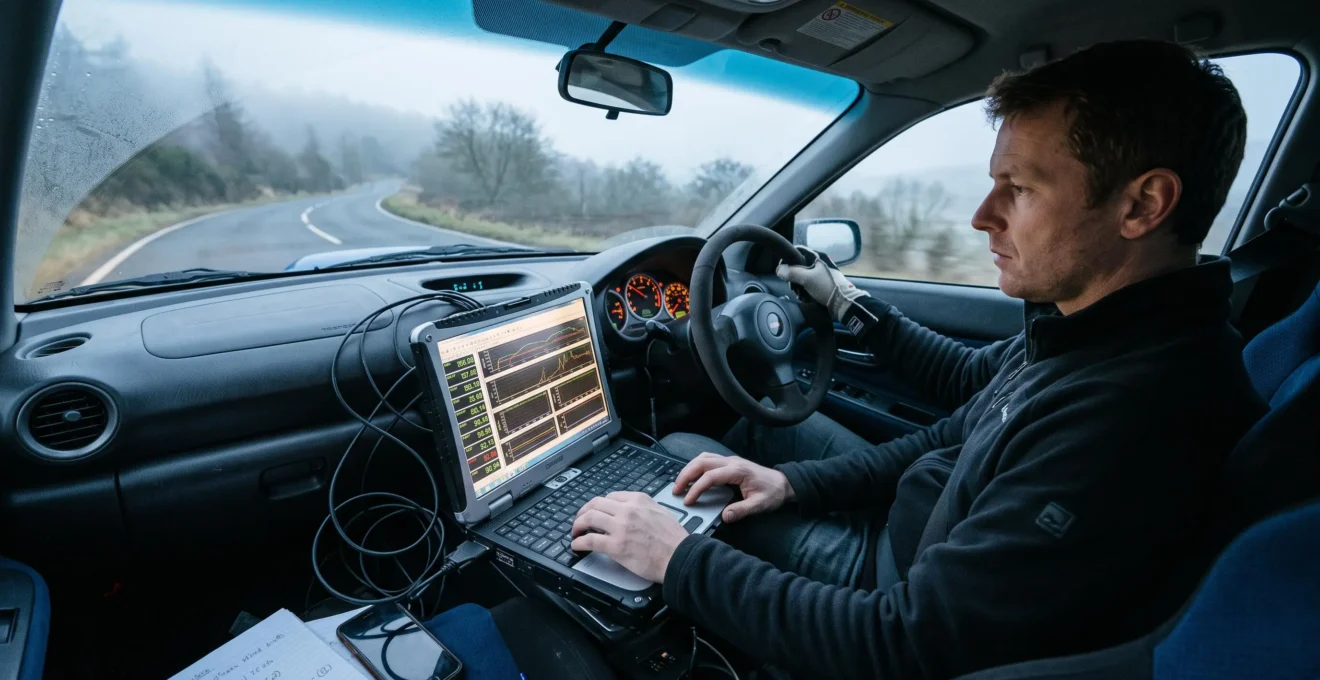
A flat spot in acceleration rarely tells you which component needs replacing. The engine may hesitate because ignition timing is being reduced, fueling is inconsistent, boost delivery is interrupted, or the electronic throttle is responding differently from what the driver expects. Installing a larger intake or a freer-flowing exhaust does not automatically address any of those causes.
Precision tuning is the process of measuring engine behavior, making targeted calibration changes, and verifying the results under controlled conditions. It prioritizes predictable torque delivery, stable fueling, appropriate knock protection, and repeatable drivability over a single impressive power figure.
Not every hesitation is a tuning problem. A leaking intake, weak fuel pump, deteriorating sensor, or transmission fault can produce similar symptoms. Calibration should follow diagnosis, not replace it.
The practical distinction is straightforward: random bolt-ons change the hardware and hope the response improves. A properly executed tune identifies what is limiting the engine, changes only what the evidence supports, and checks whether the improvement persists when conditions change.
Precision tuning: what actually matters
- Flat spots can result from ignition corrections, fueling errors, torque-management strategies, or mechanical faults. Datalogging helps distinguish them.
- A reliable custom tune starts with verified sensors, healthy hardware, appropriate fuel, and a documented stock baseline.
- Judge success by consistent throttle response, controlled knock correction, appropriate lambda, and repeatable performance—not peak horsepower alone.
- Why Does a Car Feel Different on the Same Tune When Temperatures Drop by 10°C?
- How to Prepare Your Car for a Custom Tune Without Missing a Hidden Fault?
- Off-the-Shelf Map or Custom Tune: Which Is Safer for Daily Driving?
- The Pre-Tune Sensor Problem That Can Wreck Your Engine Under Load
- When Should You Retune After Hardware Upgrades to Avoid Lean Running?
- ECU Remap or Suspension Upgrade: Which Improves Daily Driving More After 2 Weeks?
- How to Diagnose Sluggish Acceleration in 4 Tests Before Paying for Repairs?
- Why Your Car Feels « Sluggish » Even When It Has Plenty of Power on Paper
Why Does a Car Feel Different on the Same Tune When Temperatures Drop by 10°C?
A 10°C temperature drop can change how an engine delivers torque even when its ECU calibration remains identical. Intake-air temperature, coolant temperature, air density, and knock-control corrections can influence actual ignition timing, fueling, and boost behavior. The magnitude and direction of the change depend on the engine, operating conditions, and ECU strategy.
An ECU does not necessarily execute its base ignition table without modification. Actual spark timing may reflect corrections associated with temperature, load, knock detection, and torque management. As described in Haltech‘s ignition tuning documentation, engine-management systems can apply knock-related retard and control how ignition timing returns after a correction.
On a cold morning, denser intake air may increase the oxygen entering the cylinders at a given volumetric flow rate. The ECU must account for the resulting operating conditions. Depending on its strategy, it may command different fueling, change boost control, or apply different ignition corrections.
Cooler air can reduce some knock tendencies, but lower ambient temperature does not guarantee more power. A cold engine, temperature-dependent torque limits, altered traction, or changing boost behavior can produce the opposite impression.
A flat spot that appears only under particular temperatures is a diagnostic clue, not proof that the hardware is inadequate.
Installing an intake or exhaust without measuring the original response introduces another variable. A modification might alter airflow measurement, pressure losses, or turbocharger behavior without correcting the underlying torque interruption.
A useful comparison requires matched operating conditions:
- Record intake-air temperature and coolant temperature.
- Use the same gear, comparable engine speed range, and consistent fuel.
- Compare commanded and actual ignition timing, including knock correction.
- Review commanded versus measured lambda, fuel trims where applicable, and boost behavior.
- Repeat the measurement to distinguish a persistent pattern from one abnormal event.
For example, a hypothetical cold-morning log might show less ignition retard than an afternoon log at comparable load. That would justify investigating temperature-sensitive ignition behavior. It would not, by itself, prove that advancing the base ignition map is safe.
Comparisons should be performed under controlled conditions, preferably using a chassis dynamometer or a professional test environment rather than repeated full-throttle runs on public roads.
The next requirement is establishing that the measurements themselves are trustworthy. Temperature comparisons are only useful when the engine and its sensors are functioning correctly.
How to Prepare Your Car for a Custom Tune Without Missing a Hidden Fault?
Prepare for a custom tune by confirming mechanical health, checking sensor and fuel-system behavior, and recording the vehicle’s original calibration and operating data. A competent tuner should identify unresolved faults before increasing engine load or changing torque delivery. Otherwise, calibration changes may conceal symptoms without correcting their causes.
Start with mechanical integrity. Compression testing, or a leak-down test when indicated, can identify cylinder-sealing problems. Inspect spark plugs, ignition coils, intake plumbing, vacuum connections, and relevant cooling-system components.
A misfire caused by a weak ignition coil is not an ignition-map problem. Similarly, a leaking intake pipe should be repaired rather than compensated for by changing fuel or load tables.
Electronic checks are equally important. An engine can have no illuminated warning light while still storing pending diagnostic trouble codes or exhibiting abnormal fuel trims.
Check whether the mass-airflow sensor, manifold-pressure sensor, oxygen sensors, throttle position, and temperature sensors report plausible values. Compare readings against manufacturer specifications and the vehicle’s operating state rather than relying on generic pass/fail thresholds.
Fuel-system capacity must be verified before requesting additional torque. Fuel pressure, pump electrical supply, injector condition, and available fuel delivery should be assessed using procedures appropriate to the vehicle.
An engine that maintains acceptable fueling at its original load may encounter a fuel-delivery limitation when boost or airflow demand increases. Raising the requested load before identifying that limitation can create an unsafe operating condition.
The fuel in the tank must also match the calibration’s requirements. Octane ratings and fuel specifications vary between markets, so a tuner should identify the actual fuel standard rather than assuming that similarly numbered pump grades are equivalent.
Five checks to complete before your tuning appointment
- Document mechanical condition: inspect plugs, coils, intake connections, and relevant engine-health measurements. Deliverable: a dated inspection record with unresolved faults identified.
- Scan the ECU: retrieve stored and pending diagnostic codes and review available readiness information. Deliverable: an exported diagnostic report.
- Validate sensor behavior: compare temperature, airflow, pressure, and oxygen-sensor data against appropriate reference information. Deliverable: a baseline sensor log with any discrepancies noted.
- Confirm fuel readiness: document fuel grade and inspect fuel-pressure behavior, pump supply, and injector condition as appropriate. Deliverable: a fuel-system assessment.
- Preserve the baseline: save the original calibration where legally and technically supported, plus representative stock logs. Deliverable: a recoverable original-file record and clearly named comparison logs.
Saving the original calibration is frequently overlooked. A tuner should establish whether a genuine original file can be preserved and restored, as ECU security and flashing procedures differ between platforms.
Baseline logs are just as important. Without them, an owner cannot reliably distinguish a pre-existing weakness from a regression introduced during calibration.
Once the vehicle is demonstrably healthy, the choice between a standard remap and vehicle-specific calibration becomes a question of operating margins, evidence, and accountability.
Off-the-Shelf Map or Custom Tune: Which Is Safer for Daily Driving?
Neither an off-the-shelf ECU map nor a custom tune is automatically safer for daily driving. Safety depends on calibration quality, compatibility with the vehicle, fuel requirements, retained protections, and validation. A conservative, well-tested standard map may be appropriate for an unmodified car, while a properly verified custom tune can better address unusual hardware or operating conditions.
An off-the-shelf map is developed for a defined application rather than the measured behavior of every individual vehicle. Reputable providers may test extensively and retain substantial operating margins, but compatibility still depends on the precise engine, ECU version, hardware, and fuel.
A custom tune uses measurements from the specific vehicle to refine fueling, ignition, boost, and torque behavior where supported. This offers an opportunity to detect individual differences and correct drivability problems.
However, custom does not mean conservative. An aggressive calibration with inadequate knock protection, insufficient fuel-system capacity, or incomplete testing can be less reliable than a validated standard map.
The following decision grid focuses on everyday operation rather than marketing claims.
| Vehicle condition | Conservative off-the-shelf map | Custom tune |
|---|---|---|
| Stock hardware, normal climate, no identified faults | Potentially suitable if validated for the exact vehicle and fuel | May offer limited additional benefit unless a specific issue is documented |
| Modified intake, turbocharger, injectors, or engine internals | Suitable only when explicitly validated for the configuration | Generally preferable when changes materially affect airflow or fueling |
| Unusual altitude, temperature exposure, or fuel availability | Depends on the provider’s validated operating envelope | Allows vehicle-specific testing across relevant conditions |
| Existing hesitation, abnormal trims, or warning codes | Not a substitute for diagnosis | Only after the underlying faults are investigated |
| Owner prioritizes traceability and later adjustments | Depends on provider records and support | Can provide individual logs, revisions, and identifiable calibration decisions |
Accountability matters when a problem appears months later. Ask whether the provider supplies baseline and final logs, records calibration revisions, explains fuel requirements, and documents which protections remain active.
Traceability does not guarantee that an engine will never fail. It does, however, make future diagnosis more defensible than relying on an undocumented file.
Emissions compliance must also be considered. The EPA‘s information on vehicle tampering and aftermarket defeat devices explains that engine-control software modifications can raise emissions-tampering concerns in the United States. Other English-speaking countries have their own roadworthiness and emissions requirements.
A mechanically successful tune is not automatically road-legal or warranty-neutral. Owners should confirm applicable requirements before modifying an emissions-controlled vehicle.
Whatever the calibration approach, the greatest overlooked risk may be the quality of the sensor data used to develop and verify it.
The Pre-Tune Sensor Problem That Can Wreck Your Engine Under Load
A deteriorating sensor can undermine an engine tune by reporting incorrect airflow, pressure, oxygen concentration, or knock information. If the ECU or calibrator relies on that measurement, fueling and ignition decisions may be inappropriate under load. The danger is not simply a faulty component; it is the possibility of building an otherwise careful calibration around inaccurate data.
Consider a mass-airflow sensor that under-reports incoming air. Depending on the ECU strategy, this can distort calculated load or initial fueling. Closed-loop feedback may compensate in some operating conditions, potentially making the problem less obvious during ordinary driving.
At higher loads, feedback strategies and available correction authority vary between platforms. It is incorrect to assume that all factory ECUs abandon closed-loop fueling at wide-open throttle, or that every airflow error produces a lean mixture.
A manifold absolute pressure sensor can create similar uncertainty when its readings drift or its pressure reference is compromised.
The oxygen-measurement system deserves particular attention. A wideband sensor measures exhaust oxygen, which the controller interprets in terms of lambda. The reported value depends not only on the sensing element but also on electronics, installation conditions, and exhaust integrity.
A plausible-looking lambda value is not proof of an accurate measurement.
Bosch Motorsport‘s documentation for the LSU 4.9 sensor provides a useful reminder of how specific the measurement requirements can be.
“The sensor is not intended to be used for safety related applications without appropriate measures for signal validation in the application system.”
That warning concerns the documented sensor and its application. It does not establish that every aging wideband sensor is inaccurate, but it supports the need to validate measurements before using them for consequential calibration decisions.
Knock-sensor wiring introduces another potential problem. Damaged wiring or mounting issues may compromise the system’s ability to distinguish combustion knock from background vibration. Sensor diagnostics and ECU monitoring should therefore be checked against manufacturer procedures.
A practical pre-tune verification routine includes comparing airflow and calculated load with manifold pressure and engine speed, checking oxygen-measurement accuracy against suitable reference equipment, and confirming that the knock-monitoring system functions as intended.
Knock-system verification should use the manufacturer’s supported diagnostic method and qualified instrumentation. A single datalogged acceleration event cannot independently prove that a knock sensor will detect every dangerous combustion event.
The long-term consequence of faulty measurement is often underestimated. If the tuner compensates for a false sensor reading by modifying calibration tables, replacing that sensor later may reveal that the map was never correct for the engine’s true operating conditions.
Once measurement integrity is established, the next challenge is maintaining that integrity when hardware changes alter the engine’s operating requirements.
When Should You Retune After Hardware Upgrades to Avoid Lean Running?
Retune after a hardware upgrade when the modification changes airflow measurement, fuel delivery, combustion behavior, or operating load beyond the existing calibration’s validated range. Injector, turbocharger, and major engine changes generally require calibration review before demanding additional performance. Smaller intake or exhaust changes should be assessed using manufacturer guidance and measured data rather than assumptions.
Not all upgrades affect fueling in the same way. A replacement air filter that preserves the original intake geometry may have little measurable effect, while a revised mass-airflow sensor housing can alter the relationship between sensor output and actual airflow.
Likewise, changing a rear exhaust section on a naturally aspirated engine may have a smaller calibration impact than modifying the exhaust system upstream of a turbocharger. Neither outcome should be assumed without considering the specific design.
Changes to injector characteristics, fuel pressure, camshaft behavior, or turbocharger capacity can directly affect the information required by the ECU’s fueling and torque-control strategies.
| Modification | Potential effect | Recommended response |
|---|---|---|
| Replacement filter or minor exhaust change | May change airflow or pressure losses | Check compatibility and compare baseline logs |
| Revised intake or MAF housing | May alter airflow-sensor calibration | Verify measured load and fueling before demanding high load |
| Larger injectors or altered fuel pressure | Changes fuel-delivery characteristics | Calibrate injector and fuel-system parameters before normal loaded operation |
| Turbocharger or significant boost-system upgrade | Changes airflow, pressure response, and fuel demand | Perform configuration-specific calibration and controlled validation |
| Camshaft or major internal engine changes | Can change airflow, idle behavior, and combustion requirements | Review the relevant calibration strategy comprehensively |
Fuel trims provide an accessible early warning, but interpretation matters. Short-term fuel trim reflects ongoing correction, while long-term fuel trim represents learned adjustments on systems that implement it.
Positive trims indicate the controller is adding fuel relative to its base calculation. Negative trims indicate fuel subtraction. Neither identifies the cause on its own.
Compare trim values at similar operating points before and after the modification. A substantial change warrants investigation of intake leaks, sensor scaling, fuel delivery, and the modification itself.
There is no universal fuel-trim percentage that automatically proves a retune is required. Manufacturer tolerances, closed-loop strategies, sensor accuracy, and operating conditions must guide the decision.
Full-load lambda requires separate evaluation because cruise fuel trims do not establish mixture safety under high load. The correct commanded lambda depends on the engine, fuel, and calibration strategy.
Do not use continued high-load driving to investigate suspected lean operation. If measured lambda deviates dangerously from the validated target, or if fuel pressure cannot meet demand, reduce load and arrange professional diagnosis.
Driving briefly with newly installed hardware and an unchanged calibration is not inherently destructive. However, operating outside validated limits—particularly during sustained boost, towing, or track use—can expose fuel, thermal, and knock-related risks.
A modification should solve a defined problem. That principle also helps determine whether engine calibration is even the best improvement for daily driving.
ECU Remap or Suspension Upgrade: Which Improves Daily Driving More After 2 Weeks?
After two weeks, an ECU remap may offer greater everyday benefit when the main complaint is inconsistent throttle response or torque delivery. A suspension upgrade may be more valuable when poor ride control, excessive body movement, or road-induced discomfort dominates. Neither improvement is guaranteed: the result depends on the original problem, component selection, and quality of installation or calibration.
Everyday driving exposes qualities that peak-power measurements overlook. A vehicle can produce strong maximum horsepower yet respond awkwardly to small accelerator movements in traffic. An appropriately calibrated ECU may improve the consistency of torque requests, low-speed response, and transitions between operating regions.
On some vehicles, throttle mapping and transmission torque coordination are deliberately configured for comfort, emissions, component protection, or traction management. Changing those relationships without understanding the original strategy can make the car feel more aggressive without making it objectively better.
A poorly executed remap may create abrupt throttle tip-in, unnecessary gear hunting, or torque oscillation. Excessive ignition advance or boost demand can also increase correction activity when temperatures rise.
Suspension changes address a different group of problems: damping control, body movement, ride height, and responses to road irregularities.
However, stiffer springs or inappropriate dampers can worsen comfort. A suspension upgrade is not automatically beneficial merely because it replaces factory parts.
Use the following self-diagnostic before committing to either modification:
- Slow or inconsistent accelerator response: investigate throttle behavior, engine torque delivery, and calibration after excluding faults.
- Excessive bouncing or poor bump absorption: inspect dampers, springs, bushings, tyres, and suspension condition.
- Harshness over broken roads: assess tyre pressures, wheel and tyre specifications, damping, and suspension geometry.
- Strong acceleration on paper but weak response in normal gears: investigate torque-management behavior, transmission operation, and actual delivered torque.
A two-week comparison should evaluate the same commuting route, similar loading, and consistent driving conditions. Record the original complaint before the modification and assess whether it has genuinely improved.
There is no controlled comparative evidence in the supplied technical material establishing that a remap generally outperforms suspension work after two weeks.
When the dominant complaint is sluggish acceleration, a targeted diagnostic sequence provides a better starting point than either modification.
How to Diagnose Sluggish Acceleration in 4 Tests Before Paying for Repairs?
Diagnose sluggish acceleration by measuring the performance deficit, examining fuel-control behavior, reviewing ignition corrections, and verifying boost or airflow delivery. These four tests help separate a genuine engine-output problem from a subjective response complaint. They should be performed only when the vehicle is mechanically safe, using suitable equipment and controlled testing conditions.
The objective is not to collect as much data as possible. It is to establish a repeatable symptom and determine which system departs from expected behavior.
- Measure acceleration consistently. Use controlled dynamometer measurements or suitable GPS-based logging on a closed test facility. Record gear, engine speed, ambient conditions, and repeatability. Compare against a relevant baseline rather than relying on an unrelated vehicle’s advertised acceleration figure.
- Evaluate fuel trims and lambda. Review short-term and long-term trims where supported, alongside commanded and measured lambda. Distinguish normal closed-loop correction from evidence of fuel-delivery or airflow-measurement problems.
- Review ignition timing and knock correction. Log actual timing, relevant correction channels, intake temperature, and engine load. Investigate unexpected retard rather than assuming more ignition advance is the solution.
- Verify boost and airflow. For turbocharged engines, compare requested and actual boost, airflow estimates, and wastegate-control behavior where available. On naturally aspirated engines, examine measured airflow and load against expected behavior.
Each test isolates a different part of the acceleration process, but combinations are more informative than individual values.
For example, substantial positive fuel trims alongside low measured fuel pressure may justify fuel-system investigation. Positive trims without fuel-pressure evidence could instead indicate unmetered air, sensor error, or another issue.
Likewise, heavy ignition retard under load may reflect genuine knock, temperature-related protection, or a detection problem. It is not enough to identify retard; the cause must be established.
Low actual boost relative to requested boost can point toward a pressure leak, wastegate problem, control limitation, or protective ECU intervention. A single low-boost reading does not prove the turbocharger is defective.
The interpretation changes when multiple channels agree. For instance, a hypothetical vehicle showing repeatably low boost, normal lambda, and no unusual knock correction would warrant a different investigation from one displaying expected boost but substantial ignition retard.
Mechanical safety takes priority throughout testing. Misfires, abnormal noises, overheating, or evidence of inadequate fueling are reasons to stop loaded testing rather than complete the sequence.
A further boundary case is important: an engine can be mechanically healthy, achieve its expected measured output, and still feel unresponsive because torque delivery or accelerator mapping does not match the driver’s needs.
That is a potential calibration issue, but a custom tune should still preserve emissions compliance, torque safeguards, and adequate operating margins.
After mechanical and control-system faults have been separated, the final question is why published horsepower can differ so dramatically from the way a car feels on the road.
Key takeaways before changing the calibration
- Establish whether the complaint concerns actual acceleration, response delay, or inconsistent torque delivery; they require different remedies.
- Interpret engine behavior in its operating context, including temperature, fuel quality, gear selection, and ECU protection strategies.
- Use repeatable baseline measurements to determine whether tuning improves the problem without introducing new compromises.
Why Your Car Feels « Sluggish » Even When It Has Plenty of Power on Paper
A car can feel sluggish despite a strong horsepower rating because peak power does not describe throttle response, low-speed torque delivery, transmission behavior, or engine output under everyday conditions. Heat soak, protective ignition corrections, torque limits, mechanical losses, and driver expectations can all contribute. The correct solution depends on identifying which factor is responsible.
Advertised engine horsepower generally describes output under specified test conditions, often measured at the crankshaft. The power delivered at the wheels is influenced by drivetrain losses, operating temperature, and the vehicle’s control systems.
Two cars with similar peak power can therefore feel different at ordinary road speeds. Their usable torque curves, gearing, transmission responses, accelerator maps, and vehicle mass may differ considerably.
Engine calibration adds another dimension. The ECU can limit delivered torque according to gear, temperature, traction requirements, transmission protection, or other operating conditions.
A driver’s accelerator request may pass through several control functions before the engine produces the corresponding torque. The resulting delay or nonlinear response can feel like missing power, even when full-load output remains close to specification.
A sharper accelerator map is not the same as additional engine power. It changes the relationship between pedal movement and requested torque, which may improve perceived responsiveness without increasing maximum output.
Driver adaptation also matters. Once a vehicle’s acceleration becomes familiar, an unchanged response may feel less dramatic. Conversely, hot weather, lower-quality fuel, or a deteriorating component may produce a genuine difference that the driver notices before a warning light appears.
Measurement helps distinguish these cases. If the car reaches its expected output but hesitates during throttle transitions, the investigation should focus on response behavior and control strategies. If measured output is consistently below expectations, mechanical condition, fueling, airflow, and protective interventions deserve priority.
Precision tuning can improve a calibration-related flat spot when it targets a verified mismatch between requested and delivered torque. That may involve smoothing transitions, refining appropriate fuel and ignition control, or resolving avoidable control oscillation within safe limits.
However, not every flat spot is a calibration defect. Mechanical faults, transmission behavior, traction interventions, or insufficient fuel delivery may produce similar symptoms. Some torque restrictions and ignition corrections are essential safeguards rather than opportunities for performance enhancement.
Random bolt-ons introduce new variables without guaranteeing that any of those mechanisms will improve. A larger intake will not repair a failing coil. A freer-flowing exhaust will not validate an inaccurate oxygen sensor. Neither modification substitutes for understanding the engine’s requested and actual operating behavior.
Successful tuning should be judged by several outcomes together: predictable torque delivery, stable fueling, appropriate protective corrections, repeatable measurements, and acceptable behavior across the temperatures and driving conditions the car actually encounters.
Before buying another performance part, document the sluggishness, inspect the relevant mechanical systems, and obtain comparable baseline logs. If those measurements reveal a calibration-related limitation, ask a qualified tuner for a controlled adjustment with documented before-and-after results, retained safeguards, and confirmation of applicable road-use requirements.
Can precision tuning fix a flat spot without increasing peak horsepower?
Yes, when the flat spot results from a calibration-related issue. Adjusting torque-delivery transitions, throttle response, or other appropriate control parameters may improve drivability without raising maximum engine output. The tuner must first verify that the symptom is not caused by a mechanical fault or a necessary protective intervention.
Is an ECU tune safe for a high-mileage daily driver?
Mileage alone does not determine tuning suitability. Engine condition, service history, compression, fuel-system health, sensor accuracy, and operating requirements matter more. A high-mileage vehicle with unresolved faults should be repaired before additional performance is requested. Even on a healthy engine, tuning cannot eliminate mechanical wear or guarantee reliability.
Does a better throttle response mean the engine is making more torque?
Not necessarily. A calibration can request a greater percentage of available torque with less pedal movement, making the car feel more responsive without increasing its maximum torque capability. Actual improvement should be assessed using measured torque delivery, acceleration consistency, and low-speed drivability rather than pedal sensitivity alone.
Can an OBD-II scanner provide enough data to validate a custom tune?
A basic OBD-II scanner can provide useful information, including diagnostic codes, available fuel trims, and selected operating parameters. However, many vehicles require manufacturer-specific or specialist logging tools to access commanded lambda, detailed ignition corrections, boost targets, and torque-control channels. Logged data may also need independent measurement to confirm sensor accuracy.
Should a custom tune retain factory knock and emissions protections?
Appropriate knock, temperature, fuel-system, and component-protection functions should remain effective. Calibration must also comply with applicable emissions and road-use requirements. The details depend on the ECU and jurisdiction, so owners should request explicit documentation of retained protections and confirm that the proposed changes are legally appropriate for their vehicle.