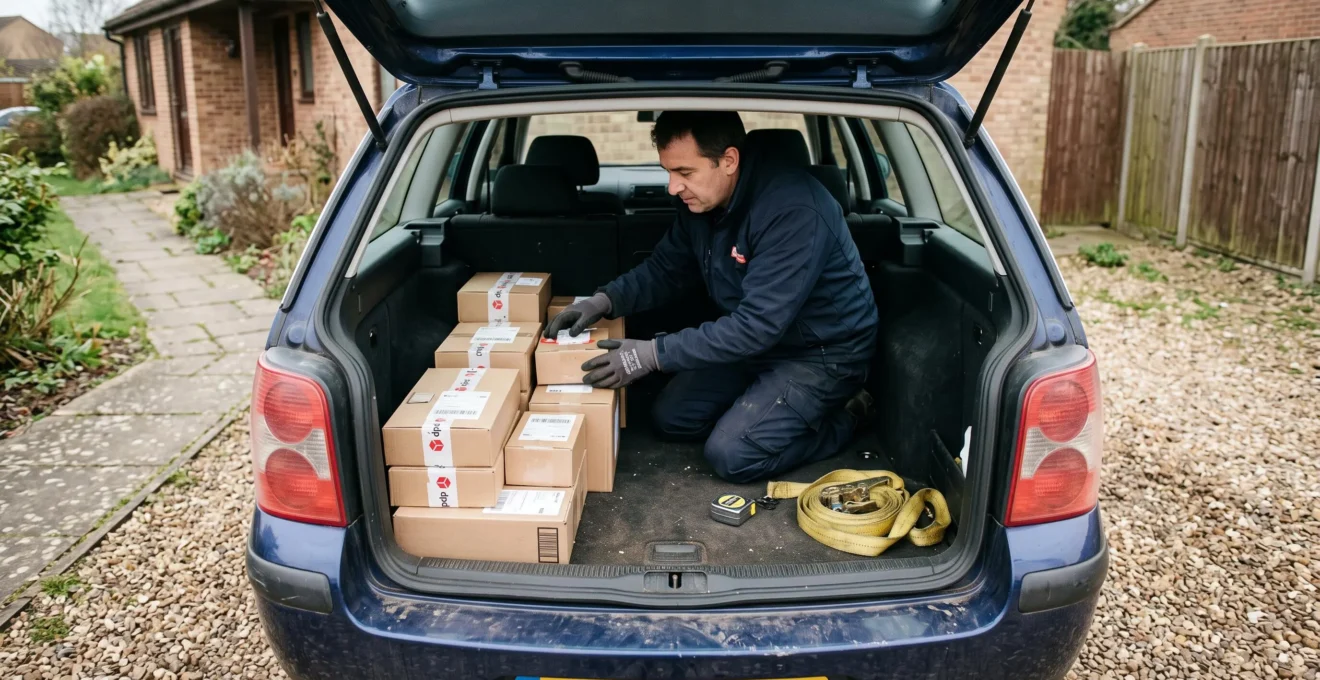
Running out of cargo space does not automatically mean needing a van. For couriers, market traders and part-time delivery drivers, the first opportunity is often to recover wasted space, improve access to parcels and choose an external carrier that suits the load.
Adding 25 % more usable cargo space is a practical target, not a guaranteed result. Whether it is achievable depends on the vehicle’s dimensions, existing packing efficiency, parcel shapes and permissible weight limits. A roof box or trailer might provide the additional volume, but neither increases the car’s permitted gross vehicle weight.
The most economical solution starts with three questions: What physically fits through the loading opening? How much cargo weight can the vehicle legally carry? And how quickly can each parcel be retrieved during a working route?
Answering those questions can reveal whether better packing, an inexpensive accessory, occasional van hire or a different vehicle is the sensible next step.
More cargo space without a bigger vehicle: the essentials
- Measure usable floor space, loading openings and parcel dimensions before buying additional equipment.
- Choose roof boxes for compatible light, bulky loads and suitable trailers for larger or heavier loads, while respecting all vehicle limits.
- Calculate remaining payload, secure every load and compare delivery time savings against equipment, fuel and handling costs.
- Why Does Packing Tighter Make You Deliver Slower Even With More Space?
- How to Measure Real Usable Cargo Space in 10 Minutes Without Special Tools?
- Roof Box or Small Trailer: Which Adds More Useful Space for Bulky Parcels?
- The Cargo Add-On Mistake That Can Get You Pulled Over in 5 Minutes
- When Is It Time to Upgrade Cargo Capacity Instead of “Making It Fit”?
- Roof Rack, Trailer, or Van Hire: Which Is Best for a 60-Mile Goods Run?
- How to Calculate Real Payload in 5 Minutes Including Driver and Fuel Weight?
- How to Match Payload and Route Demands Without Buying the Wrong Vehicle Class
Why Does Packing Tighter Make You Deliver Slower Even With More Space?
Packing more parcels into a car can slow deliveries because storage density and retrieval speed are different measures of efficiency. When the next parcel is buried beneath other goods, the driver must unload, rearrange and secure the cargo repeatedly. Dense packing works better for a few large drops than for routes requiring frequent access to individual items.
Consider a hypothetical courier carrying 20 parcels across 15 delivery stops. A tightly packed boot holds everything, but retrieving each parcel requires moving three others. If this adds just two minutes at ten stops, the route loses 20 minutes to handling. That time may outweigh the benefit of avoiding a small amount of additional driving.
The distinction is between volume capacity, the amount physically stored, and accessibility capacity, the amount that can be retrieved efficiently without disturbing the remaining load.
A useful operational test is simple: if accessing one parcel regularly requires moving more than two others, review the loading sequence. This is a practical workflow heuristic, not a legally prescribed limit or scientifically established threshold.
Instead of stacking exclusively by size, group deliveries by route order. Position later drops toward less accessible areas and keep the next deliveries close to the loading opening. Use suitable containers or dividers where they can be secured safely, and avoid creating unstable stacks.
Loading density should reflect the journey:
- Few large deliveries: dense packing can reduce wasted space because the load is handled only a few times.
- Many small deliveries: organized zones and clear retrieval paths can save time at every stop.
- Mixed fragile goods: separation and appropriate restraint matter more than fitting one additional parcel.
Repacking also introduces risks of crushed cartons, dropped goods and improperly resecured cargo. The UK Driver and Vehicle Standards Agency‘s DVSA guidance on load securing and weight distribution explains why cargo stability and axle loading must remain safe as goods are removed during a delivery route.
The best loading arrangement is not necessarily the fullest boot. Before considering external storage, establish how much of the existing cargo area can actually be used.
How to Measure Real Usable Cargo Space in 10 Minutes Without Special Tools?
You can estimate usable cargo space in about ten minutes with a tape measure, a notebook and the dimensions of your typical parcels. Measure the loading floor, account for wheel arches, check the available height and record the narrowest door opening. These measurements reveal practical loading limits that advertised boot-volume figures cannot describe on their own.
Start with an empty, level load area in the vehicle’s normal cargo-carrying configuration. If the rear seats fold, record measurements for both seat positions, but only use configurations permitted by the manufacturer.
Measure four dimensions:
- Usable length: from the closed tailgate’s interior clearance to the nearest fixed obstruction or seatback.
- Flat floor width: between the wheel arch intrusions, rather than across the widest point of the boot.
- Available height: from the load floor to the lowest relevant obstruction, such as roof trim, a parcel shelf or another fixed feature.
- Door aperture: the narrowest usable width and height through which an item must pass.
Record the tailgate opening separately from the interior dimensions. A carton may fit inside the boot mathematically yet be impossible to pass through the opening without unsafe tilting or excessive force. The loading floor height also determines how difficult repeated lifting will be.
For a quick estimate, multiply the usable floor length by the width between the arches. This gives a conservative rectangular floor area, not the total available floor area or the full cargo volume. Use typical parcel footprints to estimate how many cartons could fit in one layer while allowing for orientation, access and restraint.
For example, in a hypothetical boot with a usable rectangular floor measuring 100 cm by 90 cm, the area is 0.90 m². If a parcel has a 45 cm by 30 cm footprint, two can fit across the width and two along the length in a straightforward aligned arrangement, giving four parcels per layer. Other orientations may produce a different result.
Stacking more layers requires checking package strength, available clearance, load stability and weight limits. A roof-height measurement is not permission to stack unsecured boxes up to the ceiling.
Record a separate largest single-item limit based on the actual loading opening, internal clearances and the feasible path into the vehicle. Irregular objects may require a trial fit before accepting a job.
With a reliable picture of usable space, it becomes easier to tell whether the real limitation is parcel size, available floor area or total weight.
Roof Box or Small Trailer: Which Adds More Useful Space for Bulky Parcels?
A roof box is generally more convenient for light, bulky parcels that fit its dimensions and the vehicle’s roof-load rating. A suitable small trailer can carry larger items and potentially greater cargo weight, but introduces towing, parking and maneuvering requirements. The better choice depends on the parcel profile, vehicle compatibility and operating conditions rather than advertised storage volume alone.
Before comparing prices, establish whether either accessory can be fitted safely. A roof box requires compatible mounting points or roof bars, and the complete roof-mounted assembly must remain within the applicable manufacturer limits. A trailer requires a suitable towing vehicle, approved towing equipment and compatible electrical connections.
The practical differences become clearer when compared side by side.
| Criterion | Roof box | Small trailer |
|---|---|---|
| Best cargo profile | Light, bulky goods within box dimensions | Larger or heavier loads within trailer and towing limits |
| Loading effort | Overhead lifting | Usually lower loading height |
| Weather protection | Enclosed protection, subject to box design and seals | Depends on whether the trailer is enclosed or properly covered |
| Security | Lockable models offer a deterrent, not guaranteed theft prevention | Depends on locks, enclosure and securing equipment |
| Driving behavior | Higher centre of gravity, greater wind exposure | Different braking, turning, reversing and stability demands |
| Parking | Vehicle footprint largely unchanged, but increased height | Additional length and maneuvering space |
| Compatibility | Roof ratings, bars and mounting system | Towing limits, tow bar, electrics and trailer specifications |
A roof box is attractive when the main problem is volume rather than weight. It may carry awkward but relatively light parcels while keeping the interior clear. However, reaching above shoulder height repeatedly creates handling demands, particularly for shorter drivers or frequent delivery stops.
The aerodynamic cost also matters. FuelEconomy.gov‘s driving efficiency recommendations report that a large rooftop cargo box can reduction in highway fuel economy with a large rooftop cargo box reduce fuel economy by approximately 6–17 % during highway driving, based on specific vehicle and cargo-box configurations. The actual effect depends on equipment design, speed and vehicle characteristics.
6%–17%
Estimated reduction in highway fuel economy with a large rooftop cargo box in the vehicle configurations discussed by U.S. government guidance. This is a fuel-economy reduction, not a measured increase in cargo capacity.
FuelEconomy.gov, citing Oak Ridge National Laboratory research published in 2014.
Roof-mounted weight also raises the vehicle’s centre of gravity and can change its response to crosswinds. A trailer keeps cargo off the roof but creates different handling considerations, including trailer sway, turning clearance, braking and reversing. Neither option removes the need for proper restraint.
For dense tools, stock or equipment, a suitable trailer may be more practical, provided the car’s towing capacity, trailer ratings, nose weight and axle limits permit the load. For theft-sensitive or rain-sensitive goods, an enclosed solution with appropriate security and protection may be preferable to an exposed rack or open trailer.
An accessory only solves the capacity problem if the complete vehicle-and-load combination remains compliant. That is where a seemingly straightforward upgrade can become expensive.
The Cargo Add-On Mistake That Can Get You Pulled Over in 5 Minutes
The most serious cargo add-on mistake is treating a roof rack, roof box or trailer as permission to ignore weight limits. A roof-mounted load still counts toward the carrying vehicle’s gross weight and axle loads. Unsecured cargo, dangerous overhangs, obscured lights or number plates, and non-compliant towing equipment can also attract roadside enforcement. Actual stopping and enforcement procedures vary by jurisdiction.
A roof-load rating is not additional vehicle payload. It is a separate limit within which the roof bars, mounting equipment, box and contents must fit. The vehicle must also remain within its gross weight and axle ratings.
For example, if a hypothetical vehicle permits 75 kg on its roof and its roof bars plus box weigh 25 kg, the remaining roof-load allowance is at most 50 kg. It could be less if the roof bars, box or vehicle’s remaining payload impose a lower limit.
The same principle applies to trailers, although trailer weight is governed by its own gross rating and the vehicle’s towing limits. The trailer’s downward load on the tow ball also places weight on the towing vehicle and influences axle loading.
UK guidance is particularly clear about securing roof-mounted goods. The DVSA guidance for loading cars, vans and roof racks recommends suitable ratchet straps or effective clamping and warns against relying on bungee cords or rope as the primary restraint method for roof-rack loads.
“Do not put loads heavier than the manufacturer’s recommended maximum weight limit on roof racks.”
Before leaving, check whether cargo extends beyond the permitted vehicle envelope. Overhang marking rules, trailer registration, licensing categories, lighting requirements and towing speed limits differ between countries and sometimes between states or provinces. Verify the requirements for every jurisdiction on the route instead of assuming that one country’s rules apply everywhere.
In particular, cargo carriers or racks must not obscure legally required plates, lights or signals. Additional lighting or plate arrangements may be necessary where permitted and required locally.
Five-minute cargo departure checklist
- Check the vehicle and accessory weight limits against the planned load; record the lowest applicable allowance.
- Inspect roof mounts, straps, clamps or trailer coupling for correct attachment; complete a physical security check.
- Confirm heavy goods are positioned low and distributed appropriately; record any remaining load-balance concern before departure.
- Check that number plates, indicators, brake lights, mirrors and necessary trailer lights remain visible and functional; complete a walk-around inspection.
- Check overhangs, doors, lids and cargo restraints against the relevant local requirements; confirm the load is secure and roadworthy before setting off.
The checklist helps identify common hazards, but it does not replace manufacturer instructions, required weighing or a jurisdiction-specific compliance check. Recheck cargo security when the load changes during deliveries.
If the only way to carry the next job is to exceed a rating or compromise visibility, the correct decision is not tighter packing. It is to choose a different transport arrangement.
When Is It Time to Upgrade Cargo Capacity Instead of “Making It Fit”?
Upgrade cargo capacity when space shortages repeatedly cause extra trips, rejected jobs, excessive handling or unsafe loading. Occasional overflow can justify temporary equipment or a hired vehicle. Persistent shortages across several weeks suggest a structural mismatch between the vehicle and the work. Exceeding weight limits, obstructing visibility or carrying unstable cargo requires an immediate change, regardless of frequency.
Several warning signs indicate that improving the packing arrangement is no longer enough:
- Regularly removing seats or changing the interior beyond an approved configuration to accommodate stock.
- Making second journeys because the required goods cannot fit safely in one load.
- Declining profitable assignments because parcels exceed loading dimensions.
- Repeatedly rearranging cargo at stops to reach goods trapped underneath other items.
- Approaching or exceeding gross, axle, roof or towing limits.
The first four problems may be operational or financial. The fifth is a safety and compliance issue that cannot be justified by delivery revenue.
To assess the financial impact, calculate the cost of inconvenience: additional driving time, fuel, parking, vehicle wear, loading labor and potentially missed assignments. Compare this with the complete cost of an alternative arrangement, including hire charges, insurance, permitted mileage and collection time.
Hypothetical example: the second-trip problem
A part-time trader needs two journeys to transport market stock. Suppose the second journey adds 90 minutes and 30 miles of driving. At an assumed planning value of £15 per hour, the additional time costs £22.50 before fuel, wear and other expenses.
If a suitable larger vehicle can be hired for less than the total extra-trip cost, including collection, return and operating expenses, hiring may be financially preferable. The figures are illustrative assumptions, not published market rates or observed business results.
Frequency changes the calculation. A temporary vehicle may make sense for a seasonal sale or occasional bulky order, while weekly overflow can justify investing in compatible equipment. Permanent additions still require maintenance, storage and compliance checks.
Track overflow incidents rather than relying on impressions. Record how often jobs exceed capacity, the weight and dimensions involved, and the measurable cost of handling the problem. This gives a clearer basis for choosing between ownership, hire and changing vehicles.
When the extra capacity is needed only for a specific journey, comparing transport options for that journey can avoid an unnecessary long-term purchase.
Roof Rack, Trailer, or Van Hire: Which Is Best for a 60-Mile Goods Run?
For a 60-mile goods run, a roof rack is potentially economical for light, easily secured items, a suitable trailer is often better for bulky or heavier goods, and van hire can be preferable for a rare journey requiring substantial enclosed space. The lowest-cost option depends on total journey distance, loading time, rental logistics, fuel use, weather protection and how frequently the journey repeats.
First clarify whether 60 miles represents the entire journey or only the outward leg. A 60-mile outward trip with a return to the starting point creates a different cost calculation from a 60-mile round trip.
Each option carries costs beyond its advertised price.
| Decision factor | Roof rack or box | Small trailer | Hired van |
|---|---|---|---|
| Equipment cost | Purchase or rental plus compatible fittings | Purchase or hire plus suitable towing equipment | Hire charges, insurance terms and potential extras |
| Setup time | Mounting, loading and securing | Coupling, electrical checks and loading | Collection, paperwork, loading and return |
| Fuel impact | Added aerodynamic drag | Additional towing resistance and weight | Depends on hired vehicle and route |
| Cargo protection | Depends on enclosure and restraints | Depends on trailer type and coverings | Enclosed cargo area, with securing still required |
| Destination access | Vehicle height and unloading restrictions | Extra length, turning and parking space | Vehicle height, width and parking availability |
| Recurring use | Potentially cost-effective after suitable equipment is acquired | Potentially economical for regular suitable loads | Flexible but recurring rental costs accumulate |
A roof rack without an enclosed box may be unsuitable for loose, fragile or weather-sensitive parcels. A trailer may add useful capacity but also demands additional attention to road conditions, braking, parking and reversing. On a longer or unfamiliar route, these tasks can increase driver workload and fatigue.
For a hired van, include travel to the rental location, vehicle collection, fuel, any mileage allowance, parking restrictions and return procedures. The largest vehicle available is not automatically the most economical.
Use a simple three-question test:
- How heavy is the load? If it exceeds the remaining vehicle payload or accessory limits, eliminate that option immediately.
- How sensitive are the goods to weather or theft? Choose appropriate enclosed, secured transport where required rather than relying on exposed carriage.
- How often will this journey recur? Occasional loads favor flexible hiring when costs justify it; frequent loads may support ownership of compatible equipment.
For a basic break-even comparison, divide the initial equipment cost by the estimated saving per journey compared with hire, after accounting for ongoing expenses. The result estimates how many comparable journeys are needed to recover the investment. If the saving is zero or negative, there is no positive break-even point under those assumptions.
For example, an illustrative £300 equipment purchase that saves £30 per qualifying journey would take ten such journeys to recover its initial cost, before maintenance, storage and any other omitted expenses. These numbers are hypothetical and are not current supplier quotations.
Whichever option appears cheapest, the final choice depends on how much load the vehicle can safely and legally carry—not merely how many parcels can fit inside.
How to Calculate Real Payload in 5 Minutes Including Driver and Fuel Weight?
Real remaining payload is calculated by subtracting the vehicle’s actual operating weight from its gross vehicle weight rating. That operating weight includes the relevant driver, passengers, fuel, accessories and other equipment already aboard. The calculation can take five minutes when reliable figures are available, but kerb-weight definitions vary, and axle limits require separate checks.
Start with the vehicle identification plate and owner’s manual. Find the permitted gross vehicle weight, called GVWR in some countries and often GVW or maximum authorised mass in others. Then establish the vehicle’s kerb or curb weight and the manufacturer’s definition of what that figure includes.
Do not automatically subtract driver and fuel weight twice. Some published kerb-weight figures already include a specified fuel level, driver allowance or other equipment. Other definitions differ. The correct calculation depends on the baseline used.
When starting from a documented kerb weight, calculate:
Remaining cargo allowance = GVWR − kerb weight − additional occupants and equipment − fuel or driver weight not already included − cargo already loaded.
If the vehicle’s actual current weight can be measured on a suitable scale, the simpler approach is to subtract that weight from the GVWR, accounting for any occupants or equipment not present during weighing.
Not every vehicle plate displays kerb weight, so the manual or manufacturer documentation may be needed. Actual vehicle weight can also differ from a published specification because of factory options, modifications and fitted equipment.
Consider this explicitly hypothetical calculation:
| Item | Weight | Calculation |
|---|---|---|
| Gross vehicle weight rating | 2,000 kg | Starting limit |
| Documented kerb weight | 1,450 kg | 2,000 − 1,450 = 550 kg |
| Driver not included in kerb weight | 80 kg | 550 − 80 = 470 kg |
| Additional fuel not included in kerb weight | 20 kg | 470 − 20 = 450 kg |
| Roof box and bars | 25 kg | 450 − 25 = 425 kg |
| Other carried equipment | 15 kg | 425 − 15 = 410 kg |
| Remaining cargo allowance | 410 kg | Subject to axle and roof-load limits |
The example assumes that neither the driver nor the additional fuel is included in the stated kerb weight. It is a teaching scenario, not a vehicle specification. The 410 kg result would not establish how much could be carried on the roof, which has its own lower limit.
For parcels without a convenient scale, use supplier-declared weights, shipping labels or documented product specifications. For water, one litre has a mass of approximately one kilogram under ordinary conditions, excluding container weight. That is a useful approximation for water containers, not a general rule for oils, chemicals or mixed goods with different densities.
Dense goods such as tools, liquids and metal components should not be estimated by appearance alone. Use a suitable weighing method when weight is uncertain.
Finally, check individual axle limits. A vehicle can remain below its GVWR while exceeding a rear-axle rating because heavy goods are concentrated too far back. Place heavy cargo low, near the vehicle’s centre line and in positions consistent with the manufacturer’s loading instructions. Do not assume that moving everything forward is safe, since the front axle also has a limit.
The UK Highway Code’s rules for vehicle towing and loading state that vehicles and trailers must not be overloaded. They also address roadworthiness, trailer lighting, load security and towing-weight restrictions. Rules in other English-speaking jurisdictions must be checked locally.
Where axle loading is uncertain, a suitable weighbridge or vehicle scale is more reliable than a calculation based on assumed weight distribution. For trailers, verify trailer gross weight, towing limits and permitted tow-ball or hitch load separately.
Once both usable volume and permissible weight are known, choosing the right vehicle class becomes a route-planning decision rather than a guess based on boot size.
Key takeaways before choosing a vehicle
- Classify the constraint first: oversized parcels require more usable dimensions, while dense stock requires sufficient legal payload.
- Evaluate the complete working route, including stopping frequency, access restrictions and loading time, not just the distance driven.
- Compare the cost of recovering existing capacity with the full ownership or rental costs of moving to a larger vehicle class.
How to Match Payload and Route Demands Without Buying the Wrong Vehicle Class
The right vehicle class is the smallest practical option that safely carries the required payload and parcel dimensions while meeting the route’s operating needs. For dense urban deliveries, a compact car or estate may outperform a larger van in accessibility and running costs. Heavier loads, bulky stock and repeated overflow can justify greater capacity, provided the additional expense delivers measurable value.
The central distinction is between payload demand and volume demand. Payload concerns the weight the vehicle can legally carry. Volume concerns the physical space available for goods. A vehicle may have plenty of space but insufficient payload, or ample payload but an opening too small for a bulky carton.
Match these constraints against the working environment:
| Typical route | Main constraint | Practical starting point |
|---|---|---|
| Frequent urban parcel drops | Access, maneuverability and retrieval time | Compact car or estate with organized, secured cargo |
| Light, bulky deliveries | Volume and loading dimensions | Existing vehicle with compatible external storage |
| Occasional large goods run | Temporary capacity requirement | Suitable trailer or hired van |
| Repeated heavy stock deliveries | Payload, axle limits and loading effort | Vehicle with appropriate verified carrying capacity |
| Regular multi-stop commercial distribution | Combined volume, payload and working efficiency | Purpose-suitable commercial vehicle where justified |
Moving up a vehicle class has consequences beyond purchase price. Insurance may cost more, fuel or energy consumption can change, and larger vehicles can face parking, height or access restrictions. Commercial-use insurance requirements, vehicle registration categories, driver licensing and towing entitlements vary between jurisdictions.
For example, a courier making numerous short city-centre stops may gain little from a larger vehicle if parking becomes difficult and parcels are still poorly organized. Conversely, a market trader regularly transporting heavy equipment may need a vehicle with greater certified payload rather than another storage box.
The most practical way to pursue a 25% increase is to define the target against a measurable baseline.
Suppose a courier currently carries 16 comparable parcels safely and accessibly. A 25% capacity improvement would mean carrying 20 comparable parcels under the same relevant conditions. Achieving this could involve reorganizing the floor layout, using suitable containers or adding compatible storage. It would not be valid to count four additional parcels if their weight exceeds a vehicle or axle rating, or if they cannot be properly secured.
For mixed-size consignments, a parcel count alone is insufficient. Compare the usable dimensions, actual load weight, safe securing arrangements and loading time before and after the change. A 25% increase in advertised cubic volume is not necessarily a 25% improvement in effective delivery capacity.
Start with the changes that require the least financial commitment: remove unnecessary items, measure the available area, organize parcels in delivery order and verify the actual weight allowance. Only then compare the value of a roof box, trailer or occasional van hire.
That sequence limits unnecessary purchases while protecting the vehicle from avoidable loading damage, excessive weight and poorly secured cargo. It also provides a repeatable method for evaluating future delivery jobs as demand grows.
For the next delivery run, record the largest parcel dimensions, total consignment weight and number of stops. Use those figures to test a safer loading arrangement, then compare the actual result with the 25% target. If the target cannot be reached within every applicable limit, choose an appropriate larger or additional transport option rather than forcing the load to fit.
Can folding down the rear seats safely increase cargo space?
Yes, where the vehicle manufacturer permits that seat configuration. Folding the seats can provide a longer loading area, but it does not increase the vehicle’s permitted gross weight. Goods must remain properly secured, must not interfere with the driver’s controls or visibility, and must not create an injury risk in sudden braking.
Does a roof box increase the weight my car is allowed to carry?
No. A roof box adds external storage volume but does not increase the car’s gross vehicle weight rating. The weight of the box, mounting equipment and contents counts toward the vehicle’s applicable limits. The manufacturer’s roof-load limit must also be respected.
Can a small trailer carry more weight than a roof box?
Potentially, yes. A suitably rated trailer can provide greater carrying capacity, but the actual allowance depends on the trailer’s specifications, the vehicle’s towing limits, hitch or tow-ball limits and applicable regulations. The trailer’s permissible payload is its allowed gross weight minus its own actual weight and any included equipment.
How can fragile parcels be protected when cargo space is limited?
Use suitable protective packaging, separate fragile goods from heavier items and prevent cartons from sliding, tipping or being crushed. Keep heavy goods low and secure the overall load with appropriate equipment. Avoid stacking beyond packaging strength or relying on loose cushioning as a substitute for cargo restraint.
Is adding 25% more usable cargo capacity realistic for every car?
No. A 25% improvement is an illustrative planning target, not a verified universal result. A poorly organized boot may offer meaningful room for improvement, while an efficiently packed car may have little spare capacity. Any increase must be evaluated against actual loading dimensions, permissible weight, accessibility and cargo security.