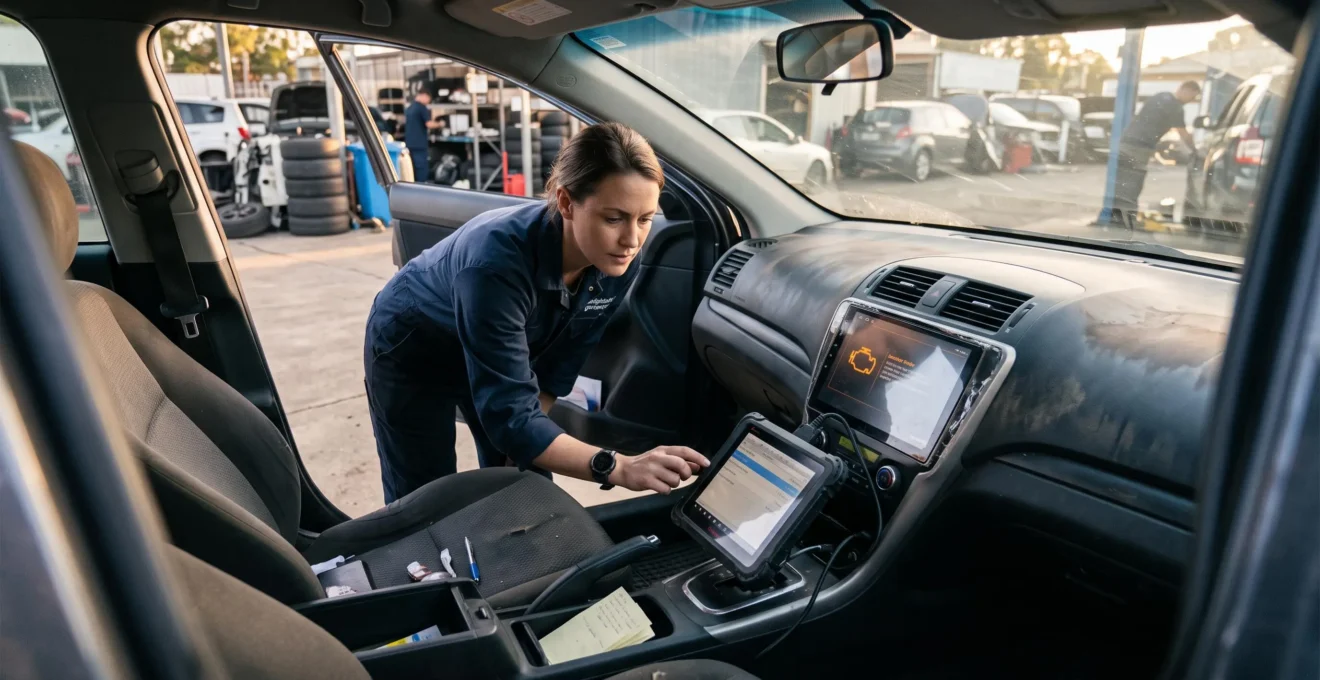
A modern car can brake automatically, monitor blind spots, guide you through parking and update its software without visiting a garage. Those conveniences also introduce components that may be expensive to diagnose, replace or recalibrate once the warranty ends.
The important distinction is between a technology that occasionally becomes unavailable and one that genuinely needs repairing. Heavy rain can temporarily disable lane assistance without damaging anything. A failed radar unit, by contrast, may involve replacement parts, specialist labour and calibration.
Could these technologies add £1,000 in repair costs over five years? They can create repair scenarios of that financial scale, but £1,000 is not an established average five-year cost or a prediction for every driver. Actual exposure depends on the vehicle, its equipment, warranty, maintenance and repair history.
The practical approach is to identify expensive components before buying, test them properly and maintain the systems that deliver meaningful safety benefits.
Vehicle technology repair risk: the essentials
- Camera and radar systems deserve particular attention: replacement, associated bodywork and calibration can create substantial bills even after relatively minor damage.
- Check before replacing: software problems, obstructed cameras and temporary environmental limitations can resemble hardware faults.
- Buy for long-term value: prioritise proven crash-prevention technology, test every fitted feature and obtain model-specific repair quotations before choosing expensive extras.
- Why Do In-Car Screens and Sensors Fail More Often After Heatwaves?
- How to Test Key Car Tech Features in 12 Minutes Before You Buy Used?
- Tech-Heavy Car or Simpler Model: Which Is Less Stressful Over 7 Years?
- The Update Neglect That Causes Persistent Tech Glitches Over Time
- When Should You Schedule Tech Check-Ups to Prevent Random Glitches?
- Why Does Lane Assist Switch Off in Heavy Rain Even on a New Car?
- High-Tech Trim or Basic Trim: Which Makes More Sense if You Keep Cars 7+ Years?
- Which Advanced Car Tech Features Actually Reduce Crashes by 20%—and Which Just Annoy You?
Why Do In-Car Screens and Sensors Fail More Often After Heatwaves?
Prolonged heat can stress vehicle electronics, particularly displays, adhesives, seals and components repeatedly exposed to high temperatures. However, a malfunction appearing after a heatwave does not automatically prove heat damage. The repair risk becomes significant when a defective screen, camera or sensor requires an expensive assembly replacement or specialist calibration.
A car parked in direct sunshine can develop much hotter interior conditions than the surrounding air. Repeated heating and cooling expand and contract materials at different rates, potentially weakening adhesive bonds, ageing plastics and stressing electrical connections. Automotive components are designed for demanding conditions, but their resistance varies by component and vehicle.
Touchscreen problems may include uneven brightness, discoloured areas, separating display layers or touch inputs that stop registering correctly. These symptoms matter most when the display controls functions that cannot easily be operated elsewhere.
Camera and radar problems are different. Damaged seals, optical components or electronics can affect the information a driver-assistance system receives. Still, moisture, contamination, impact damage and ordinary component defects are alternative explanations worth investigating before blaming heat.
The financial difference between cosmetic and functional deterioration is important. A faded decorative display may be inconvenient, while a failed camera or radar sensor can disable a safety function and require professional diagnosis. Neither outcome automatically proves a four-figure bill.
$900–$1,200
AAA’s estimated repair or replacement cost for a windscreen-mounted camera sensor in its research on three 2023 US-market vehicles. This is a component repair estimate, not a heat-related failure cost or a UK quotation.
The hidden expense often lies in how the car is assembled. Depending on the model, a display may be integrated into a larger unit, while a camera replacement may require calibration. Owners should ask whether a faulty component can be repaired separately before approving an entire module replacement.
After a particularly hot summer, check that the screen responds across its full surface, the reversing camera produces a clear image and no persistent sensor warnings appear. Photograph abnormalities and note whether they occur only when the cabin is hot.
Early detection can help document a problem while warranty cover remains available. It cannot guarantee that heat-related damage will be prevented or that an expensive component will be repairable.
How to Test Key Car Tech Features in 12 Minutes Before You Buy Used?
A 12-minute technology inspection can expose obvious faults in a used car’s displays, reversing camera, parking sensors and driver-assistance warnings. Start with the ignition and dashboard, test the controls while stationary, then check suitable functions during a safe drive. It is a screening exercise, not a substitute for professional diagnostics.
Ask the seller to leave the vehicle switched off before you arrive. A car that has already been started may conceal an unusual system boot delay or an intermittent warning visible only at startup.
With the owner’s permission, follow this timed sequence:
| Time | Test | What to record |
|---|---|---|
| 0–2 minutes | Switch on the ignition, observe the dashboard warning-light sequence and start the vehicle. | Warnings that remain active after the normal startup checks. |
| 2–4 minutes | Allow infotainment to load. Test menus, touch response and physical controls. | Freezing, repeated restarts, blank areas or unresponsive inputs. |
| 4–6 minutes | Check reversing camera clarity and parking sensors while stationary, following the manufacturer’s instructions. | Distorted images, unavailable feeds or persistent fault messages. |
| 6–8 minutes | Inspect camera areas, sensor covers, the windscreen and visible signs of previous repair. | Chips, damage, poorly fitted trim or obstructed sensor surfaces. |
| 8–12 minutes | During an appropriate test drive, check assistance-system status and any safe, permitted functions. | Unexpected deactivation or warning messages under suitable conditions. |
Do not deliberately approach obstacles, cross lane markings or create a dangerous situation to trigger emergency braking or steering assistance. Some functions cannot activate unless specific speed, road and visibility conditions are met.
Five checks to complete before committing to a used car
- Record the startup warnings: take a photograph of any message that remains after the normal system checks.
- Test the infotainment controls: create a short list of any frozen menus, delayed responses or display defects.
- Inspect camera and parking functions: note which features work and photograph any unavailable-system messages.
- Request maintenance evidence: obtain service records, applicable software-update information and any ADAS calibration reports.
- Commission diagnostics for unresolved faults: request a written, model-specific assessment and repair estimate from a suitably equipped workshop.
A short test cannot reliably reveal heat-dependent failures, rain-related problems, intermittent wiring faults or software errors that appear only occasionally. An inexpensive generic OBD scanner may also miss manufacturer-specific faults in camera, radar and body-control systems.
For any persistent safety-system warning, obtain a quotation that covers diagnosis, possible component replacement and any required calibration. Avoid treating an unexplained warning as a small cosmetic bargaining point. The final price adjustment should reflect a documented repair estimate rather than an assumed £1,000 charge.
A seller who can demonstrate working equipment and provide relevant repair records offers more useful evidence than one who simply promises that a warning will disappear after purchase.
Tech-Heavy Car or Simpler Model: Which Is Less Stressful Over 7 Years?
A simpler car may be less stressful over seven years because it has fewer optional electronic systems that could require out-of-warranty repairs. However, a technology-rich model can provide meaningful safety, convenience and potentially operating-cost benefits. The better choice depends on repairability, warranty coverage, actual equipment and the owner’s tolerance for unexpected expenses.
The comparison should consider total ownership cost rather than the showroom equipment list alone. A relatively inexpensive car with reliable standard safety systems can be better value than a more expensive model full of proprietary electronic conveniences.
For each candidate technology, consider three separate questions: how likely is a relevant fault, how costly would repair be, and what happens if the feature stops working?
| Technology | Potential repair exposure | Consequence of failure |
|---|---|---|
| Automatic emergency braking camera or radar | Potentially substantial replacement and calibration costs | Loss of an important crash-prevention function |
| Large integrated infotainment display | Potentially costly if the complete assembly must be replaced | Reduced access to controls, information or connected features |
| Power-operated seat mechanisms | Additional motors, switches and control components | Convenience loss; potentially more serious if essential adjustment fails |
| Powered tailgate | Motors, sensors and control hardware may need repair | Access and convenience problems |
| Adaptive LED headlamp system | Potentially expensive integrated lighting assemblies | Reduced lighting functionality and possible roadworthiness implications |
This is a qualitative assessment, not a measured failure-rate ranking. Accurate probabilities require model-specific reliability evidence that cannot be inferred merely from the number of electronics fitted.
Safety and legal consequences must also be separated. A failed optional convenience feature is not equivalent to defective required lighting. Whether a defect affects roadworthiness depends on the relevant country’s rules and the specific fault, not simply on the presence of an advanced system.
Mid-range models frequently offer a useful compromise: essential crash-prevention features without every expensive comfort extra. Buyers should verify the actual specification, since equipment varies across countries, model years and individual vehicles.
Warranty timing changes the calculation considerably. A feature repaired under a valid warranty may have little direct repair cost to the owner, whereas the same failure after cover expires could require a substantial payment. Warranty exclusions and conditions matter as much as the headline duration.
Some technologies can also offset their costs. Effective collision-prevention systems may reduce particular crash risks, while navigation, efficient powertrain management or parking assistance may offer practical benefits. None guarantees a financial saving for every owner.
The least stressful vehicle is not necessarily the one with the fewest screens. It is the one whose important features remain useful, serviceable and affordable throughout the planned ownership period.
The Update Neglect That Causes Persistent Tech Glitches Over Time
Neglected vehicle software updates can leave known bugs unresolved and contribute to compatibility problems with smartphones, navigation services and connected features. However, missed updates do not automatically damage hardware or cause every electronic fault. Before paying for replacement parts, check the software version, manufacturer guidance and whether a relevant fix already exists.
Modern infotainment systems depend on several interacting software components. A phone operating-system change can affect an older Bluetooth or smartphone-integration system, while an outdated infotainment release may contain bugs addressed in later firmware.
Navigation databases also become outdated, but old map information is different from defective electronics. Updating maps may correct routing information without solving a freezing display or faulty camera.
Owners typically encounter three update methods:
- Over-the-air updates: compatible vehicles receive software through an onboard connection, sometimes requiring owner approval or a parked installation.
- Dealer-installed updates: a workshop uses approved equipment to install software or address manufacturer-specific problems.
- USB-based updates: certain vehicles allow owners to install eligible infotainment or navigation updates using manufacturer-provided files and instructions.
Not every model supports all three methods. Some software modules can only be updated by an authorised or appropriately equipped repairer.
When a system repeatedly freezes, first record exactly what happens and when. Check the installed version against the manufacturer’s information, then look for release notes describing the same problem. A software update is most useful when it addresses the observed symptom.
If the problem continues, follow the owner’s manual for any supported restart or factory reset. A reset can erase personal settings and paired devices, so preserve important information beforehand. Safety-critical software faults should be handled through manufacturer-approved procedures, not experimental resets.
Updates have their own risks. An installation may take a vehicle temporarily out of service, change saved preferences or alter feature behaviour. Read the instructions, ensure the required power conditions are met and perform the update while safely parked, not during a journey.
For vehicles without automatic connectivity, keeping a record of checked versions and completed updates makes subsequent fault diagnosis easier. There is no universal rule that every system must be updated monthly.
Software maintenance is a useful low-cost diagnostic step, but it cannot repair damaged wiring, moisture intrusion, a defective touchscreen or a mechanically misaligned sensor.
When Should You Schedule Tech Check-Ups to Prevent Random Glitches?
Schedule vehicle technology checks around events that can affect electronic systems: extreme weather, windscreen replacement, bumper repairs, collision damage and approaching warranty expiry. Persistent warnings also justify an earlier inspection. These checks may uncover faults and calibration problems, but no inspection schedule can guarantee that unpredictable electronic failures will not occur.
Seasonal checks are a practical starting point. After a hot summer, inspect displays, camera images and warning messages. Before winter, pay attention to battery condition, windscreen clarity, wipers and whether exposed sensor surfaces are clean and undamaged.
The most important repair-related trigger is work involving driver-assistance sensors or components that influence their alignment. A camera mounted near the windscreen and a radar positioned behind the bumper depend on accurate information about their orientation and surroundings.
The Institute of the Motor Industry explanation of ADAS repair requirements describes the need to assess inspection, alignment and calibration when repairs affect sensors, associated parts or vehicle geometry. Requirements vary by manufacturer and model.
Consequently, a windscreen replacement or bumper repair should prompt a question about the vehicle’s prescribed procedure. It does not follow that every repair requires identical calibration work.
When calibration is required, ask the repairer for records showing what was checked and whether the system met manufacturer specifications. A dashboard without warnings is reassuring, but it does not replace proper repair verification.
Watch for repeated signs of trouble: assistance systems reporting faults after startup, a camera image intermittently disappearing or a feature remaining unavailable in otherwise suitable conditions. Such symptoms deserve investigation rather than repeated dismissal.
Before the manufacturer’s warranty expires, deliberately test the equipment that is normally used less often. Document any reproducible fault and report it while cover remains active. Do not assume that a fault reported just before expiry will automatically qualify for free repair; the actual warranty conditions govern the outcome.
Good maintenance reduces avoidable uncertainty. It also creates a useful paper trail when an electronic problem emerges later, particularly if previous bodywork or glass replacement may have affected a sensor.
Why Does Lane Assist Switch Off in Heavy Rain Even on a New Car?
Lane assistance can switch off in heavy rain because its cameras cannot reliably identify road markings through poor visibility, spray or glare. The system may withdraw assistance when detection confidence becomes insufficient. This is often an intended safety limitation rather than evidence that a camera has failed, even on a brand-new vehicle.
Camera-based lane systems typically analyse images of the road to estimate lane boundaries and the vehicle’s position. Heavy rain reduces image contrast, while standing water, reflections and faded markings can make the boundaries difficult to recognise.
The Tesla Model 3 owner’s manual on Lane Assist limitations explicitly identifies poor visibility, heavy rain, fog, glare and worn markings as conditions that can interfere with operation.
Those are model-specific instructions, but they illustrate why camera-based assistance cannot be expected to function consistently in all weather.
Several owner-controlled factors are worth checking:
- Dirty glass, moisture or contamination in front of the camera.
- Worn wiper blades that leave streaks across the camera’s viewing area.
- Windscreen damage affecting camera visibility.
- Incorrectly fitted replacement glass or unresolved post-repair calibration requirements.
Windscreen coatings can also affect optical clarity depending on their condition and the manufacturer’s requirements. Avoid applying products to camera viewing areas contrary to vehicle instructions.
Distinguish temporary unavailability from a persistent fault. If assistance returns when the rain stops and markings become clear, the system may simply have reached its operating limit. If warnings remain during good visibility on clearly marked roads, consult the manual and arrange suitable diagnostics.
There is also a repair-cost consequence. Vehicles with windscreen-mounted cameras may need additional inspection or calibration after glass work, depending on the model. Camera-free vehicles do not incur that particular camera-related requirement.
For that reason, ask about glass-replacement procedures and insurance cover when purchasing a car with integrated driver-assistance cameras. Do not assume that a standard windscreen quotation includes every necessary operation.
Keep the windscreen clear and remain responsible for steering at all times. A temporary assistance shutdown is not permission to disregard visibility or road conditions, and the absence of a warning does not guarantee that lane detection is reliable.
High-Tech Trim or Basic Trim: Which Makes More Sense if You Keep Cars 7+ Years?
For ownership lasting seven years or more, a mid-range trim with essential safety equipment may offer a better balance than either a stripped-out base model or a fully loaded version. Higher trims add convenience and potential repair exposure, while resale benefits depend on their features continuing to work. The right answer comes from comparing specific equipment, not trim labels.
Unlike comparing two different vehicle models, a trim-level decision can isolate the extra equipment purchased with a higher specification. Start with the manufacturer’s feature lists for the exact model year and market.
Separate the added features into three categories: proven safety equipment, frequently used convenience features and equipment that provides limited practical value to the owner.
| Feature category | Reasons to choose it | Long-term question |
|---|---|---|
| Automatic emergency braking and relevant safety assistance | Potential protection against specific collision types | What maintenance, calibration and repair support is available? |
| Heated seats or useful parking aids | Regular comfort or manoeuvring benefits | Can individual components be repaired economically? |
| Powered tailgate, complex seat adjustment or gesture controls | Extra convenience | Would failure be expensive relative to how often the feature is used? |
| Large proprietary infotainment display | Integrated controls and a larger information interface | Is the unit replaceable, supported and affordable after warranty? |
For each trim-exclusive feature, request a realistic out-of-warranty repair quotation where available. Include labour and any calibration that the manufacturer requires. Compare the information with the price premium for the higher trim and the actual length of warranty protection.
A useful decision exercise is to create a hypothetical ownership scenario. Suppose two trims share the same essential safety systems, but the more expensive one adds powered conveniences and a larger integrated display. If the buyer rarely uses those extras, their benefit may not justify the purchase premium and additional repair exposure.
That scenario does not prove the higher trim will fail or cost more to repair. It demonstrates why the buyer’s personal use of the equipment matters.
Resale value introduces another complication. Desirable equipment can make a used car more attractive, but broken powered accessories or an unreliable central screen may discourage buyers. The financial effect varies by model and local market and should not be assigned an invented percentage.
Buyers should also avoid assuming that base trims contain fewer safety systems. Some manufacturers provide important assistance features across the range, while others reserve certain capabilities for higher specifications.
A well-maintained middle specification is often a sensible candidate, but its advantage must be established through actual equipment, serviceability and price rather than assumed reliability.
What matters before choosing advanced car technology
- Preserve meaningful protection: a feature with credible crash-reduction evidence may justify maintenance and repair exposure that a purely decorative upgrade does not.
- Compare like with like: distinguish documented reductions in particular collision types from advertising claims about overall road safety.
- Check usability: safety features offer less practical value when drivers routinely switch them off because warnings or interventions are intrusive.
Which Advanced Car Tech Features Actually Reduce Crashes by 20%—and Which Just Annoy You?
There is no universal 20% crash reduction from advanced vehicle technology. Some systems perform substantially better for specific collision types, while others primarily improve comfort or convenience. Automatic emergency braking has particularly strong evidence for preventing certain crashes, but its benefits, operating limitations and potential repair costs must be evaluated separately.
The distinction matters because a percentage without a defined outcome can mislead buyers. A reduction in rear-end collisions is not the same as an equivalent reduction in every road accident, serious injury or insurance claim.
According to IIHS research on advanced driver assistance, forward collision warning combined with automatic emergency braking reduced rear-end crashes by approximately 50% in a referenced study. Forward collision warning alone was associated with a 27% reduction in the same crash category.
Separate IIHS research found that pedestrian-detecting automatic emergency braking reduced pedestrian crashes by 27%. These are US research findings for specific systems and outcomes, not guaranteed reductions for every vehicle or country.
Approximately 50%
Reduction in rear-end crashes associated with forward collision warning and automatic emergency braking in a study cited by IIHS. The result does not describe all crash types or every vehicle fitted with the technology.
Insurance Institute for Highway Safety, advanced driver-assistance research overview.
The following comparison separates established crash-prevention evidence from the everyday ownership experience.
| Technology | Documented safety value | Possible annoyance or repair exposure |
|---|---|---|
| Forward collision warning with automatic emergency braking | Strong evidence of reduced rear-end crashes in relevant studies | Unexpected warnings; camera or radar repair and calibration costs |
| Pedestrian-detecting emergency braking | Evidence of reduced pedestrian crashes in a specific study | Detection limitations; sensor-related repair exposure |
| Lane-departure warning and prevention | Evidence of benefit for certain crash categories, with mixed findings across measures | Unwanted warnings or steering interventions; camera-system limitations |
| Parking cameras and proximity alerts | Useful low-speed awareness; no comparable percentage established here | False alerts, obstructed lenses and possible component replacement |
| Gesture controls and elaborate infotainment features | No direct crash-reduction effect established by the cited research | Interface frustration, software issues and additional electronic complexity |
The same technology can provide genuine safety value and still frustrate its owner. Lane warnings may activate near unclear road edges, while automatic interventions can sometimes feel intrusive. These reactions matter because a disabled feature cannot deliver its intended assistance.
IIHS also reports a 2023 observational dataset involving more than 2,000 vehicles arriving at dealerships. Automatic emergency braking was active in 93% of observed vehicles equipped with it, compared with 57% activation for vehicles equipped with lane-departure warning but not lane-departure prevention.
Those observations show differences in feature activation. They do not establish the reasons every driver selected those settings or prove that one system was switched off solely because it was annoying.
Repair exposure remains the other side of the calculation. The AAA research discussed earlier found substantial ADAS costs in certain collision-repair scenarios, including an average of 1,540 $ in ADAS-related components for the minor front-collision scenario it studied. That is a US collision-repair estimate, not an expected five-year bill.
The buyer-protective choice is therefore not to reject advanced safety technology. It is to distinguish features with credible crash-prevention benefits from expensive extras, understand sensor repair requirements and avoid paying for complexity that adds little value.
When shopping for a newer vehicle, prioritise effective automatic emergency braking and other relevant safety equipment, check the manufacturer’s operating limitations, and obtain model-specific repair and calibration information. That gives a more useful basis for a five-to-seven-year ownership decision than either a blanket fear of electronics or an impressive technology list.
Should I keep a separate £1,000 repair fund for car electronics?
£1,000 can be a useful personal budgeting scenario, but it is not a statistically established five-year electronics repair allowance. The appropriate reserve depends on the vehicle, available warranty, insurance cover and likely repair prices. Obtain quotations for expensive fitted components and consider your broader vehicle-maintenance budget before choosing an amount.
Does comprehensive car insurance cover failed cameras and radar sensors?
Coverage depends on the insurance policy and cause of damage. Accident-related sensor repairs may be treated differently from ordinary electrical breakdown, wear or gradual deterioration. Ask the insurer whether relevant glass, bodywork and ADAS calibration costs are covered, and check excesses and exclusions. Policies vary between countries and providers.
Can an independent garage repair advanced driver-assistance systems?
Some independent workshops have the diagnostic equipment, manufacturer information and calibration facilities required for particular vehicles. Others may need to refer specialised work elsewhere. Ask whether the garage supports the exact model and system, follows the prescribed procedure and provides documented calibration results where required.
Can a weak 12-volt battery cause electronic warnings without a failed sensor?
Low supply voltage can contribute to electronic malfunctions or warning messages in some vehicles. Battery condition and charging-system checks may therefore be relevant during diagnosis, especially when several unrelated systems report problems together. However, a voltage issue should not be assumed without testing, and persistent safety warnings still require appropriate investigation.
Is it worth buying an extended warranty for vehicle electronics?
It may be worthwhile if the contract covers expensive electronic assemblies, sensors, diagnostic labour and necessary calibration without restrictive exclusions. Compare the premium, excess, claim limits, vehicle age restrictions and servicing conditions with realistic repair quotations. A policy described as comprehensive may still exclude important electronic components.